
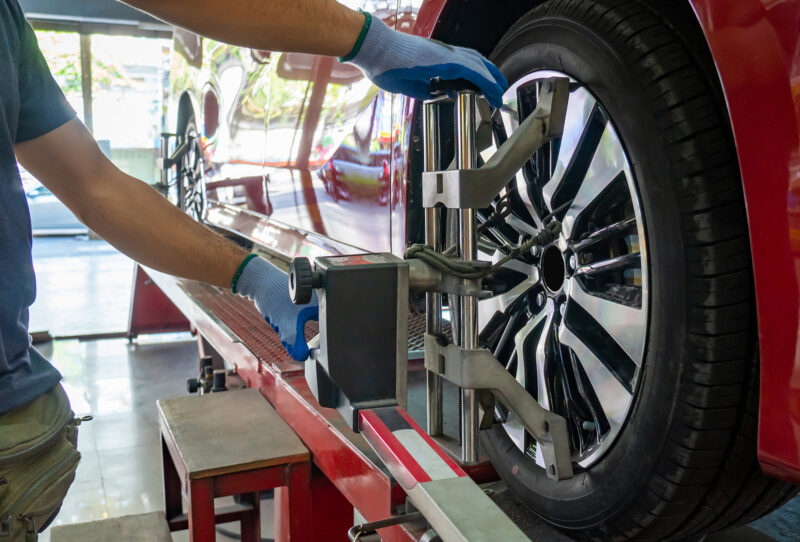

Wheel Alignment
Failure to adjust the wheel angles leads to problems with steering, vehicle stability, tire wear, and increased fuel consumption.
Classification of wheel angles:
There are many wheel angles in the car, which can be divided as follows:
A- Front wheel angles and rear wheel angles.
B – adjustable angles and fixed (non-adjustable) angles.
c- Angles specific to the inclination of the wheel and angles specific to the inclination of the steering axle. Wheel
angles:
1- Caster angle (the angle of inclination of the steering axle with respect to the vertical plane, backward or forward)
2- Camber angle (the angle of inclination of the wheel with respect to the vertical plane, about the transverse axis of the wheel)
3- Ton angle (the inclination of the wheel with respect to the vertical plane, about the vertical axis of the wheel)
4- Axel steering angle (inclination of the steering axle with respect to the vertical plane, inward or outward)
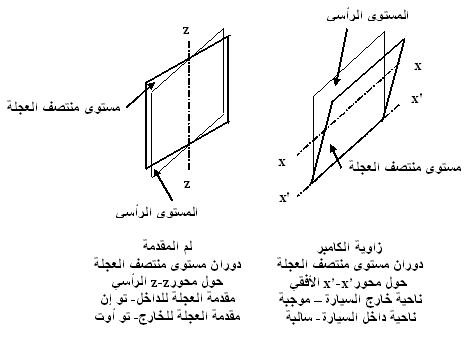
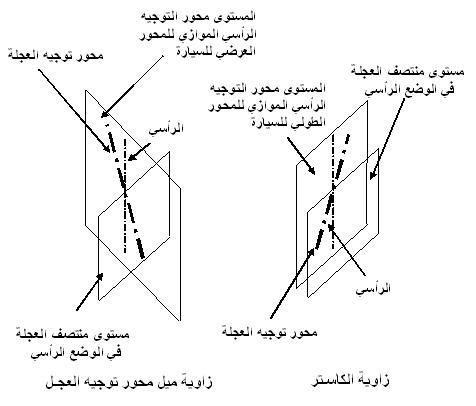
| Caster angle (positive angle) | The angle of inclination of the steering axle (the angle is positive in the figure) |
| The tilt of the steering axle is parallel to the plane of the wheel. The caster angle is positive when the upper point of the steering axis is tilted toward the rear of the vehicle. | The tilt of the steering axle is perpendicular to the plane of the wheel. The steering axle tilt angle is positive when the top point of the steering axle is tilted inside the vehicle. |
| 1- Castor (Caster,US) angle : | |
| The caster angle is the angle of inclination of the wheel axle backwards or forwards with respect to the vertical plane when viewed from the side. When steering the wheel, it rotates around an axle installed in the suspension system. The caster is the angle of inclination of this axis, which is an angle measured in degrees. When looking at the car from the side, in the event that the highest point of the axis is directed towards the rear of the car, the caster angle is considered positive (+), and in the event that it is heading towards the front, the caster angle is negative (-). |  |
The caster angle is the first angle in the angle adjustment order when making the caster angles. The caster angle for each wheel on the same axis must be equal, if the two caster angles on the same axis are not equal, this will cause the car to swerve to the side with less caster angle.
The purpose of the caster angle: The
presence of a positive caster angle on the wheel causes the wheel to drive itself in a straight line, which means that the driver does not need to maintain the steering of the car when traveling in a straight line.
The caster angle affects the directional control of the steering system but does not affect tire wear. The angle of the caster is affected by the height of the car, so it is important to maintain the height of the body it is designed for. Overloading the car or having a weak rear spring will affect the angle of the caster.
Most cars have a positive caster angle. But why did most pre-1975 cars have a negative Zoya Caster?
There are two reasons for this: a negative angle makes steering easier (less force is needed to steer the car). The other reason is that the cars at that time were not equipped with radial tires. Non-radial tires have the property of denting at high speeds so that the contact area moves backward relative to the center of the wheel, leading to the convergence of the caster angle axis in front of the contact area, and thus the caster angle becomes positive with increasing speed. When radial tires (which do not have this feature) are installed in these cars, these cars will suffer from negative caster angle problems.
It is common that the caster angle (the inclination of the Kingpin or imaginary line passing from the center of the upper ball joint to the center of the lower ball joint from the vertical) is within 2 degrees. In some cars, it may reach 10 degrees to improve the work of the camber angle in reversing the wheel after turning, but the car needs power steering to overcome the difficulty of steering with an increase in the caster angle.
| Effect of the caster angle difference from the required value: | |
| the problem | the influence |
| Caster angle is too positive | Difficulty steering – More sense of bumps in the road – Wheel vibration |
| Caster angle is too negative | – Car stuttering (the car is difficult to control) – swaying from left to right – unbalance at high speeds |
| The caster angle of the two wheels is not equal | A deflection occurs in the direction of the wheel with the caster angle: the most negative value / the least positive value |
In most front wheel drive cars, the caster angle, such as the camber angle, has no adjustment.
The caster angle relative to the drive axle:
– The caster angle is positive for rear
– wheel drive cars – and it is negative for front-wheel drive cars.
This adjustment of the caster angle leads to the generation of self-torque to adjust the wheel path forward. This torque produced increases with speed and with increasing traction effort.

| Vorlauf geometry In this design the caster angle is increased without increasing the effect of the caster angle (the distance where the main axle meets the vertical axis of the wheel) by delaying the main axle from the center of the wheel. This gives balanced forward steering at higher speeds, and better cornering performance. Increasing the impact will affect the steering if the road is noticeably uneven. |  |
| 2- Camber angle: The camber angle (the angle of inclination of the wheel relative to the vertical plane when viewed from the front) is an angle measured in degrees, and when there is a camber angle, the wheel appears tilted on the road surface (not perpendicular). In the event that the upper point in the tire is tilted from the vertical to the outside of the car, the camber angle is positive, and in the event that it is tilted towards the inside of the car, the camber angle is negative. |  | |
| In the event that the camber angle is not adjusted, there will be wear on one side of the tire. In the event that the camber angle is negative, there will be wear on the inner side of the tire. In the event that the camber angle is positive, there will be wear from the outer side. |  |  |
| (The form of tire wear from the inside or the outside) | ||
| – In the event that there is a difference in the angle of the camber from one side to the other, there will be a problem of deviation of the car to the side with the most positive camber angle. It is a small angle of up to 2 degrees. And adjust the camber angle to be equal to the wheels on the same axis.The purpose of the camber angle: – When making the camber angle for the tire, the angle works on the wheel dent, this dent absorbs the slight movement as a result of the uneven ground and not transferred to the steering links. |  |
| The camber angle works to compensate for the road slope (the road rises from the middle and decreases from the sides to drain the water, so that the wheel becomes perpendicular to the convex road. | 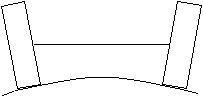 |
| – As well as to compensate for the weight of the car and passengers on the axle. | 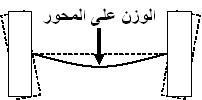 |
 |  |
| Analyze the feedback of the weight on the wheel with the presence of the camber angle | |
| – In the event that the camber angle is zero, the reaction of the load from the ground F’ will pass through the end of the wheel hub, which may lead to bending. The inclination of the wheel is such that the perpendicular reaction force F will pass through the part of the larger diameter of the wheel axis | The force F can be resolved into two components F1 in the direction perpendicular to the wheel axis, and F2 parallel to the wheel axis. The force F1 is of a lower value and the force F2 prevents the wheel from being pushed out, and it prevents it from slipping off the shaft. |
For many years, it was common practice to adjust the camber angle from zero to a little positive angle to compensate for the car’s load, but the current adjustment is to make the wheel have a small negative camber angle to increase the car’s stability (increase the car’s grip when shifting) and improve handling. In the event that the camber angle is zero, then in the case of the conversion process, the wheel will rise from the ground from the inside and thus reduce the area of contact, but in the case of a negative camber angle, this will reduce the occurrence of this phenomenon.
The positive camber angle is often used these days in off-road vehicles as the positive camber angle reduces steering effort.
In the old car with double wishbone suspension, the camber angle could be adjusted, but in current cars with McPherson strut suspensions, the angle is not adjustable.
| The effect of the camber angle difference from the required value: | |
| the problem | the influence |
| Too positive camber angle | – Premature wear on the outside of the tire – Severe wear on the suspension parts |
| Too negative camber angle | – Premature wear on the inside of the tire – Severe wear on the suspension parts |
| The camber angle of the two wheels is not equal | A deflection occurs in the direction of the wheel with the camber angle: the most positive value |
| 3- Toe in: Toe in angle (it is the inclination of the wheel when looking at the wheels from the front). The foreground measurement is measured as the difference between the distance between the front of the tire and the background of the tire. It is measured in millimeters in the English system or in millimeters in the metric system. Mostly it is set close to zero, meaning that the wheels are parallel. The foreground does not mean that the distance between the front of the tires is less than the distance between the back of the tires. The opening angle of the foreground is the opposite.The front part = the distance between the front of the calf – the distance from the back of the calf = (a) – (b) If the front angle is not adjusted, there will be wear on both tires. This form of wear is like a saw tooth. |   | |
| In the event that the sharp end of the tire is heading towards the middle of the car, this indicates that there is a large front angle. In the event that the sharp end of the tire turns out of the car, this indicates that there is a large angle to open the front. |  |  |
| The shape of the sharp end direction of the tire |
| * In the word toe, it means to make the big toe of the foot point inward in when standing * In the word toe, it means to make the big toe of the foot point outward when standing | 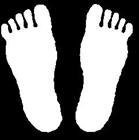 |
| Toe out |
The purpose of having a front
camber angle : – The introduction camber angle cancels out the effect of having a camber angle, since the wheel with a positive camber angle moves as part of a cone as shown in the figure. When moving the cone forward, the wheel will not move in a straight line, but will move in a circle, meaning that the wheel is trying to go out. That is why the two-way is adjusted inward when the car is stationary, that is, the direction of the wheel is inward and equals its movement in the cone outward, that is, when moving forward, the wheel becomes in the forward direction.
 |  |
With increasing speed, the wheels try to open outward and therefore adjust inward to modify the effect of opening. With increasing speed, the wheel becomes directed forward.
The angle of the front is not the last angle to be set in the wheel angle adjustment process. The angle of the front wheel opening can be adjusted in most cars for the front wheels. In some cars, the front wheels can also be adjusted and unlocked for the rear wheels.
4- King Pin Inclination KPI (or Steering/ Swivel Axis Inclination SAI):
| The inclination of the steering axis is measured in degrees. This is the tilt of the axle from the vertical when the wheel is viewed from the front. And be in the range of 6-7 degrees. – The angle in old trucks and cars is called the main axle tilt angle (which uses a main axle instead of ball joints) – the axle tilt leads to reduce the non-convergence distance (the distance between the line of inclination of the vertical axis / wheel axis with the steering axle) which is called the radius of friction . |  | ||
 |  |  | |
| Various shapes of main axis tilt angle/ steering axis | |||
| This tilt also gives a small amount of wheel alignment. When the wheel is turned around the main axle, the front of the car rises slightly, and thus the weight of the car helps return the wheel to the forward direction |  | ||
| The effect of a difference in the angle of inclination of the steering axis from the required value: | |
| the problem | the influence |
| Incorrect angle value | – Instability – Weakness in the wheel’s return after turning – Deviation in the direction of the wheel with the lowest angle – Difficulty in steering |
5- Included angle:
| The overall angle is the angle between the wheel axis and the steering axis, which is not measured directly, but is equal to adding the camber angle + the steering axis inclination angle. If the camber angle is negative, then the overall angle is less than the angle of inclination of the axis, and if the camber angle is positive, the overall angle is greater. The overall angle must be equal to the two wheels on the same axis |  |
Scrub radius (the offset):
| The radius of friction is the distance between the point where the steering axis meets the ground and the point where the wheel axis meets the ground. The radius of friction must be equal to the two wheels on the same axis, in the absence of this, there will be a strong pull to the steering wheel at all speeds. The friction radius is affected by the overall angle and is also affected by the difference in wheels and tires or the difference in tire inflation, which will make there is a difference in the friction radius of each wheel on the same axis. The radius of friction is positive when the tire track is outside the steering axle, and negative when the tire track is inside the steering axle (front-wheel drive vehicles always have a negative radius of friction). |  |
In the case of braking and one of the front wheels does not brake (as in the case of a brake fluid leakage in one of the two diagonal brake circuits) and this leads to the car swerving. If the friction diameter of the front wheels is negative, the deflection of the car is reduced. Therefore, radial double brakes (X shape) are installed on front-wheel drive vehicles with a negative friction radius. Front-rear dual brakes (figure II) are installed on rear-wheel drive vehicles with a positive friction radius.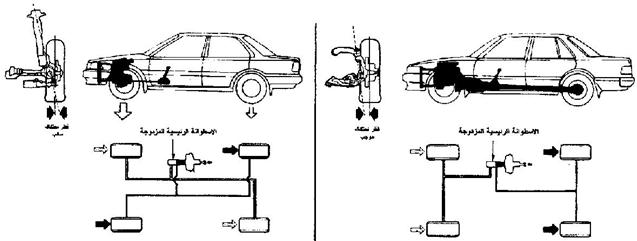
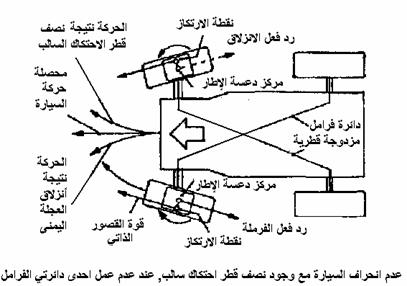
Friction radius is factory designed and not adjusted. In the event that your car swerves there is traction on the steering wheel, even though the angle adjustment is correct, look for other causes affecting the friction radius.
Other problems related to wheel set:
1- wheel set back:
 |
| Wheel lag is when one of the front wheels is back. The presence of this problem and the use of wheel angle adjusters that operate on the front axle only, leads to the inaccuracy of the tonnage angle. To work with these devices, you must check the amount of wheel lag (6-7 mm is allowed for some manufacturers). More so the possibility of a retort link. Or preferably use devices that adjust the four wheels. |
2- Axle set side:
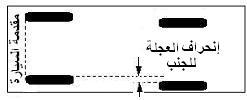 |
| It occurs as a result of a mismatch of the front wheel track with the rear wheel, as a result of chassis warping or the installation of a faulty rear axle. |
3- thrust angle:
 |
| It is the angle formed from the direction of the rear wheel thrust relative to the longitudinal axis of the vehicle. If this angle is not zero, the steering wheel will be misaligned. The best solution is to adjust the two in the rear wheel first (for a car that allows rear adjustment) and then do the two in the front wheel tuning. In the event that the rear wheel adjustment is not possible, the 2N adjusts the front wheel with this problem in mind, to allow the steering wheel to straighten. |
4- Straightening the steering wheel:
 |
| The steering wheel must be straight when the vehicle is moving on a straight and level road. Not installing the wheel in its correct place, is often the main reason behind this and appears after the process of adjusting the angles. If it is assumed that the steering wheel has not changed position, the lack of alignment is the result of a problem in the angles of the front and rear wheels. When aligning the steering wheel, the rear tow must be adjusted first to make the drive axle as closely aligned with the longitudinal axis of the vehicle as possible. Then the steering wheel is installed in the upright position, while adjusting the angle of the front forehead. Before installing the steering wheel, you must turn the engine and turn the steering wheel left and right several times, to eliminate any load on the steering servo valve. After adjustment, the engine must be started to ensure that the valve is not overloaded.Some roads are designed with a tendency to drain rainwater, and this leads to the steering wheel not being straightened when walking on it in a straight line (walking on the right side of the road) there is an appearance of the wheel not being straight when moving forward, and its deviation to the left. This can be adjusted, according to what is allowed by adjusting the angles of the calf from the difference in angles from one side to the other, as follows: – The angle of the left caster can be adjusted to be more negative (0.5 degrees). The left camber angle can be adjusted to be more positive than the right wheel. |
5- The vehicle’s riding height:
 |
| Vehicle height is usually measured in inches or millimeters, from scissors to floor. A difference of within an inch (25.4 mm) is allowed from side to side and from front to back. This height cannot be adjusted. Vehicles with a torsion bar are excluded. The only solution to modify this is to change the spring (the springs on the same axle must be completely replaced). Changing the car’s height will affect the camber angle and the tonnage angle, so when changing the spring or resetting the shaft, the angles must be checked to maintain tire wear. The only thing that indicates that the spring is weak is a lack of height, in the event that the height is correct, then the spring is normal. |
There are no reviews yet. Be the first one to write one.