
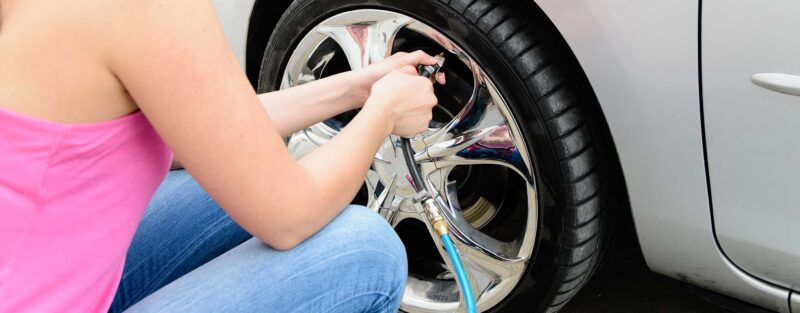

Measuring tire inflation
pressure The correct tire pressure extends tire life, improves fuel consumption and gives you better vehicle control while driving. The correct size of the tire will be found written on the tire itself, in the car owner’s manual, or on a sticker in the dashboard tray or on the driver’s door. Pressure is measured in either pounds per square inch or kilopascals. Use a pressure gauge to measure tire inflation every two weeks. For proper measurement, measure the tire pressure while it is cold.
To perform the measurement process, loosen the cap of the inflation valve and then place the tip of the gauge on the valve and press; If you hear a vent sound, this indicates an air leak and an inaccuracy of the measurement. In the case of using a pen-type gauge, the leg will be pushed out and the measurement is indicated on it, and if a pressure gauge is used, the reading will appear on the face of the gauge.
If the inflation pressure is low, inflate the tire; If the inflation pressure is high, drain the air. Air leakage is done by pressing the needle into the center of the valve. After adding or leaking air, measure the pressure again. Repeat the process to check the inflation pressure of all tires, including the spare tire.
Measuring the wear of the surface of the tire The wear of the surface of the
tire leads to poor control of the car and weak brakes, especially on wet roads and during rain.
To measure tread wear, use a tread thickness gauge in the area of greatest wear; In the event that the reading is less than 1.5 mm, change the tire with a new one with the same dimensions and specifications as the other tire on the same axis. To measure wear without using a gauge, insert the ten centigrade into the notch on the side. If the number ( . )appears, replace the tire.
Newer tires have an indication of tread wear manufactured inside the tire, which often appears as rings when tire wear is more than 1.5 mm.
Replacing the tire
Lifting the tire cover
Park the vehicle on level ground (no slope) Put the transmission in the fixed position – or rear for manual transmission. Apply the handbrake and place an obstacle in front of the tire opposite the tilt of the tire being replaced (example: front right in case of rear left replacement). Make sure the extra tire is fully inflated before installing it in place of the other tire.
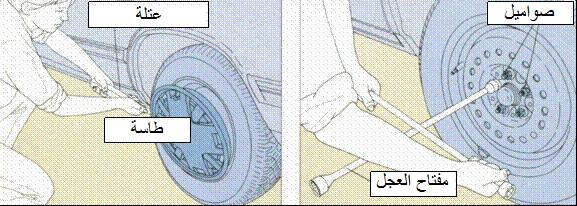
Insert the pulled end of the wheel wrench (or screwdriver) between the cover and the wheel, and use it as a lever to lift the cover.
Loosen the wheel nuts
Use the wheel wrench to loosen the wheel nuts. And if there is a sign (L) in English (L), this means that the nuts are threaded left and must be loosened by turning the key in a clockwise direction. Nuts without markings are right-handed and must be loosened by turning the wrench counterclockwise.
In the event that the nuts do not respond to loosening, apply oil to facilitate the loosening process and leave them for several minutes and try again. The nuts should not be completely loosened at this stage.
Loosen the wheel nuts
Lift the vehicle using the hand winch from the raised position, close to the wheel you intend to change, until the wheel is off the ground. (If there is a fixed stand, place it under the vehicle at the loading point and lower the vehicle onto it.) Loosen the wheel nuts Using the wheel nut loosening wrench, put the nuts into the wheel cap to prevent them from loosening. Pull the wheel with the tire out. Attaching
the additional wheel
Roll the wheel into place, raise the wheel and support it with your knee, if necessary, to measure the holes with the wheel bolts. Push the wheel into the mounting bolts and hold them firmly in place with one hand and with the other tighten the wheel nuts so that the loose part is toward the wheel.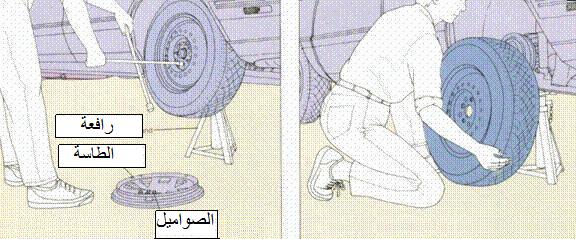
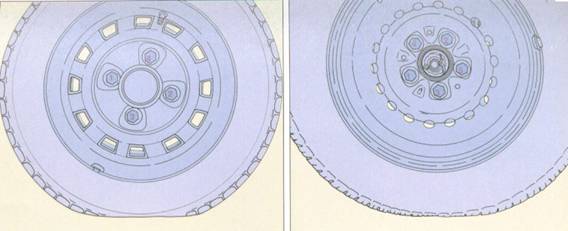
Tweaking the calf nuts: To
distribute the stress evenly, thread the nuts in a specific order as shown in the figure. Lower the car using the manual jack, or raise it with the manual jack and then pull the mounting bracket from under it and then lower it if using the fixed carrier. Twist all the nuts back and the wheel is on the ground.
Install the calf cover. If the replacement tire is damaged, repair it or change it as soon as possible. The original wheel must be re-installed instead of the spare, as in some cars the extra wheel is for emergency use only.
There are no reviews yet. Be the first one to write one.