

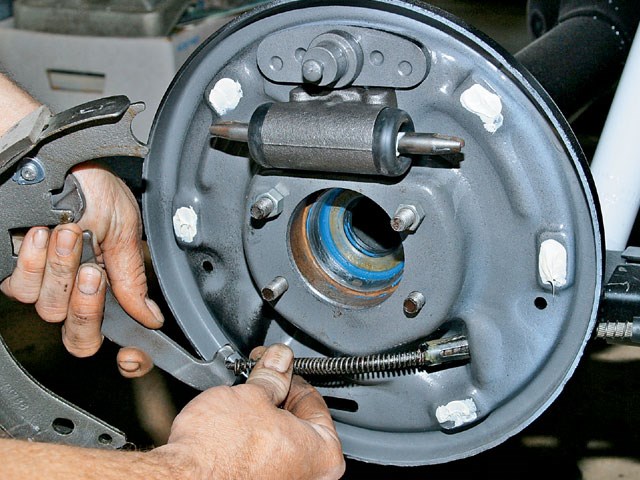
examined the servo servo brake Checking the Power Brake Booster
In most cases , maintenance servomotor are examined me and dislocations LED unidirectional and the work of dismantling and change consoler Elly or LED or servomotor.
Most of the problems with the servo come from motorists’ complaint that brake performance is poor or unsatisfactory. And occasionally, the complaint is about continuous brake loading, which is accompanied by rapid wear of brake friction linings (especially disc brake linings).
Vacuum booster, hydraulic brake-booster or electro hydraulic or Power booster can be removed and repaired. But in most of the workshops, the technician prefers to install a new or renewed servo instead of repairing the servo due to the lack of special equipment, the required experience and the internal parts needed to make the repair inside the workshop.
Checking whether the cause of brake load is caused by a servo failure
A quick check to determine whether the servo is the cause of brake load is as follows:
a. Raise both front wheels.
b. (With engine not running) Depress the brake pedal several times to eliminate servo loosening (or hydraulic servo depressurization).
c. Turn the wheels by hand to check the condition of the brake load. Then start the engine and check the brake load condition again.
* Check the free clearance of the pedal. If there is no clearance, adjust the clearance, and if there is a clearance, this indicates a malfunction of the servo and caused it to load the brakes and in this case it must be replaced or repaired.
Vacuum servomotor
Checking the vacuum source :
A high vacuum from the motor is required for good performance of the servo. The intake manifold vacuum is checked by means of a vacuum gauge attached to the intake manifold as close to the servo connection as possible.
1- Run the engine at no-load speed and measure the amount of vacuum, it should be in the range of (17 to 20) inches of mercury (minimum 14 inches of mercury), and the value of the reading changes with the opening and closing of the throttle valve. If the vacuum reading is low, look for a missing collector vacuum tube, a damaged interlock, or the engine needs to be tuned or packed, see Figure (1).
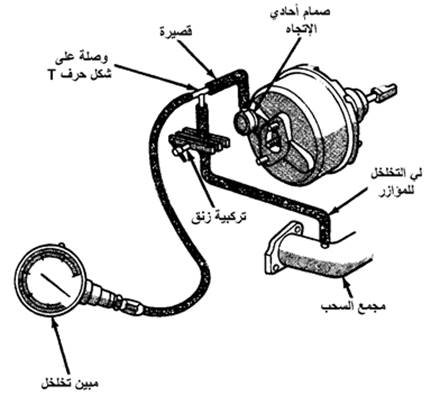 |
| Figure (1): Examination of the source of the rarefaction using the rarefaction indicator |
2- With the vacuum path connected to the intake
manifold closed , a decrease in vacuum by more than 1 inch within 15 seconds indicates
that the one-way valve is damaged or there is an internal leakage of the servo.
Vacuum tube (LI) examination
a. Lee checks for looseness by looking for any external signs of cutting or ripping.
b. It is checked for any internal obstruction in the torsion duct, by removing the torsion from the one-way valve while the engine is running. Notes the entry of air in the wind and irregular rotation of the engine in the absence of an obstacle.
c. Check the inside for traces of wetness. If traces of brake fluid are present, this indicates damage to the secondary interlock of the primary piston of the master cylinder. The presence of traces of engine oil indicates that the one-way valve of the servo has been damaged.
One- way valve check
1- The valve is removed from the servo and blown into it, and the direction of air flow is observed. Air can be blown in the direction from the servo to the intake manifold, not in the opposite direction.
Checking the servo
1- Checking the operation of the servo
a- Press the pedal several times and the motor does not work to get rid of the vacuum servomotor, Figure (2).
 |
| shape (2) |
b – Press the pedal and keep the pressure constant.
c- Turn the engine and notice a slight descent of the pedal to the bottom (Fig. 3).
 |
| shape (3) |
2- Checking the air intake of the servo (1)
A- After running the engine for a minute or two, turn off the engine.
B – When pressing the pedal several times with equal pressure, make sure to increase the remaining distance with the increase in the number of pressing times, Figure (4).
 |
| shape (4) |
3- Checking the air threading of the servo (2)
A- While the motor is running , press the pedal and keep the pressure at a constant amount, Figure (5). b- While continuing to press, stop the engine for 30 seconds and make sure that the remaining
pedal distance (the height of the pedal) does not change .
 |
| shape (5) |
4- Determining the source of the servo leak The source of the servo leak
can be determined either by a vacuum pump or by using a glass container and fittings.
Using a vacuum pump:
1- Disconnect the vacuum valve from the one-way valve and connect the vacuum pump directly to the valve or servo vacuum opening, Figure (6).
2- With no pressure on the pedal, make a vacuum in the pump in the range of (17 to 20) inches of mercury. This vacuum must remain constant for several minutes. Any deficiency in the vacuum value indicates a leak in the control valve or servo chamber.
3- Press the brake with a medium pressure, you will notice an immediate decrease in the loosening value with the movement of the brake pedal.
With continued pressure, return the vacuum back to (17-20) inches of mercury. The vacuum should remain constant for 30 seconds. If the pressure value drops, this indicates a leak from the membrane, control valve, or servo chamber.
 |
| Figure (6): Vacuum pump to detect servo leakage |
Using a glass container and fittings:
Connect the servo to a glass container half-filled with water and knit the lid, and another one inside the container is connected to the intake manifold, Figure (7).
 |
| Figure (7): Using a glass jar and screws to detect leakage of the servo |
1- When the engine is running, bubbles appear from the air in the bowl for a while, then the bubbles stop.
2- In the event that bubbles continue to come out without stopping with the engine running, this indicates a leakage in the membrane, control valve, or servo chamber, Figure (8).
 |
| Figure (8): Check for servo leakage |
Hydraulic servo
Before starting to check the hydraulic servo system, begin by checking the condition of the engine and the operation of the servo steering system, which may affect the operation and performance of the servo. If there are brake and steering problems, the reason may be poor pressure and fluid supply.
1. Check the power steering fluid level. On some cars, the power steering fluid reservoir has a dipstick marked with a marker to measure the fluid level at operating temperature. In others, the measuring stick has a mark and the liquid is cold and a mark and the liquid is hot. Refer to the maintenance manual to measure the fluid level and use the fluid type specified in the vehicle’s specifications.
2. Check the condition of the power steering fluid, if there is any contamination of the fluid or the smell of burning other than the fluid, and add new fluid before starting any other operation.
3. Check the condition of the power steering pump belt and replace it if the belt is cracked, polished, or has grease or oil on it. Also check the amount of belt tension according to the specifications stated in the instruction manual and that the belt is installed correctly on the belt pulley and tensioner.
4. Check for traces of any fluid leakage, steering and servo bearings. To check the condition of the leak, ask the technician to run the engine at idle high, apply the brakes, and turn the steering wheel from the far right to the far left. This procedure will lead to the generation of high pressure that will cause the fluid to rush out from any place where there is a leak. In the event of a leak, tighten connections or replace pipes and fittings when necessary.
| Warning: Do not keep the steering wheel in the maximum steering position for more than 5 seconds when performing the system leak test. This may damage the system as a result of using the high pressure process for a long time. |
5. If there is a leak around the pump, clean the area and tighten all connections and screws. If the leak persists, replace and repair the pump.
6. Check the brake fluid level in the master cylinder reservoir and add fluid as needed. If air is present in the brake hydraulic system, it must be removed from the system before the hydraulic servo check begins.
7. Check the idle speed of the motor and adjust it if necessary.
Checking the operation of the hydraulic servo
1. While the engine is stopped, press the pedal several times to release the hydraulic pressure in the pressure manifold.
2. Press the pedal and then turn the engine. You should feel the movement of the pedal downward and then feel the increase in the pressure of the pedal on the foot.
Pressure
manifold test 1. While the engine is running, turn the steering wheel until it stands, keeping it in this position for no more than 5 seconds.
2. Return the steering wheel to its center position and then disengage the engine.
3. Press the pedal. You should feel the presence of 2 or 3 servo pressures.
4. Repeat operations 1 and 2 This will lead to the charging of the pressure manifold (increasing the hydraulic pressure in the pressure manifold).
5. Deactivate the engine, wait for an hour, then press the brake pedal. There should be 2 or 3 servo strokes. In the event that the pressure manifold cannot maintain the pressure for a long time or cannot maintain the pressure, then this indicates a problem with the valves, and this is a common problem with the pressure manifold. In both cases the servo must be disassembled and the valves changed.
Electro-hydraulic servo
Check fluid level in the tank : The
electro-hydraulic servo uses brake fluid to actuate the servo. The tank of the master cylinder is divided into three chambers, one of them serving the electro-hydraulic servo and isolated from the other two chambers.
To check the fluid level in the tank it must be done with the pressure manifold empty of fluid. This is done as follows:
1. Depress the brake pedal at least 10 times while the engine is not running.
2. Brake fluid is added to the reservoir.
Checking fluid leakage :
The process of detecting leakage in the system is considered one of the easy operations because the pressure manifold is always pressurized at a high pressure (3450 kPa), so any leak, even a small one, will lead to a rapid decrease in the level of the fluid. To determine the exact location of the leak, the following can be done:
1. Wipe the master cylinder assembly, tubes and fittings with a cloth dampened with brake cleaner or alcohol.
2. Depressurize the pressure manifold as previously shown. Adjust the fluid level in the master cylinder reservoir.
3. Run the engine and wait for the pump to charge the pressure manifold.
4. Check all connections on the pressure manifold, master cylinder reservoir, pressure switch and at the brake pedal push lever. If any of these connections are leaking, tighten them. If tightening does not work, replace the damaged part. If there is a leak at the pedal push arm, change the servo and master cylinder. If there is a large amount of leakage at the cap of the liquid tank, it may be the result of overfilling the tank and the pressure manifold being charged. Clean the leak site and then re-adjust the fluid level in the tank.
Check the work of the electro-hydraulic servo
a. Depress the brake pedal while the engine is not running, maintain the pressure and then start the engine. You should feel the pedal move downward and remain at a constant height. If the pedal drops down under normal pressure, replace the servo and master cylinder.
b. While the engine is not running, press the pedal ten times to release the pressure manifold. You should notice that the pedal becomes stiffer as the accumulator continues to charge.
c. Release the installation brake.
d. Turn the ignition key but not start the engine. In this case, the dashboard warning light will be lit and the pump will operate for 20 seconds to charge the pressure manifold. After 20 seconds the pump stops working and the lamp goes out. In the event that the pump does not work at all, check the electrical connections of the pump. If the pump does not stop, check the electric motor for a short circuit or leakage in the hydraulic system.
pressure test
The test is done by using a special device to measure the pressure of the servo (containing a pressure gauge that reads 1000 psi), a pressure manifold with an ablation valve, connections and valves. To prepare the test, unload the pressure in the pressure manifold by pressing the pedal at least 10 times, then loosen the pressure switch and install the gauge in the place of the switch, then install the switch in the specified place in the pressure manifold of the device.
A- Test the upper limit pressure
Close the bleed valve and turn the ignition key, but without starting the engine, and leave the pump running to charge the pressure manifold with the servo until it stops working. Note the gauge pressure reading. The pump pressure should be in the range (635-735 psi). If the pressure is higher than (735 psi) change the pressure switch. If the pump continues to spin without reaching the stipulated pressure, replace the pump.
b- Minimum pressure test
Close the bleed valve, turn the ignition key, but not start the engine, and leave the pump running until it is finished. Bleeding from the pressure manifold reached me in the servo fluid chamber of the master cylinder reservoir. Open the bleed valve and note the pressure indicator reading when the pump starts. The pump should start operating at a pressure of 490-530 psi. In the event that the pump started operating at a pressure above the permissible pressure limits or did not start operating at the permissible limits, replace the pressure switch.
 |
| Figure (9): Minimum pressure test |
A pre-charging pressure test. Press
the brake pedal ten times and the ignition key is turned on. Then note the reading indicated at the beginning that the pedal becomes solid. This reading indicates the value of the pre-charging pressure, which must be in the range of 200 to 300 pounds/ inch.
Replace the brake servo electric Replacement of the Power Brake Booster
damaged servomotor can jaw from the car repaired or replaced, the process of the jaw vary from car to other steps, but the majority of the solution of the car follow the steps outlined below. The installation steps are the same as the disassembly steps in reverse order.
| Caution While working to remove the servo from the car, the side of the car must be covered with the protective side cover to avoid damaging the car surface due to friction during work. |
How to remove the vacuum servo from the car
1. Use the clamping brake to stabilize the car, then disconnect the negative pole of the battery.
2. Unscrew the brake tubes from the master cylinder exit holes. Then put a seal on the tubes and on the exit holes of the cylinder to prevent spillage or dirt contamination of the liquid.
3. I disconnect the vacuum from the one-way valve in the servo.
4. Loosen the nuts connecting the master cylinder to the servo, and carefully lift the cylinder.
5. Disconnect the stop light switch from the brake pedal.
6. Unscrew the stop light switch from its place.
7. Loosen the nuts of the servo fixing to the car from the inside of the car.
8. Lift the pedal push lever from its seat.
9. On the side of the engine compartment, move the parts around the servo.
10. Pull the servo out of the vehicle.
* Be sure to adjust the length of the servo drive arm before installing the servo in the vehicle.
In the event that the length of the thrust lever is longer than necessary, this will push the primary piston in the master cylinder inward, as it will cover the compensation hole with the primary piston interlock, leading to continuous brake loading. But in the event that the thrust arm is shorter than necessary, this will increase the pedal’s travel and make the pedal affect the brakes at the end of its journey, and the shortening of the arm length leads to the presence of a sound in the servo during braking.
Servo thrust rod (shaft) length measurement
Most servos use an adjustable thrust rod to extend and shorten the length of the servo thrust arm. There are three ways to check the length of the servo push arm.
Scale method.
Air method.
Vortex method.
The gauge method is carried out prior to mounting the cylinder with the servo and uses a gauge indicating the permissible limits for the length of the thrust rod. The air method is used after installing the cylinder and servo, by applying air pressure (low pressure) through the brake fluid exit hole and noticing the air exit from the compensation hole to the brake reservoir. In the event that the servo thrust lever is too long, no air will pass into the tank. And this process needs to bleed air from the cylinder after that. In the vortex route, the brake fluid surface is seen in the reservoir chamber of the primary circuit while the brake pedal is depressed by the technician’s assistant. In the case of a vortex while pressing and lifting the foot from the pedal. In the event that there is no spiral, this indicates the length of the arm is too long. In the case of a large vortex, this indicates that the length of the arm is too short.
Scale method
The gauge method is the fastest method, and measures the distance from the tip of the thruster to the surface of the servo housing (thrust height). The measurement is carried out prior to the installation of the master cylinder with the servo. The operation is carried out by using an altimeter or slide (allow/no-allow) in which the arm must touch the not-to-allow area and be below the allowed area a short distance, Figure (10).
 |
| Figure (10): Scale method for measuring the length of the servo push arm |
If the height of the thrust lever does not match the specifications, adjust the height and check its value before installing the cylinder with the servo, Figure (11). After the installation process is completed, open the reservoir cap and check the length of the servo by vortexing the brake fluid.
 |
| Figure (11): Adjusting the height of the servo push arm |
The hydraulic servo
method for removing the servo from the car
1. Before starting to remove the servo from the car, press the pedal several times and the engine does not work to remove the hydraulic pressure in the pressure manifold.
2. Undo the master cylinder from the servo but leave the brake tubes attached to the cylinder.
3. Set the cylinder aside, being careful not to bend or damage the tubes. Secure the drum with a strong point to the vehicle with a wire and do not leave the drum hanging on the brake tubes.
4. Unscrew the brake tubes from the hydraulic servo holes, plug the servo holes and tubes with a stopper to prevent fluid from spilling out.
5. Resolve the push-arm of the pedal. Loosen the servo mounting nuts from the servo mounting position, and remove the servo from the vehicle.
Electro-hydraulic servo
How to remove the servo from the car
1. Before starting to remove the servo from the car, press the pedal several times and the engine is not working to remove the hydraulic pressure in the pressure manifold.
2. The brake tubes must be removed from the master cylinder because the master cylinder and the servo are one part.
3. Loosen the electrical connections connected with the servo.
4. Remove the push lever from the pedal from inside the car.
5. Loosen the servo mounting nuts and then lift it with the master cylinder as one part of the vehicle.
| Terminology in this section | |||
| support | Booster | membrane | Diaphragm |
| vacuum servo | Vacuum booster | hydraulic servo | Hydraulic-booster |
| Electro-hydraulic servo | Power booster | pressure complex | Accumulator |
| internal leak | Internal leak | replacing | Replacement |
| one-way valve | Check valve | control valve | Control valve |
| Dual servo (double) | Tandem booster | arent | Vacuum |
Summary The
first question that arises when dealing with a servo unit, do we replace it or do we repair it? The vacuum servo is often replaced but sometimes it needs to be repaired. First, make sure that spare parts are available. Second, do not disassemble the servo without using the special tool for that. Before disassembling and disassembling the servo, check its operation as well as the valves and the one-way valve.
To remove the vacuum servo from the car, the master cylinder and the thrust lever connections are removed and the vacuum strut is twisted, then loosened and lifted from the vehicle.
Before installing the servo again, check the length of the servo thrust lever. After the installation is completed, test the car on the road.
When starting to check the hydraulic servo, check the fluid level and add fluid as needed. Before dissolving the hydraulic servo from the car, start by depressurizing the pressure manifold, then dissolving the thrust rod and master cylinder, then the hydraulic tubes and fittings. To repair the hydraulic servo, disassemble it, clean the parts and check them, replace the damaged parts and assemble the servo. After completing the assembly of the servo and its installation with the master cylinder in the car, refilling the brake circuit with its fluid and removing the air from the circuit, test the car on the road to ensure the validity of the brakes.
Some of the electro-hydraulic servo parts can be repaired separately such as the pressure manifold and pressure switch, pipes and fittings. However, the pump and servo must be replaced if damaged.
There are no reviews yet. Be the first one to write one.