


In most modern cars, there are several valves in the hydraulic brake circuit, some to prevent the phenomenon of wheel locking, and others for other purposes, such as the pressure difference valve that contains a switch for the pressure difference lamp between the first and second circuit of the dual circuit of the brakes, which warns the driver by lighting the brake warning lamp on the car dashboard. As well as the pressure-retaining valve inside the diaphragm brake circuit to prevent air from entering the circuit and reduce brake response time.
Locking wheels: Locking wheels
occurs when the braking force exceeds the force of friction between the tire and the road, the force of friction depends on the weight on the wheel multiplied by the friction coefficient.
Locked-up condition:
Braking force > (weight on the wheel x the friction coefficient between the tire and the road)
Reasons for wheel locking:
– increased braking force; (emergency brake)
Low weight on the wheel; (As a result of the distribution of loads, or the transfer of weight from the rear axle to the front as a result of the formation of an inertial force during braking – as in the figure)
– low coefficient of traction; (The presence of snow or oil on the road surface – the presence of a layer of water and a smooth tire)
 |
| Weight transferred from the rear axle to the front axle (reduces weight on the rear wheels, increases weight on the front wheels) |
The types commonly used in modern cars are:
q metering valve
q proportioning valve
q pressure differential valve
q combination valve
q residual pressure check valve The
figure shows a brake hydraulic circuit in which both are installed Calibration valve, proportioning valve, pressure differential valve.
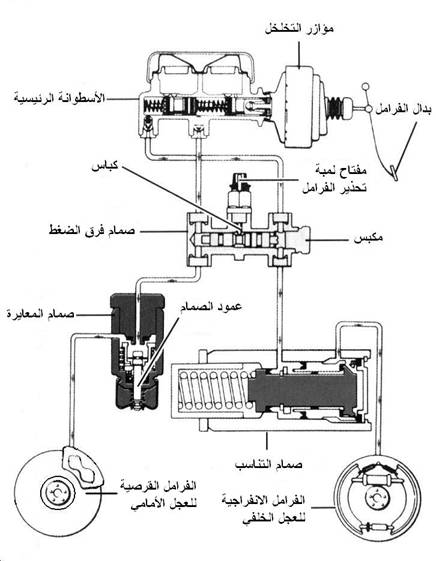 |
| brake hydraulic circuit valves |
Metering valve The metering valve is
installed on vehicles that have only disc brakes on the front axle and strut brakes on the rear axle. The valve is mounted on the front wheel brake line with disc brakes. The function of the valve is to operate the disc brakes and the diaphragm brakes at the same time. Since the brake rim brake has a powerful shoe-return spring, when the brake pedal is depressed, the disc brakes begin to operate before the brake pressure overcomes the shoe-return spring on the rear brake. The effect of the brakes on the front wheel before the rear wheel on roads with a low coefficient of traction (snow) causes the front wheels to lock up. The presence of a calibration valve prevents the front wheels from locking up when starting to brake on slippery terrain. Locking the front wheels causes the driver to lose the ability to steer the vehicle.
When the front brakes work before the rear brakes, the weight transferred to the front wheels is little, and in the case of slippery ground (where the value of the friction coefficient is low), the braking force on the front wheel is greater than the product of (weight on the wheel x value of the friction coefficient), and this happens Front wheel lockout.
The figure shows a section of the calibration valve, which shows the internal structure of the valve, methods of connecting the valve to the circuit, and the way it works.
 |
| Calibration valve internal structure, connection and working method |
Disc brakes can operate at a pressure lower than the strut brakes due to the presence of springs for shoe return on the strut brakes, which need pressures ranging from 0.7 to 1.0 MPa to overcome their impact. The calibration valve spring has the force gauges of the shoe return spring (that’s why it is called the calibration valve) so that it opens against the effect of a pressure equal to the overcoming pressure of the shoe return springs, thus ensuring the operation of the disc and thrust brakes at the same time. The valve has a shaft that is pushed from the outside to compress the spring and open the valve during the operation to remove air from the front brake circuit.
A valve to fit Proportioning valve
This valve is used to reduce brake pressure going to the rear wheel cylinders if the pressure reaches a certain limit. This reduction in pressure reduces the possibility of a rear axle lock-up when the brake pedal is depressed. The valve allows the entire pressure to pass to the rear wheel cylinders until a certain point called the manifold point or the pressure change point, after this point the pressure reaching the wheel brakes decreases, as shown in the figure.
When applying low or medium force to the brake pedal, the pressure is equal to the front wheel and the rear wheel. After the manifold point, the proportional valve reduces the pressure of the rear wheel so that it becomes half the pressure of the front wheel (this ratio is in the range of 0.25 to 0.50), which is why it is called the proportional valve.
 |
| The proportional valve reduces the rate of increase in rear brake line pressure while continuing to increase the pressure of the master cylinder due to pressure on the pedal |
There are several types of proportional valve used in cars, and the types differ in terms of shape, design, method of work and placement in the circuit.
Types of proportional valve:
A – valve actuated by means of a spring (spring).
The pressure is controlled by means of a spring (operating at a certain pressure)
B – valve that works by force of acceleration.
Pressure control by means of inertia force (works by increasing braking force)
C – valve operated by load sensor (change in vehicle height or weight).
The pressure control is carried out by a control arm connected to the car body (chassis), which works when the weight is low on the rear axle (as a result of the load or as a result of the weight transferred to the front axle during braking)
1- A proportional valve that works by means of the spring (as in the figure):
(A) ) separate valve and pipeline mounted rear axle,
(b) the valve body is
fabricated with the body of the master cylinder, (c) a separate valve and threaded to the outlet of the master cylinder.
 |  |  |
| Placing the proportioning valve on the brake circuit |
2- Valve that works by deceleration force: The
valve is installed diagonally in the car body. When the deceleration value increases, the ball rushes into the valve, under the influence of inertial force, to close the brake fluid tracks and reduce pressure on the rear axle.
 |
| Fit valve works by deceleration force |
3- A valve that works through the load sensor. The
proportional valve is installed between the car body (chassis) and the rear wheel axle, as in the figure. When the weight is increased on the rear axle, the valve is affected by the position of the car body relative to the wheel axle, and leads to a small reduction in the pressure of the brake line. However, if the weight on the rear axle is low, the valve is affected and there is a significant reduction in the back pressure of the brakes.
 |  |
| The proportional valve lowers the pressure on the rear axle of the brake based on the change in vehicle height due to the load on the rear axle (load distribution and/or weight carried) |
Pressure difference valve (one of the two-
circuit failure warning switch) This valve is connected to the two circuits of the two-circuit and each circuit passes from one end of the valve inside the valve A cylinder with a piston This piston has a conical shape on both sides In the event of a decrease in pressure in one of the two circuits, the piston moves towards the lower pressure due to The effect of the pressure difference, the conical part pushes the brake warning lamp switch shaft and connects the circuit, and the red brake lamp on the instrument panel lights up. as in fig.
 |
| pressure differential valve |
Combination valve
This valve contains in one unit the calibration valve, proportioning valve and pressure differential valve (a circuit failure warning switch in the brake dual circuit). The combination of valves in one body is characterized by reduced possibility of leakage, and ease of detection.
The figure shows one of the designs of the combined valve, where the titration valve is in the front part, the middle part is the pressure difference valve, and the back part is the proportioning valve.
 |
| LED assembler |
Residual pressure check valve
Some dual brake cylinders have a valve at the oil outlet from the master cylinder to the diaphragm brake, as shown in the figure, in order to keep the brake fluid in the brake circuit tubes at a low pressure (above zero – Less than the return shoe spring pressure), so that there is a quick brake response when the brake pedal is applied, as well as to prevent air from entering the brake system, the air is entered into the circuit while the piston is back (if there is a vacuum in the circuit), this valve is not used in the circuit which have disc brakes as any pressure remaining in the circuit will cause the wheel piston to be unable to reverse and the friction linings will remain in contact with the disc permanently.
There are no reviews yet. Be the first one to write one.