
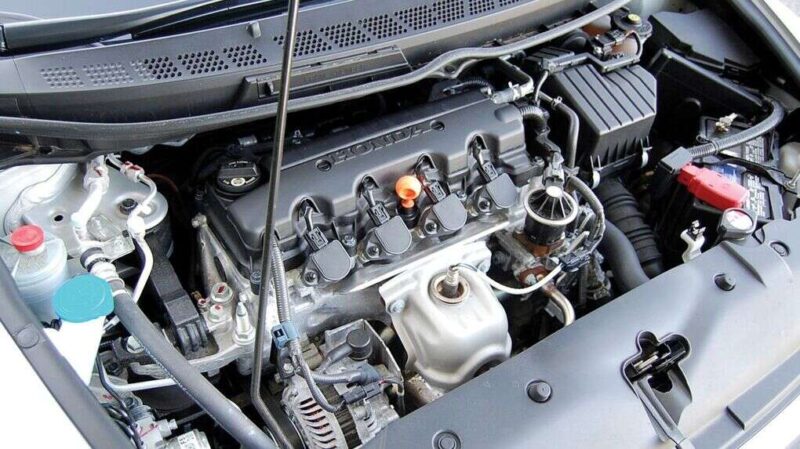

Normal ignition system in the car Ignition System

Conventional ignition system:
In diesel engines, diesel ignites by itself as a result of its higher temperature at the end of the compression stroke than its self-ignition temperature, and therefore diesel engines do not need an ignition system.
In gasoline engines, the temperature at the end of the compression stroke does not reach the temperature of its self-ignition, so you need an ignition system that releases successive electric sparks in each cylinder to ignite the charge. (Air + fuel) compressed inside the cylinders at the end of the compression stroke, causing a severe explosion that pushes the piston down and thus generates power in the engine.
Parts of the conventional ignition system :
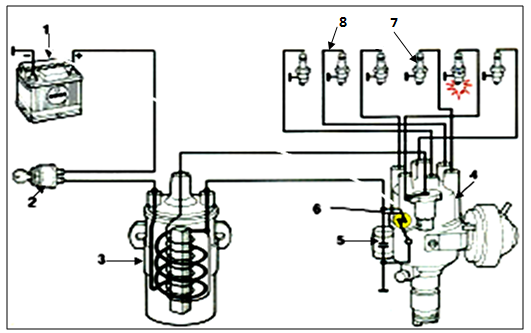
The conventional ignition system contains the following components:
1- the battery
2- the ignition switch
3- Ignition coil (Boubina)
4- Spark distributor
5- Intensifier
6- Contact breaker (Aplatin)
7- Spark plugs.
8- High pressure wires.
1- Battery : The battery
supplies the ignition group with the required current when the engine starts, after which the generator replaces the battery in supplying the group with electric current.
2- The ignition switch (contact): Ignition switch
is connected and disconnected from the ignition system.
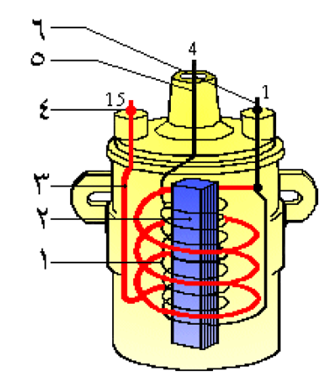
3- Ignition coil : Ignition Coil
The ignition coil is a device that converts the primary voltage, the low battery voltage (12 volts), to the high ignition voltage, ranging from 15,000 to 40,000 volts. The thin insulated and the primary coil with a relatively small number of coils made of copper wire with a larger diameter than the wire of the secondary coil and these two coils are wound one inside the other as in the form where the secondary coil is first wrapped around the iron core and then the primary coil is wrapped around it, and the ignition coil represents the point of contact between The primary circuit and the secondary circuit, and inside some types of ignition coils there is oil to cool the heat resulting from the passage of high-voltage electric current.
Parts of the ignition coil:
1- secondary coil
2- wrought iron sheets
3-Primary coil
4- The input current coming from the ignition switch and symbolized by it (15)
5- The high-voltage output current to the spark distributor and symbolized by it (4)
6- The terminal connecting to the contact breaker and symbolized by it (1)
4. Sparks distributor (Alospratir): Distributer
The distributor sparks reception current high voltage (spark) of ignition coil and distributed to the spark plugs in the order of ignition in the engine is done by rotating the rotor (Alshakoc) compound on the revolving distributor column to touch points connecting wires in The distributor cover and takes its movement from the engine through the camshaft because its speed is the same as the speed of the camshaft, which is half the number of turns of the crankshaft.
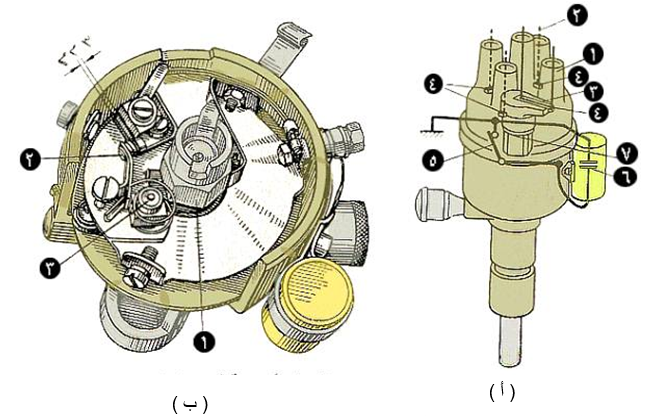
In Figure (A):
1- Distributor cover
2- Exits of cables connected to the spark plugs
3- Distributor rotor
4- Contact point
5- Contactor (aplatin)
6- Capacitor (condenser)
7- Cutting cam
in Figure (B): Details Distributor work :
1- Cutting cam
2- Contact arm
3- Axle (Benz) pivot for contact arm
5- Condenser: Condenser
The capacitor consists of a group of metal sheets (plates) with insulating strips between them. Each of the foil and insulators is wrapped in a cylindrical shape. This group is kept inside a cylindrical box of aluminum (or any other metal). One end of the foil is connected from the inside to the box and becomes negative while the other end connects Wire connected to the primary coil.
The capacitor has two important benefits:
A- It increases the electromotive force produced in the secondary coil. When the circuit of the primary coil is cut by the contact breaker, the electrical energy stored in the capacitor is discharged against the direction of the original current, and this leads to the rapid fading of the magnetic field arising when the battery current passes through the coil Primary .
b- It protects the contact points from burning and damage from the spark that occurs on the contact breaker when connecting and cutting the current, so it absorbs and stores electrical energy.
Any defect in the capacitor that leads to a quick damage to the contact breaker and a weak spark so that it is not enough to ignite the fuel mixture in the cylinder, or the spark does not occur at all.
6- Contact breaker (platin):
controls the time of passage of current in the primary coil and is made of tungsten or platinum alloy and is installed on the distributor tray and cuts the current of the primary circuit to release electromagnetic energy from the primary coil and extract high voltage from the secondary coil, and the contact breaker consists of two pieces One of them is moving through the distributor shaft cam and the other is fixed and connected to the ground through the distributor body.
7- Spark plugs: Spark Plug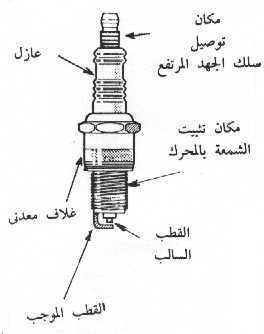
It consists of a metal casing that ends at the bottom with the negative pole, which is connected to the chassis (ground) by means of the cylinder head. Inside the metal casing, a porcelain insulator is installed, and the positive electrode penetrates the middle of the insulator from top to bottom. The electric spark is emitted between the electrodes through the gap between them, which ranges between 6 and 0 mm to 8 and 0 mm.
– The function of the spark plugs: The
function of the spark plugs is to deliver the high-voltage ignition current to the combustion chamber in the engine cylinders in an isolated way and convert it into a spark that jumps between the gap of the candle, causing the ignition of the fuel-air mixture.
Therefore, the spark plug must meet the following conditions:
1- It can withstand the high temperatures that fall on it.
2- High resistance to mechanical stress against high pressures.
3- It has good thermal conductivity with high electrical insulation.
– a
Types of spark plugs: The types of spark plugs differ. When installing, the appropriate candle must be chosen according to the specifications of the factory according to the type, condition of the engine used and operating conditions. There are the following types of candles:
1- Hot
candle 2- Medium
candle 3- Cold candle
First: Hot candle:
in which there is The ceramic nose of the candle is long, as this ceramic nose exposed to the combustion gases works to retain the heat and not leak it to the body of the engine quickly. For its glow and its prominence in the path of the flame front.
Second: the middle candle:
This type is used in engines that operate under normal operating conditions, in which the length of the ceramic nose is shorter than the hot candle, and therefore the heat leakage path is shorter, as shown in Figure (B).
Third: The cold candle: It is
used in engines with high speeds and large loads and in hot countries. The length of the ceramic nose is relatively short and does not retain heat, but rather a rapid leakage of it occurs as in Figure (C). 
– How the conventional ignition system works:
The basic work of the ignition system is to convert the primary current (battery current) into a high pressure current in the form of a spark sent to the spark plugs, and this conversion takes place in the ignition coil, which is the connecting point between the two circuits. The work of the two circuits will be explained:
1- Primary circuit:
The primary circuit or low electrical pressure circuit consists of the following parts:
1- Battery
2- Ignition switch
3- Primary coil
4- Contact breaker
5- Capacitor
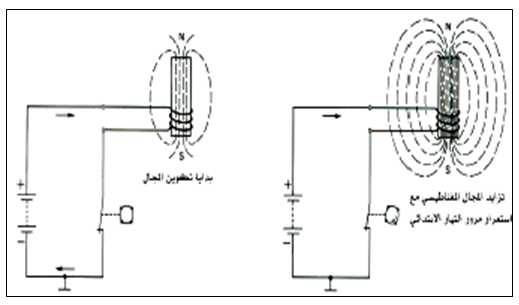
In it, the current flows from the battery through the ignition switch to the ignition coil and from it to the contact points. If the contact points are connected, the primary circuit is completed and the current flows in it, which generates a magnetic field in the primary coil. As the current continues to pass, the amount of the generated magnetic field increases .
B- Secondary circuit:
The secondary circuit or the high-pressure circuit consists of the following parts:
1- The secondary coil
2- The spark distributor (sprater)
3- The high-pressure wires (
spark plugs ) 4- The spark plugs
When the contact points are separated, the primary circuit is interrupted The magnetic field collapses in the coil and a high electromotive force is generated in the secondary coil (in the form of a spark) transmitted through the high pressure wire to the spark distributor, which distributes the sparks according to the ignition arrangement in the engine and from it to the spark plugs in the cylinder.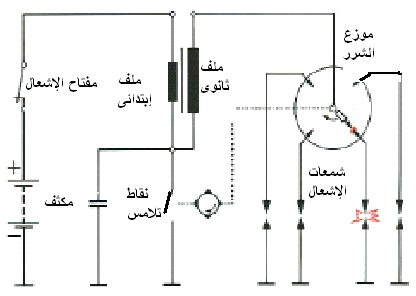
Spark control devices : The
higher the speed, the less travel time for the piston and to give the charge enough time to burn before the piston reaches the high dead point (N-M-Z), the occurrence of the spark must be presented with the increase in speed. And this work is done by the sparking device with the speed.
How the ignition advance device works with speed :
When the crankshaft speed increases, as well as the distributor shaft, the centrifugal weights are pushed outwards by the effect of the centrifugal force against the tension of the spring and the movement of the weights is transmitted to the follower or the cam plate with which the cam moves an angular movement in the direction of rotation, and thus the cam precedes its original position and the date of the spark gradually advances according to Speed increase. But when the speed decreases, the centrifugal weights rejoin each other by the effect of the tension of the spring, and the spark is relatively delayed whenever the speed decreases. The centrifugal ignition timing regulator is located inside the ignition distributor at the bottom of the contactor plate, and it is mounted on the distributor shaft itself.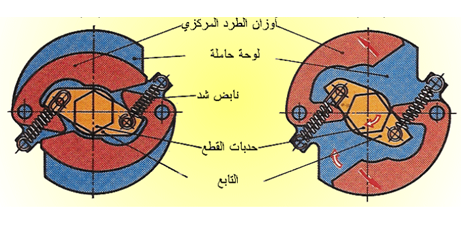
When the load on the engine increases, the vacuum inside the combustion chamber decreases, which necessitates the provision of the spark when the load increases in order to give a longer time for the spark to cause combustion.
How the ignition advance device works with the load
When the load is large, the throttle opening is large and the vacuum on the flexible membrane is reduced, so it does not move. When the load is light, the throttle opening is small, and a large disturbance occurs in the pressure chamber. With the help of the atmospheric pressure inside the chamber, the separating membrane moves to the right against the pressure of the spring, and the arm moves the plate (plate) of the contact points with an angular movement against the pressure of the spring, causing the spark to advance. 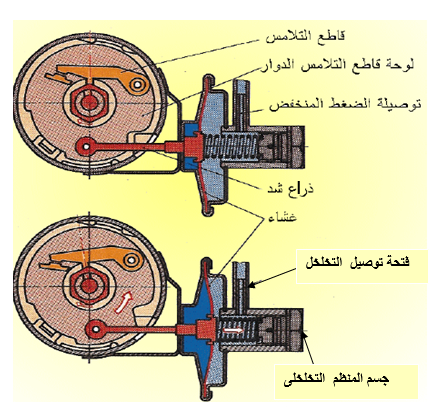
There are no reviews yet. Be the first one to write one.