
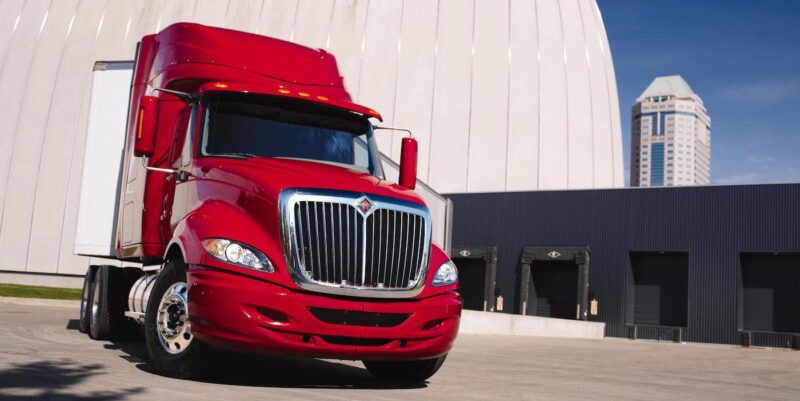

Brakes for heavy vehicles (trucks and buses):
Air Brake System The
force of the hydraulic brake system is not enough to brake heavy vehicles with the driver’s force or the servo force, but a source of the acting force other than the driver is needed. This can be provided by compressed air, and the force acting on the wheel brake is equal to the air pressure multiplied by the diaphragm area of the wheel cylinder. The manometric pressure in the brake system is either 5 or 7 bar (0.5 to 0.7 MPa-N/mm²).
The driver uses only foot pressure to control the entry of compressed air into the brake circuit to affect the friction linings of the wheel brakes.
The brake cycle as a complete unit consists of two main parts. The first part supplies the equipment with the compressed air needed for it. While the second part contains the brake control devices and their operation.
 |
| Dual air brake circuit parts |
The air supply part consists of an air compressor, an air filter with a tire inflator connection, a pressure regulator, a anti-frost pump, an air tank, a valve for surplus air, tubes and valves, and sometimes filters for the brake tubes.
The brake control and operation part consists of the brake pedal valve, handbrake valve, brake drum, as well as a set of special valves in the dual brake and trailer brake equipment.
The air brake system provides more pressure than the driver’s force, which is able to stop the large mass of the truck, while at the same time saving the driver’s effort in pressing the pedal. The air brake is distinguished from the hydraulic brake in that there is no problem in terms of brake fluid leakage, as well as the ease of connecting the tractor brakes (locomotive) with the trailer.
Retarders
The Retarder is a device that reduces the load on the friction service brakes of the brake system of heavy vehicles. As the friction brakes are subject to the phenomenon of brake wear due to the high temperature of the parts. The temperature of the brake parts in heavy cars increases as a result of the use of friction brakes to stop the large mass of the car. and exposure to frequent use of the brakes, such as in urban buses. That is why heavy cars and buses are equipped with an additional brake system that does not depend on friction.
Retarders not only work in road vehicles but also extend to railways.
Retarders are used to reduce the vehicle’s speed, and to maintain a constant speed while descending a slope. Retarders are not able to stop the vehicle completely, as their efficiency decreases at low speeds. They usually slow the car down and then the friction brakes stop the car. Since the friction brakes in this case are not used at high speeds or at a high rate, this increases their operational life, and the fact that the brake parts do not heat up and transfer to the rim increases the life of the tires as well.
Most of the retarders work by means of the brake pedal. In the first stage of pressing the pedal, the retarders are engaged, and with continued pressure on the pedal, the friction brake is applied. Retarders can be activated automatically or manually via a lever. The retarders can be a separate part installed in the car, or as an integral part of the transmission system.
Retarders may be used to turn them on partially at the start of the movement to quickly reach the operating temperature of the engine in cold weather.
Engine brake:
Gasoline cars:
Most petrol car drivers know what is called engine brake when going down an incline. They put the gearbox in its lower gear, and they don’t push the gas pedal. The deceleration does not occur as a result of friction in the engine (even if it does participate), but when the throttle valve is closed in the intake stroke, the air cannot enter the cylinder. As a result, there is a vacuum in each intake stroke of each of the engine cylinders, and its effect on the wheels increases due to the high reduction in the gearbox at low gear. Thus, the vehicle deceleration occurs.
Diesel cars:
Since there is no throttle in a diesel engine, the previous method cannot be used to apply engine braking. But one company used the idea of opening the exhaust valve when the piston reached the top dead point. Thus, before the compressed air does the work of the spring to help push the piston down, the pressure is leaked, and this is similar to the engine acting as an air compressor, and since the torque needed for this comes from the wheel via the high reduction gearbox, this slows the vehicle. The amount of power that the engine operates to slow the vehicle is estimated at 90% of the engine power for some engines. This type of heavy vehicle driver is known in North America as the brake jack. One of the disadvantages of this brake is the high noise it emits during operation, and some even recommended not to use it on the roads.
Exhaust brake:
Exhaust braking is simpler to operate than engine braking. Where there is a valve with an exhaust pipe. When the valve is closed, the pressure in the exhaust system is raised, which pushes the engine to work with a higher effort during the exhaust stroke, and thus the engine works like an air compressor. And where the pressure force comes from the wheel through the gearbox, this slows the vehicle. In this system, the brake tubes must be designed to withstand high pressure, and this system provides less power to slow the vehicle compared to other systems.
The hydraulic retarder:
This system uses a viscous retarder between moving and stationary blades in a fluid-filled chamber to create the required deceleration. There are different types of fluids, there are decelerators that use transmission fluid, separate oil, or water.
Simple decelerator blades attached to the transmission shaft can be used between the clutch and the wheel. They can be driven by gears from the shaft. The blades are in a room with little space between the blades and the wall of the room that also has the blades in the automatic transmission. When the movement is needed to slow down, liquid or water enters the chamber and the viscosity hindrance slows the vehicle. A liquid will heat up in the room and will therefore need a cooling medium. The deceleration force can be changed by increasing the liquid level in the chamber.
The hydraulic retarder operates completely quietly compared to the engine brake.
The electric retarder:
The electric decelerator uses electromagnetic induction to provide the deceleration force. It consists of a rotating part attached to either the axle, the transmission or the transmission line. A fixed part is attached to the car body. There is no contact surface between the stator and the rotor, and there is no fluid either. When deceleration is desired, the coils of electrical wires are connected to the stator of the battery, generating a magnetic field that generates an inductive current in the rotating part, which reduces its speed and thus the part connected to it. The rotor is designed to provide the required cooling. There is no burden on the car’s cooling system when the decelerator is turned on.
In hybrid cars, an electric retarder is used to assist mechanical braking and works to charge the battery. The energy in the battery is then used to accelerate the car (increase its speed).
There are no reviews yet. Be the first one to write one.