
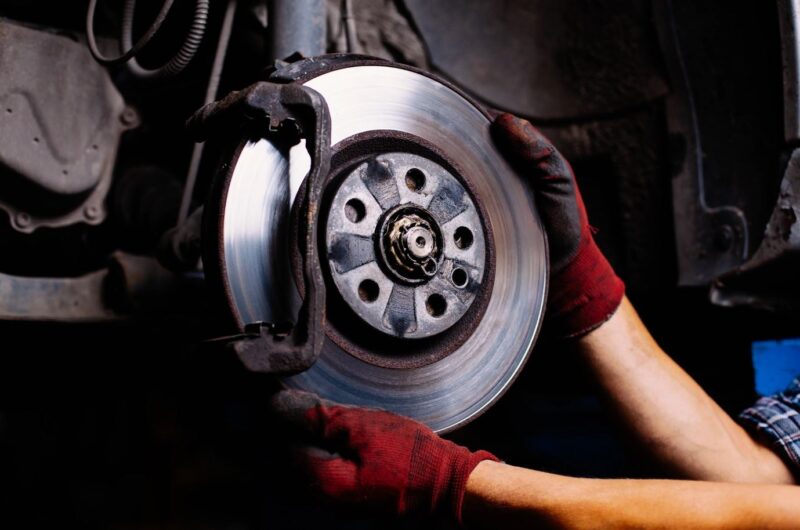
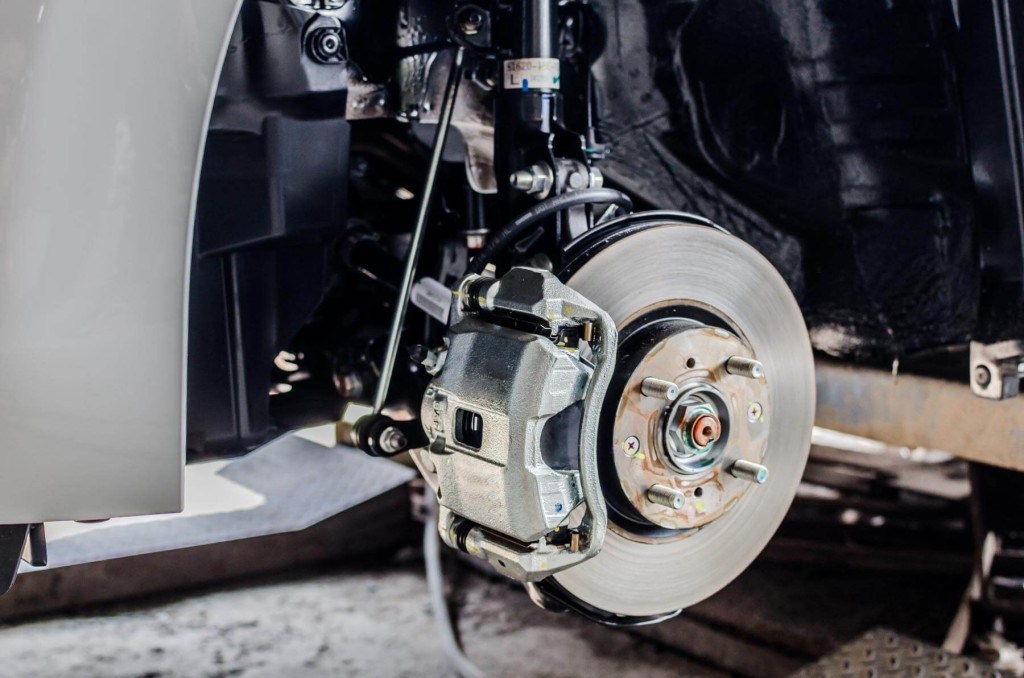
Car brake systems:
– service brakes – hold brakes
– brake
control systems (antilock wheels system – brake assist system……)
brake system components (service brakes and anchor brakes):
Figure (1) shows the components and parts of the brake system Where the system consists of the following:
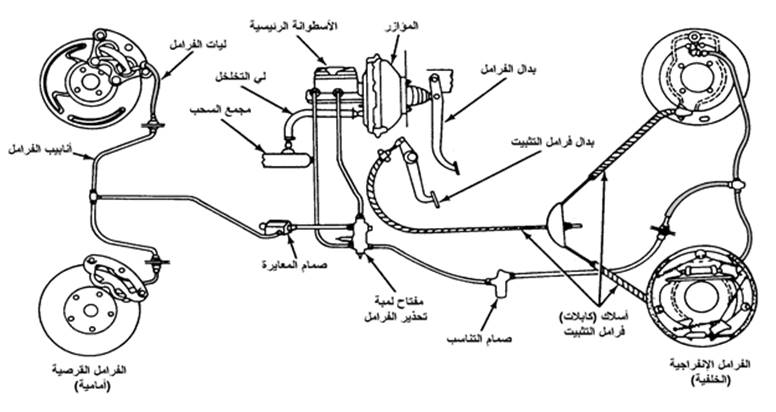 |
| Figure 1: Components of the hydraulic service brake system and the stabilizer brake |
Brake pedal A means of transferring force from the driver’s foot to the brake system.
q Booster increases the power of the pedal.
q The master cylinder converts pedaling force into hydraulic pressure
q Brake tubes & hoses to transfer brake fluid to the wheel cylinders.
q Brake valves to control brake pressure to avoid wheel lockup.
q Wheel cylinders convert oil pressure into a force that acts on the friction linings.
q Wheel brake (Disc-Drum) produces a friction force between the friction linings and the surface of the rotating atmospheres (disc or circuit).
q Parking brake to stop the car.
hydraulic brake circuit:
The hydraulic brake circuit transfers the force from the driver’s foot (the pedal and the servo) to the wheel brake. It consists of the master cylinder, tubes and brake cylinders, and wheel cylinders (sub-cylinders). For safety reasons and the safety of passengers and the vehicle, the hydraulic circuit consists of a double circuit (dual circuit). In the event of a leak in the hydraulic system, the service brake does not have a complete breakdown, but some wheels remain. Each circuit handles a certain number of wheels, depending on the vehicle’s brake circuit design. Each circuit is separate from the other circuit in terms of the track and brake fluid used.
Types of dual circuits (Dual):
Figure 2 shows the different forms of connecting the two circuits, and they differ from one car to another according to the design of the car.
 |
| Figure (2): Types of dual brake circuits used in cars |
The different ways to connect the dual circuit:
A- (1) front / (2) rear
B- (1) axial (front left wheel and rear right wheel / (2) front right wheel and rear left wheel)
C- (1) four wheels/ ( 2) Front
D-(1) Front and Rear Left Wheel/ (2) Front and Rear Right Wheel
E-(1) Four Wheels/ (2) Four
Wheels Antilock Brake System (ABS) Antilock Brake System (ABS)
, is a system Connected to the brake circuit of most modern cars. It works to prevent the wheels from locking up during braking. It also makes use of many parts of the system in other vehicle stability control systems.
 |
| Figure (3): Anti-lock wheels system |
The system consists of the following parts:
1 – wheel speed sensor
2
– electronic control unit 3 – hydraulic control unit
4 – warning lamp that the anti-lock system does not work,
brake system checklist Brake Inspection Check-list
Friction lining
1. Friction linings shall have no significant wear. The thickness of the glued bushings should not be less than (0.8 mm), while the riveted bushings should be of sufficient thickness so that the rivet head is not visible.
2. The lining must not be polished or have cracks, and there must be no indication that it is separated from the metal part in which it is fixed.
3. It should not have traces of contamination with grease or brake fluid.
Wheel cylinders
1. There should be no trace of leakage (push the dust guard back to detect external leakage in the cylinder).
2. The movement of the piston inside the cylinder should be smooth.
The circuit(s)
1. There must be no cracks or dents in it or a change in its rotation (oval shape).
2. Sofa oil should not have any traces of damage or leakage.
3. Pomegranate bearings for the calf must not have any traces of wear or roughness, and they must be sound and lubricated.
Hinged brakes
1. There shall be no change in the color or shape of the retaining springs or the tension springs.
2. The self-adjusting system must be working in good condition.
3. The clearance between the shoes and the circuit must be equal at both ends in order to obtain equal braking for all wheels at the same time.
Brake springs and tubes
1. There should be no traces of leaking or dripping.
2. There should be no traces of damage to the cylinders.
3. Brake tubes shall be free from rust or corrosion.
4. Be careful not to bend or break the brake tubes and fittings during the installation process.
Brake wire(s)
1. The movement of the cables must be smooth inside their case.
2. It should not have folds or tears.
Control valves
1. There should be no appearance of leakage.
2. It must be well fixed in its places.
Master cylinder
1. The level of brake fluid in the reservoir must be within the permissible limits.
2. There should be no apparent leakage.
3. The brake fluid reservoir cap must be in good condition.
Workshop brake
fluid safety precautions :
– brake fluid is toxic (wash your hands thoroughly after handling brake fluid)
– brake fluid is flammable (avoid placing fluid near high heat or open flames)
– brake fluid is voracious to absorb water (exposure to skin or eyes to fluid Brakes cause severe problems. If the eye is exposed to brake fluid, the eye is washed with flowing water several times and then shown to the doctor. It is recommended to use safety glasses when handling brake fluid.
– Brake fluid interacts with the car’s paint (beware of spilling brake fluid on the car body). If the car paint is spilled or contaminated with brake fluid, wash the surface of the car well with soap and water.
– Beware of contamination of the friction linings with brake fluid. Contamination of the linings with brake fluid works to change the friction coefficient of the lining and changes the properties of the lining
– Do not mix two different types of brake fluid Dot 3 and Dot 4
– Do not use mineral oil instead of brake fluid in the brake system.
Working under the car:
– Do not work under a car raised by the car winch, but the car must be raised on a metal stand.
– In the case of working and the vehicle on a hydraulic jack in the workshop, the safety instructions for handling the jacks must be followed.
– When working under the car, safety glasses must be worn, to protect against falling dust and the like.
Dealing with the wheel brakes:
– The temperature of the circuit and disc may be high as a result of using the brakes. Leave the car for a while to cool the parts, or wear gloves if necessary.
Dealing with the hydraulic servo:
– The hydraulic pressure must be removed before starting any operation related to the servo, by pressing the brake pedal several times while the engine is not running.
Anti-locking wheels handling:
– Refer to the maintenance catalog for safety precautions – before starting any vehicle with an anti-locking wheel system.
Removing the brake parts:
– Keep your fingers out of the wheel piston track when using air pressure to remove the piston
– Begin by unscrewing the secondary piston positioning pin before removing the primary piston
– Be careful when handling parts that have springs, the springs may spur during disassembly
– Beware of inhaling dust from the friction linings, do not use compressed air to get rid of friction residues
Test the car:
– When testing Make sure the road is clear of cars and follow the traffic rules.
Special tools and equipment. Brake
tools. Basic Brake Hand Tools:
– Tubing or line wrenches
nut wrench – Bleeder wrenches wrench
– brake line repair kit Tubing tools
– Brake pliers
– Drum brake tools
– Allen wrench and special bits for loosening the Allen and Torx bits saddle bolts
– Kit (vigil) for inserting the disc brake piston into the saddle C-clamps
– Wheel brake smoothening kit Brake cylinder hones
Brake System Measuring Tools: Brake System Measuring Tools
: Metal Slide (clearance gauge) feller Gauges
– micrometer to measure the disk and circuit Rotor and the drum micrometers
– shoe gauge circuit (adjust the shoes before the installation of the circuit) shoe and the drum gauge the
– scale clock (measuring not neutralization disk) the Dial Indicator
– force Da’sh scale (pedal) pedal – effort gauge the
– pressure gauge Oil (brake line pressure gauge) Hydraulic pressure gauge
Specialized Brake Tools
– Seal and Dust boot installers
– Wheel bearing service tools
– Hydraulic system tools
– Servo service kit (booster height gauge – Vacuum pump, Power brake service tools,
electrical and electronic parts testing kit:
Jumper wires
– Optical device for testing conduction and current, Test light
– Multimeter (volt-ampere)
– Ohmmeter
– Voltmeter Voltmeter
Ammeter
– waveform meters
– Scan tools
: Brake System Cleaning Tools
– Vacuum cleaning systems
– Wet cleaning systems
Brake service equipment: Brake Service Equipment
– Brake lathes
– On-car disc lathe Lathes Brake
– polishing disc surface Rotor Burnisher of Brake
– grinding circuit Grinder Drum
– grinding shoes shoe Grinders of Brake
– piston Hydraulic press of Hydraulic
– equipment bleed air pressure bleeding equipment pressure
Clothes prevention
– A muzzle to prevent inhalation of tire brake dust, Respiratory protection,
instructions and maintenance books,
Auto Repair Manual
There are many manuals and maintenance books available in the market. We need these books to get the information needed to perform checks and adjustments for different types of cars.
– Instructions booklet for the car owner
– General maintenance instruction books available in the market for different types of cars
– Instructions and maintenance books for the manufacturer (found at car dealerships)
– CDs that contain technical information about car types
– Information on the Internet for car types and models different.
These sources contain a wealth of information about automobile systems:
– Indications of warning lamps, and the symbols that appear on the car dashboard
– How to detect (check) the fluid level in the car
– Types of oils, fluids and greases used, their specifications and quantities
– Amount of clearances and lengths required
– Specifications of spare parts, and how to determine the specifications of the part to be replaced
– Special equipment Required
– Inspection, maintenance and replacement
steps – Repair steps
– Safety warnings and alerts
– Required torques and screws, and belt tensioners
That is why the workshop should contain up-to-date sources of information about the cars that are dealt with in the workshop, and the technician should train on how to extract the information and benefit from it. As well as the availability of the kit and know how to use it. And make the steps in the correct order according to the catalogs. And making sure to understand the warnings and alerts related to the safety of the person, the safety of the vehicle, and the safety of the workshop.
There are no reviews yet. Be the first one to write one.