

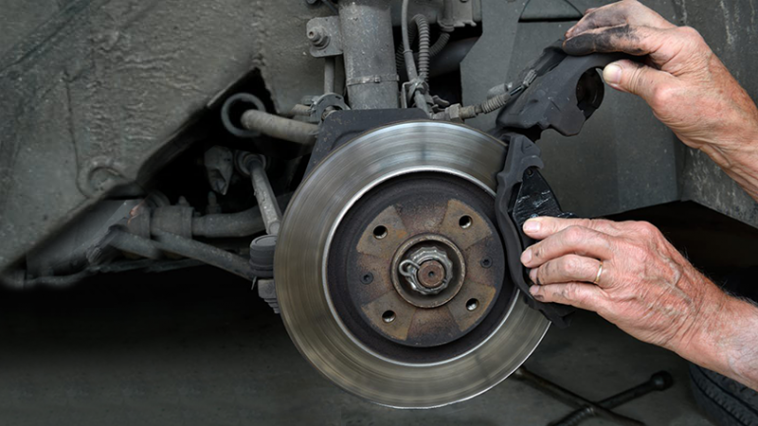
When driving a car, some of the symptoms of car brake problems may appear, which can be identified by feeling when dealing with the “pedal” brake: a stony pedal that needs high strength to obtain the required brake, or a spongy pedal (long duration and distance of impact) ) or low (the pedal drops near the floor of the car to activate the brakes), a sensitive pedal (a small amount of pressure on the pedal causes strong braking). Noise and vibration when using the brake (a loud audible sound that varies in its type and strength), as well as vibration (in the pedal, steering wheel, car) during braking. Also, there may be a difference in braking force (lack of brake force “total brake breakdown”, weak brakes, continuously loaded brakes). In addition, the condition of the brakes can be judged from the performance of the car during braking (increased stopping distance, deviation of the car during braking). Illumination of the brake warning lamp on the dashboard.
These are symptoms that indicate a problem with the brakes, some of which may be due to a simple problem with the brakes, and some may be behind a big problem. The brakes are important in terms of safety for passengers and road users, and therefore the causes of these symptoms must be investigated as soon as they appear, and it is not recommended to drive the car at all when the brake warning lamp on the dashboard is illuminated.
These symptoms, some of them appear suddenly, but the majority start simple and increase with use and may not be felt by the driver of the car. It may be noticed by another user (compared to his car). These symptoms indicate the possible causes of it. The technician relies on it to identify system problems. The brakes need to inspect it and the components of the system using the devices to accurately identify the problem, perform maintenance, repair, replace damaged parts, and adjust the brakes.
The following table contains a list of the common symptoms of brake problems and the possible causes of malfunctions revealed by these symptoms.
| Symptoms of brake problems | |||
| statment | Symptoms | Explanation of symptoms | Holiday probability |
 | brake persistence | Brakes stuck, wheels are hot, engine power is lost, vehicle brakes fail to release | – Adjustment of low clearances – Blockage of the bypass port on the master cylinder – Weak pedal return spring – Wheel piston sticking |
| car swerving | The car is veering in either direction when the brakes are applied. | – Linings contaminated with grease, oil or brake fluid – Asymmetric linings – A poorly inflated tire or corroded surface – Under -tuned brakes – Suspension problems | |
 | petrified | The need for high pressure on the pedal to activate the brakes. | – Problem in the servo system – Freezing or sticking of wheel cylinders – Damaged (corroded or polished) friction linings – Blockage or blockage in the brake line |
 | Warning lamp illumination | Illumination of the warning lamp in the dashboard | – Brake activated – Low brake fluid level (due to wear of the friction linings, or leakage) – Friction lining erosion – Yellow or ABS indicates that the antilock system is disabled. |
 | vibration | The brake pedal, steering wheel or the entire vehicle vibrates when the brakes are applied | – Unevenness of the disc surface – Failure to attach/fixate any system component – Problem with the steering or suspension system – Unbalanced tires |
 | creaking sound | The brakes should operate with minimal noise. Some noise is normal but excessive squeaking, rattling, crunching, or banging. | Sometimes there is a sound for a short time when the lining is wet, but the persistence and repetition of the sound means that there is a problem with the brakes – the surface of the disc is not level or the circuit is not rotated – the linings are worn out – the shoes are warped – the pomegranate is worn with the wheel not fixed – the saddle is not adjusted with the disc – the presence of impurities in lining material |
 | Low or squishy | The pedal may reach the floor of the car until the brakes are activated. | – No brake fluid in the main cylinder – Air in the brake circuit – A large free space in the brake pedal – A large distance between the shoe lining and the circuit of the breakout brake (the star wheel does not work in self-adjusting the brakes) – Contaminated brake fluid – Uneven disc surface, which pushes The wheel piston is backwards and it takes a longer distance to push the piston back |
 | sensitive brake | The brakes are done with the least pressure to replace | – Lubricant or oil on the brake linings – A component of the system is not properly installed – The saddle is not aligned with the disc – Malfunction in the brake tubes and connections – One of the saddle attachment bolts is missing – A slippery trim or piston in the saddle wheel |
| Increase stopping distance | The brakes are working but the stopping distance is increased (weak brakes) | – Wear in the surface of the tire – Locking wheels – Wearing of the friction linings – Overheating of the friction linings – Damage to the brake servo |
Source for more information:
http://www.bendix.com.au/tech-tips/brake-problems
http://www.brakesplus.com/brake-services/
The following graphic also shows the brake failure dashboard based on symptoms of problems brakes:

There are no reviews yet. Be the first one to write one.