

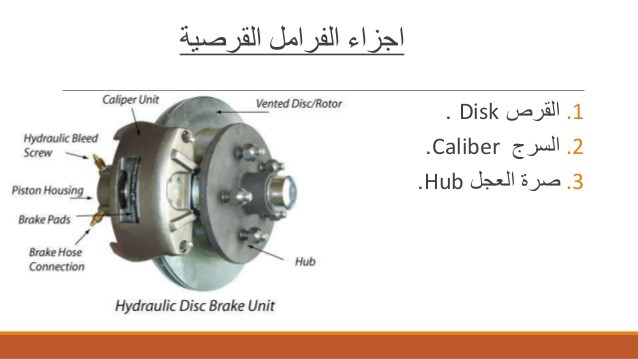
Brake Pad Replacement
Car wheel solution:
a- Use a wheel wrench and remove the wheel bolts.
B – Lift the car on the jack (make sure it is stable on the jack).
c- Loosen the calf screws according to the jaw arrangement Figure (1).
 |
| Figure (1): Dissolving the wheel from the car |
Checking the thickness of the friction bushings:
The thickness of the bushings can be checked by looking through the hole for observing the thickness of the bushings in the saddle. In the event that the thickness is less than the specifications, the lining shall be replaced in Figure (2).
 |
| Figure (2): Note the thickness of the lining |
| warning:* Do not change one liner in the saddle (a new one and an old one). * Do not change the bushings of one wheel and leave the other wheel on the same axle without changing the bushings. |
Replacing the bushings:
There is no need to loosen the brakes from the saddle when performing the bushing replacement.
Most of the bushings in a fixed saddle when replaced do not need to be lifted from the saddle. It is changed by lifting the staple for fixing the bushings and pulling the bushings out (Figure 3).
 |
| Figure (3): Changing the bushings in a fixed saddle |
Most floating saddle bushings need to be replaced when changing the saddle off the disc. When lifting the saddle off the disc it is not left suspended from the brake caliper, but must be attached to the body of the vehicle with a wire.
Returning the piston into the cylinder:
To make it easier to lift the saddle off the disc we need to move the liners a little further from the disc, and we need some way to push the piston back. Before returning the piston into the cylinder, it must be ensured that the fluid level in the master cylinder reservoir is between half and two-thirds full so that the fluid does not spill when the piston is returned into the cylinder. Therefore, we need to empty the excess liquid from the tank (Fig. 4).
In the case of a radial double brake circuit, the excess fluid must be drained from the two reservoir chambers.
 |
| Figure (4): Excess brake fluid drained into the reservoir |
Methods of returning the piston into the cylinder with the
saddle 1- Fixed saddle:
* To return the piston we need to use a screwdriver or a lever. Insert the screwdriver or lever between the bushing and the disc or between the bushing and the piston, then carefully push the bushing or piston to the side until the piston goes into the cylinder (Figure (5)).
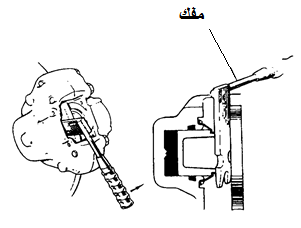 |
| Figure (5): How to push the piston inward using a screwdriver |
* Pliers with sliding jaw. Hold the lip of the liner and the outer surface of the saddle and then press to insert the piston into the cylinder (Figure 6).
 |
| Figure (6): The method of pushing the piston inward using pliers |
2- Floating saddle:
* The lever is inserted between the surface of the disc and the liner, and the saddle is pushed out, and this leads to the movement of the piston inside the cylinder (Fig. (7)).
 |
| Figure (7): Pushing the piston inwards using a lever |
* Large pliers with sliding jaw. Loosen with the letter of the inner lining and loosen on the inner side of the saddle body, and when pressing on it pushes the piston into the cylinder, Figure (8).
* A bottle in the shape of the letter “C”. The stinger is placed on the surface of the saddle and the outer lining, tightening the saddle will lead to the movement of the saddle outward and the insertion of the piston in (Figure 9).
 |
| Figure (8): Pushing the piston inward using pliers with sliding jaws |
 |
| Figure (9): Pushing the piston inwards using a C-shaped cylinder |
| Warning: Do not attempt to use any of the above methods to insert the piston into the cylinder with a rear wheel disc brake that uses a hold brake combination, as this will damage the anchor brake. |
To remove the disc brake linings of the rear axle, to which the stabilizer brake is installed, the cable of the stabilizer brake is dissolved, and a special tool is used to push the piston inward for this purpose (Fig. 10).
 |
| Figure (10): Using a special tool to push the piston inward for disc brakes that have a clamping brake |
Removing the saddle from the disc
a- Fixed saddle:
Usually the saddle is removed from the disc by undoing the screws for mounting the saddle with the steering arm or axle (Fig. 11).
 |
| Figure (11): Resolving the saddle bolts |
b – Floating saddle:
In some floating saddle designs, the saddle is loosened by loosening the guide pin. Loosening the guide screws will allow the saddle to be lifted from where the saddle is mounted and off the disc (Fig. 12).
 |
| Figure (12): Solve the screws of the floating saddle |
In many systems the saddle is held in place by one or two support pins or brackets. Loosen the bolt, then push the bolt out by means of a screw (Fig. 13).
 |  |
| Figure (13) Loosen the support pin of the saddle |
After dissolving the saddle stabilizer some types can lift the saddle and keep the bushings in their respective mounts. In others, the saddle comes out with the lining.
| CAUTION: When lifting the saddle from its stand, it must be suspended by a wire that clips to the vehicle axle (Fig. 14). |
 |
| Figure (14): Suspension of the saddle to the body of the car |
Check the linings
Check the condition of the lining and measure the thickness of the lining, refer to the catalog for the car to find out the minimum thickness allowed in Figure (15).
 |
| Figure (15): Measuring the thickness of the lining |
Change the lining if the lining thickness is less than or close to the permissible thickness, Figure (16) or there is uneven wear or traces of contamination in the lining.
 |
| Figure (16): Changing the bushings |
Checking the disc
1- Measure the thickness of the disc
a) Clean the disc surface with a cloth, and visually inspect the disc surface.
b) Measure the thickness of the disc at (4-12) points for the disc and compare the readings with the permissible standard values of the disc, Figure (17).
 |
| Figure (17): Measurement of the thickness of the disc |
Replace the disc if the disc is cracked, its thickness is less than permissible, or there is a thickness difference between the measuring points within (0.254 mm).
2- Measure the flatness of the dial surface
Place the watch (shown) 10 mm from the edge of the dial, set the watch to zero, turn the dial slowly and note the difference in reading, Figure (18). The discrepancy between the readings is within (0.245 mm).
 |
| Figure (18): Measurement of flatness of the disc surface |
| CAUTION: Before performing the hourly measurement, ensure that the dial is well secured. If there is movement: In the event that the disc and hub are separate.Tighten the wheel nuts onto the disc. In the event that the disc and the hub are one part,Tie the pomegranate wear the calf to prevent movement and then reset it before using the car, Figure (19). |
 |
| Figure 19: Disc threading shape |
Saddle Inspection:
Check the saddle for signs of brake fluid leakage. Also, check the condition of the dust guard. If the dust guard is damaged or torn, or there is a leakage of brake fluid, remove the saddle from the car (remove the brakes) and make repairs or change the saddle when needed (Fig. 20).
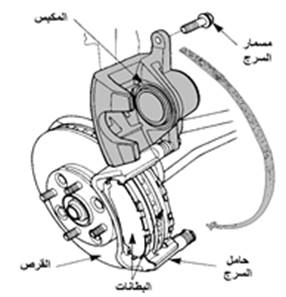 |  |
| Figure (20): Solve the saddle from the car |
Fitting the bushings:
In some cars, the bushings are attached to the saddle and then the saddle is fitted to the disc. In others, the bushings are attached to the bushings holder mounted on the disc and then the saddle is attached.
When installing new bushings, the piston is moved back so that new bushings with a larger thickness can be installed. This can be done by using a wooden hand to push the plunger in (Fig. 21).
 |
| Figure (21): Piston reversing |
Apply silicone grease to the bushings, guides and guide tracks. Figure (22).
 |
| Figure (22): Lubrication of the saddle parts |
Mounting the saddle:
The saddle is installed on the disc and then the guide bolts (Fig. 23) are tightened.
 |  |
| Figure (23): Connecting the saddle bolts |
Ensure that the brakes are not loaded:
(a) Depress the pedal several times.
(B) Make sure when moving the disc that there is no resistance or friction in the disc, Figure (24).
 |
| Figure (24): Checking the quality of the saddle installation |
Wheel Fitting: (a) Install the wheel nuts by hand and tighten them evenly with a wheel wrench.
(B) Put the wheel on the ground and then tighten the wheel in the correct order and with the standard torque, Figure (25).
 |  |
| Figure (25): The installation of the calf |
Check the brake
fluid level: Add brake fluid to the reservoir up to the MAX level, Figure (26).
 |
| Figure (26): Refilling the brake reservoir to the required level |
Normalizing the brakes:
When installing new linings, it must be ensured that the surface of the linings are in contact with the entire surface of the disc and the surface of the linings is prepared for brake performance. This is done while testing the car on the road. It is driving the car at a speed of (50 to 60 km/h) and then using the brake to stop the car. Do this five or six times with about 20-30 seconds between applying the brakes to allow time for the friction surface to cool. Then drive the car at 85 to 90 km/h on the highway and then apply the brakes five or six times to reduce the vehicle speed to (30 km/h) leaving (30 seconds) between applying the brakes.
The driver is advised to avoid hard braking after changing the linings during a driving distance (150 km) inside the city and during a walking distance (400 km) on the highway.
| Warning: * When testing the car on the road, be sure to follow all traffic laws when driving. * And you must look in the mirror to make sure that there are no cars behind when trying to brake. |
Maintenance of the saddle disc brakes Servicing Disc Brake Calipers
check and replace parts of the saddle brake
1. Saddle solution of the car.
2. Remove the dust guard from the pistons (use a plastic stick so as not to damage the piston or the cylinder) Figure (27-a).
 |
| Figure (27): Disc brake saddle parts |
3. Remove the piston using compressed air as shown in Figure (27-B). Put a thick piece of cloth in front of the piston or a piece of wood so it doesn’t get damaged. Keep your fingers away from the piston (sometimes the piston will push out at high speed).
| Warning: * Be careful when using air to pry the piston out of the saddle. Use a thick cloth and apply the air gradually. If the piston does not come out, remove the compressed air connection, tap the saddle with a plastic mallet, and try again. |
4. Remove the roller interlock with a non-metallic stick.
5. Disassemble the saddle parts as in Figure (28), then clean all the parts and when you have finished cleaning them, dry them with compressed air.
 |
| Figure (28): Disc brake saddle parts (Moving saddle) |
- Inspect the cylinder for traces of scratches or rust, and measure the clearance between the cylinder and piston with a filler gauge. If the condition of the roller is not satisfactory, replace it. In the case of using the roller, smooth the inner surface of the roller as in Figure (27-D). The diameter of the cylinder should not be more than (0.001 inch) (0.025 mm) from the specifications.
7. Clean the visor and interlock duct with a non-metallic brush and use air to clean afterwards. Do the cleaning several times.
8. Lubricate the new interlock with the specified oil and attach it to the groove (peripheral hole) on the drum using only your fingers. Then lubricate the cylinder bore.
- Inspect the piston and replace it if there are any signs of wear, rust or scratches. If the saddle has more than one piston, the pistons are replaced (paired). Check the condition of the plastic pistons for cracks or dents.
- Thoroughly clean the piston and dust guard assembly. Then paint the dust guard with the specified oil and then install it on the piston as in (27 c). Some pistons need to use a silicon interlock that is placed in the slit before installing the protector (Fig. 29).
 |
| Figure (29): Lay out the silicone interlining in the duct of the dust guard before installing the guard |
12. Grease the piston and cylinder with brake fluid, then place the piston on the cylinder and press it inward as shown in Figure (27-e). Sometimes it is necessary to use a clamp (Zarginah) as in Figure (27-f) and. Do not use the clamp directly with the plastic plunger. Put a piece of wood or plastic in between.
13. Install the friction bushings. Some cars allow the bushings to be installed after the saddle is attached to the car. Then lubricate the places that need lubrication. And beware that the oil reaches the bushings or disc.
| CAUTION: · Each brake saddle must be fitted to the appropriate side, i.e. the right saddle with the right wheel and the left saddle with the left wheel as this may place the air extraction pin from the brake circuit in a hard-to-reach area. |
- Remove the air from the cylinders after making sure that the pads are in close contact with the disc by pressing several times on the brake pedal.
There are no reviews yet. Be the first one to write one.