

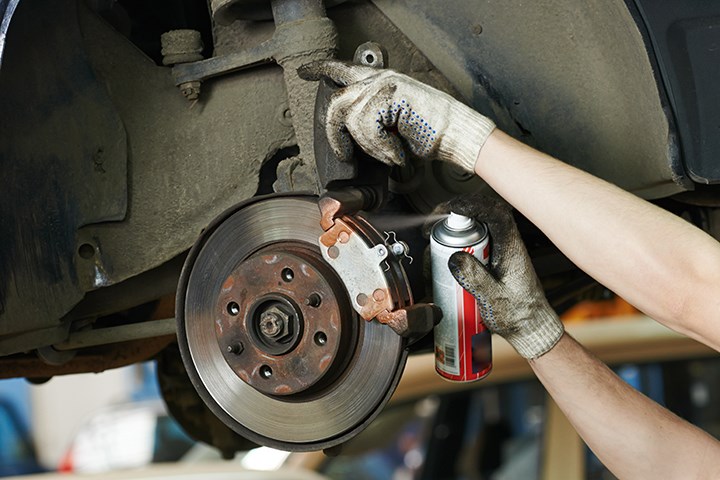
: Inboard brake
To improve the work of the suspension system in the car, the location of the wheel brake has been changed in the car. This technique is applied so that the friction brake does not use the wheel-mounted brake to perform its task as it is applied in most cars. Instead, the brakes are installed close to the differential. Moving the brakes inward reduces the unsprung weight significantly. It improves riding, handling, and braking.
By decreasing the ratio between the untransformed weight of the spring to the weight transmitted by the spring, it improves the functioning of the suspension system.
Some cars have single disc brakes inside, which operate on both rear wheels.
The internal brake system has many disadvantages in terms of maintenance, as there is a difficulty in dealing with the internal brakes compared to the external brakes on the wheels, and exposure to high heat as a result of its proximity to the exhaust pipe and poor cooling inside. As well as having problems with the brake installation.
Traction control system (TCS)
The system is also called
Acceleration slip regulation (ASR) or Automatic slip regulation (ASR). Figure 1.
 |
| Figure 1: Car wheel anti-rolling system |
Wheel slippage is that the linear velocity of the wheel axle is not equal (less) than the velocity that should be obtained by turning the wheel.
Linear velocity is less than (rotational velocity x circumference of the wheel).
Slippage is the rotation of the wheel around its axis without any displacement.
Calf slippage occurs in many cases. When driving on slippery terrain, which gives little traction to the wheels on one side of the vehicle, or on both sides. As in the case of exiting a snow-covered parking lot onto the road, walking on the edge of the road, accelerating (the car speeding up) during corners, or sudden acceleration (the engine speeds up and the foot suddenly lifts off the clutch pedal), or accelerating when the car is on the road Diagonal.
During the process of slipping (such as during the process of creep (locking the wheels)), the wheel provides minimal traction (the vehicle’s instability). Also, wheel slippage leads to tire wear and wear in transmission parts (such as differential gears), with exposure to a high sudden load when starting the linear movement of the wheel in case of contact with a high-adhesive surface during slipping.
Anti-slip system provides optimum traction for road conditions and prevents wheel slip. The ABS is an extension of the ABS, with which it shares many components and parts. As well as the force transmitted to the wheel during acceleration or braking, which is affected by the condition (slipping / creep) of the wheel on the road. Just as the closing of the wheel during braking occurs within one tenth of a second, the increase in torque at the beginning of the movement leads to a rapid increase in the speed of rotation of the wheel in one or both traction wheels.
The anti-skid system performs two tasks, which is to increase the grip while maintaining the vehicle’s stability. The system uses the brakes to reduce the rotational speed of the driving wheels in the event of a skid. In addition to the brakes, the engine management system is used to reduce the engine torque transmitted to the driving wheels.
The antilock system uses the same antilock system parts and components, and is complemented by some other parts. as in Figure 2.
 |
| Figure 2: Anti-roller system components and parts |
Components of the anti-lock wheel system:
– The wheel rotation speed sensor, which sends a signal to the electronic control unit to be able to calculate the linear speed of the wheel.
– The electronic control unit, it receives the signal of the wheel sensor, from which it calculates the slip for each wheel, and the anti-slip system intervenes when the slip in one of the wheels reaches a high degree of slipping. The incoming signal is received by 2 processors working in parallel. A signal is sent to the hydraulic control unit to activate the brakes on the sliding wheel. The unit also receives the signal of the engine management unit.
Hydraulic control unit, wheel slip action has been added to the electronic control unit to prevent wheel locking. In the event of an increase in the speed of the wheel rotation (slipping) the unit works based on the signal coming from the electronic unit to control the pressure of the brake fluid in the wheel brakes, that is, the system can brake the driving wheel without intervention from the driver.
– Parts of the hydraulic brake system and wheel brakes, the system uses brake fluid from the master cylinder and through the wheel brake cylinders, the brake pressure is controlled for the driving wheels.
– Engine Management Module:
The engine management module intervenes to reduce drivetrain torque to prevent wheel slip by:
– Delaying or disabling the spark in one or more cylinders
– Reducing or cutting fuel to one or more cylinders with an Electronic throttle control (ETC) fuel injection system
– Reducing the throttle opening in the feeder system
– Reducing the engine turbo boost in cars with a turbocharged engine.
Traction control during start-
up acceleration During acceleration at the start of the movement, the brake control system operates up to a speed of 30 km/h. When wheels lose traction at speeds above 30 km/h, the responsibility to prevent slip falls to the engine’s closed circuit control (engine management system).
Traction control in cornering
Not only does traction control work to move the car from a standstill without skidding , but during the maneuvering of a front-wheel drive car, there comes a point at which the front wheels are not able to steer and tow the car at the same time without loss. adhesion; The antilock system works to prevent this from happening and to maintain the vehicle’s steering.
Front wheels slipping in front-wheel drive vehicles while entering a curve causes the vehicles not to turn as far as the front wheel is steered (understeer)*.
Reducing engine torque leads to a reduction in vehicle speed and modification of the vehicle’s trajectory. In rear-wheel drive cars, the anti-wheel slip system can overcome (oversteer)**
* Oversteering , in which the rear of the vehicle is pushed toward the outside of the bend.
* * Under-steering, in which the front of the car pushes towards the outer side of the bend.
Electronic Stability Control (ESC):
The system is also known as the
Electronic Stability Program (ESP) and Vehicle Stability Control (VSC).
It is an evolution of ABS and TCS. The system is designed to detect the difference between control inputs from the driver and feedback from the vehicle. When it detects that there is a difference, the system intervenes by applying the brakes to the wheel with which the vehicle’s path is corrected. This system is designed to improve the vehicle’s stability, especially in sharp corners, and on roads with little contact (slippery) surfaces. And make the steering sound as desired by the driver.
The system uses many sensors and an electronic control unit to indicate the state of equilibrium and to intervene when there is a feeling of loss of balance in the car. The control unit can act to prevent the vehicle from understeering or understeering by reducing power from the engine, or applying the brakes, as in Figure 3, 4.
 |
| Figure 3: Imperfect guidance and how to overcome it by means of the system (left without the system) |
 |
| Figure 4: Over-steer and how to overcome it using the system (left without the system) |
The vehicle stability control system relies on the vehicle’s brake system as a means of steering the vehicle. Intervention by brake is directed to one of the wheels (such as the left rear wheel to overcome the problem of understeer, or the right front wheel during oversteer),
to reach the optimal goal of balance, the system not only applies the brakes but can also intervene from the engine side to accelerate the other wheels braked.
The system consists of the following parts as in Figure 5:
– Parts of the traditional brake system in the car
– Parts of the anti-locking wheels system
– Steering wheel
sensor – The car’s movement sensor around its vertical axis yaw sensor. With a lateral-acceleration sensor
 |
| Figure 5: Vehicle Stabilization System Parts |
Regenerative brake:
This system works to reduce the vehicle’s speed by converting some of the movement’s energy into electrical energy. This electrical energy is stored in the battery or a set of capacitors for its use. The system can recover approximately 25% of the vehicle’s kinetic energy during braking.
This system is used in electric cars, and hybrid cars. The energy recovered is used to charge the batteries to increase the vehicle’s operating range. The use of the system also reduces wear on the friction linings and extends the service life of the friction brakes. It increases fuel efficiency. As 30% of the fuel energy is lost to the atmosphere due to the use of friction brakes. Recycling a quarter of this waste and using it again increases fuel efficiency. Energy recovery brakes should not be confused with dynamic braking as electrical energy in a dynamic braking system is lost as heat by electrical resistances.
The energy recovery brake does not operate as an independent brake, but works with the friction brake for the following reasons:
– The efficiency of the energy recovery brake decreases rapidly with decreasing speed
The amount of energy recovered is proportional to the amount of capacity in which the energy is to be stored (the state of battery charge). Therefore, dynamic brakes or friction brakes must be used with the system to absorb the excess energy.
The amount of the recovery brake and the friction brake must be controlled to obtain the required braking force.
The energy recovery brake uses the idea that an electric motor can simultaneously act as a generator. During braking, the traction motor is connected as an electric generator during braking, and the output from it is connected to an electric load. This load on the motor is what provides the braking.
BMW has equipped a car that is not electric or hybrid with an energy recovery brake system. With the development of technology in the battery industry and the emergence of batteries with an absorbent glass mat (AGM) filling that has the ability to charge quickly without boiling, these batteries can undergo a deep charge cycle (complete discharge and charge) that acid batteries cannot bear. This battery is suitable for connection with the energy recovery brake system. The battery can be fully charged by braking, and the load on the engine can be reduced by reducing the work of the generator. This type of brake reduces weight and fuel consumption and reduces the amount of carbon dioxide emissions. This system is installed in the company’s cars with tires with low rolling resistance, electric air conditioning and electric power steering. And the energy recovery brake system without an electric motor in the car.
Adaptive Cruise Control (ACC)
The cruise control system allows the driver on the highways to adjust the speed of the car to the speed he wants, and the system works to stabilize that speed with different resistances that the car meets on the road, and when pressing the brake pedal or the clutch disconnects the system. In this system, the control was done by Throttle opening control. But the new system (Active Travel Control) works to maintain a reasonable distance between the vehicle in which it is installed and the vehicle in front of it. It uses a radar installed in the front of the car. The modern system alerts the driver if an object is 100 meters ahead, and in the event of approaching it, the system applies weak braking and warns the driver by pulling the seat belt. If the driver does not respond, the system applies force to the brakes.
The system can reduce and slow down the vehicle according to the speed and distance selected by the driver.
The system can be deactivated when the driver applies the brake pedal or clutch.
In one of the system disconnect systems, there is a pressure sensor in the master cylinder. When the pedal is pressed and the pressure inside the cylinder increases, the system disconnect switch activates.
There are no reviews yet. Be the first one to write one.