


New systems to improve the brake performance of the
New Systems to Enhance the Brake Performance
brake force distribution system Electronically
Electronic Brake-force Distribution (EBD)
is a system that works to change the amount of brake force acting on each wheel, based on the road condition, speed, load .. etc. Often combined with an ABS system, the Electronic Brake-force Distribution system can increase brake pressure on each wheel for maximum stopping power while maintaining steering control.
In cars without this system, when the brake pedal is pressed, the brake force is distributed according to the dimensions of the brake parts system (master cylinder, wheel cylinders). But in cars equipped with this system, the brake pressure is distributed to each wheel according to the road condition (the amount of traction) and the load on the wheel.
In the case of maximum straight line braking, the brakes increase the brake pressure on the front wheels over the rear wheels so that the wheels do not lock up due to part of the load being transferred from the rear wheel to the front wheel due to braking (weight transferred during braking). In the case of braking while steering in corners, the system changes the braking force from the left wheel to the right to maintain stability. It also works in the event of a difference in the coefficient of traction on the road under the wheels by distributing the braking force in proportion to the amount of adhesion present, to obtain the ideal braking.
 | |
| When braking, the load on the front axle increases, so the system increases braking force on the front axle. | When the load on the rear axle increases, the system increases braking force on the rear axle |
 |
| When the car enters a corner and when the brake is applied, the system increases the force on the outer wheels |
Braking system within the curve
Cornering Brake Control (CBC)
this system is the development and extension of the system to prevent the closure of the wheels. It distributes the brake force to the wheels during maximum braking inside a corner, so that the car remains in the same direction as desired.
Help system for emergency brake
Emergency Brake Assist (EBA)
Help system for the emergency brake is a safety drive system is designed to ensure maximum braking capability is used in case of emergency stop (immediate). By noting the speed and pressure applied to the brake pedal, the system can predict that the driver is trying to stop the vehicle immediately. In the event that the pedal is not pushed to the end of the journey, the system skips this and presses the pedal to the end of the journey, until the ABS system takes control and prevents the wheels that have been locked from being locked.
Some types of emergency brake assist system work by means of a sensor mounted on the pedal. In the event of a sudden lifting of the foot from the pedal, the system senses that there is an emergency situation, and accordingly the system works to affect a light force on the brake pedal to get rid of the pedal clearance and the brakes are ready to work when Putting the driver’s foot on the brake pedal, thus gaining a time that leads to a shortening of the stopping distance by several metres, which may be the difference between life and death, or between an accident or no accident, or a minor accident and a serious accident.
Brake Assist system
Brake Assist (BA or BAS)
is a system Ataa brake technology that increases the brake force in the case of extreme braking (emergency). The company Daimler-Benz is the first to apply this system, and as a result of the research conducted by the company, that 90% of drivers do not apply the brake pedal with the necessary force in an emergency.
The brake assist system senses emergency braking by measuring how fast the brake pedal is applied. In the event of emergency braking, the system increases the pressure to reach the maximum brake force to compensate for the driver’s pressure with the wrong force. This results in a 20% reduction in stopping distance based on some studies. Since 1988, Mercedes has made Brake Assist a standard (not optional) system on all models.
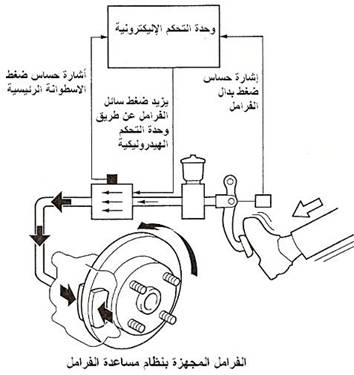 |
| How the brake assist system works |
The pressure is increased by hydraulic control, or by an electric valve located inside the servo (smart booster), which opens the air valve of the servo and rapidly increases the brake pressure with the maximum servo that the servo can provide.
Advanced
Brake Assist Plus (BAS Plus)
It is the latest technology in the field, and is the advanced design of the brake assist system. This system uses radar to calculate how close other cars are; In the event that the distance between the front and rear cars begins to decrease or the rate of decrease is high, the system will begin to warn the driver. In the event of a potential collision, the system calculates the ideal amount of brake force required to avoid that accident in a fraction of a second. And if the driver begins to put his foot on the brake pedal – even with weak pressure – the system applies the ideal force to the brakes immediately, avoiding a collision (near collision). The presence of the advanced brake assist system has been shown to significantly reduce rear-end collision accidents, and is one of the driver assistance systems to improve road safety.
The advanced brake assist system can be used with other driver assistance systems such as the Distronic plus system that automatically reduces the vehicle’s speed and stops it according to the road conditions.
Will help the brake system of the mandatory regulations that must be provided by all vehicles in Europe starting in 2009 becomes a
dynamic control system (motor) brake
Dynamic Brake Control (DSC)
in the event that the driver tries to car arrest in the case of an emergency, the system accelerates the activation Brakes to provide maximum braking in the shortest distance.
The electronic unit compares the readings of the sensors with the values stored in the memory, and activates the system if the following conditions are present
– the pressure in the master cylinder is greater than 30 bar.
Pressure increase rate greater than 6000 bar/sec
– The vehicle’s speed is more than 3 mph (about 5 km/h)
– The vehicle is not traveling in reverse
– One or more wheels are not in the state of the anti-lock system system
in the event that all of these conditions are available, the system works. The system deactivates if the vehicle speed reaches less than 3 mph or the driver takes his foot off the pedal.
The system also provides stability to the vehicle by controlling the brakes and the engine in balancing the car inside the curve. It also prevents wheel slip.
Installation of electrical brake
Electric Parking Brake
began the appearance of electrical installation brake in the automobile this century , the onset, has been used in many modern cars.
There are two basic types of electric stabilization brakes. Instead of using the mechanical method, which works by pulling the driver to the cable by means of a lever (lever). In the first type, this function is performed by an electric motor that pulls the clamping brake cable. The second, more advanced type is the use of a motor controlled by a computer unit, connected to the brake caliper to activate the clamping brake.
The system will include some other features, such as the self-locking brakes will work when the car stops, and then the brakes will release when the gas pedal starts to be pressed. The driver of the car can deactivate or activate the system.
Some cars equipped with an automatic transmission (automatic) are equipped with a locking brake release device. Later models require the brake pedal to be depressed so the transmission can be positioned from the mount to the forward or reverse select position. The reason for the modification is by adding the need to press the brake pedal before carrying out the transfer process, is to secure the car from the danger of accidentally putting the carrier in motion.
Braking system by cable
Brake by wire
brake by cable is a new way for the transfer of power from the brake to the calf instead of brake. It is what is done today through the hydraulic system, or for trucks by means of compressed air. By cable means that the method of transmitting the force will be electronic (electrical) and not mechanical.
It is the so-called x-by-wire multi-technology, which is that all car systems are allowed to operate via electronic components instead of the traditional mechanical method.
The system is also called electro-mechanical brakes (EMB), and it is easier to manufacture, maintain, and better for the environment.
A car equipped with cable brakes has a small electric motor near the wheels that creates brake pressure. The motor is controlled by electronic control units, which are connected to the brake pedal and which take the input to it by the driver.
This system has many advantages:
– It has a quick response, reduces stopping distance, and increases safety.
– Since there are no mechanical parts in the system, the cable braking system works very quietly. There is no vibration of the pedal associated with the operation of the antilock system.
– The system needs a smaller footprint, which allows car manufacturers to save on the size of the space in the front of the car.
The system has less weight than other conventional systems.
Maintenance of the system is easier, than the maintenance of other traditional systems.
There is no corrosion from brake fluid, and this reduces the negative impact on the environment.
Braking system without cable
Brake by wireless
which is the latest trend in the brake future, will brake as in the case of “brake by cable,” but with the replacement of the cable signal , such as Bluetooth technology, so that instead the brake is connected to anything is a way send the signal, the signal reaches To the electric motor when the wheel brakes, it activates the brakes. This medium will save a lot of electrical wires and cables.
This technology will be applied to all suits, steering wheels and air conditioning…. etc. There will be no contact between the cab, engine, transmission, brakes and lights. The car will consist of two parts, a lower part with the engine, transmission and wheels, and the other part is the cabin. Here, the cab can be raised from above the chassis, and a cab in another color or design can be installed. Thus, a person can have one chassis, but the car can be converted from a family car, to a sports activity car, to a small truck…… by changing the cabin only, and at a low cost!
There are no reviews yet. Be the first one to write one.