
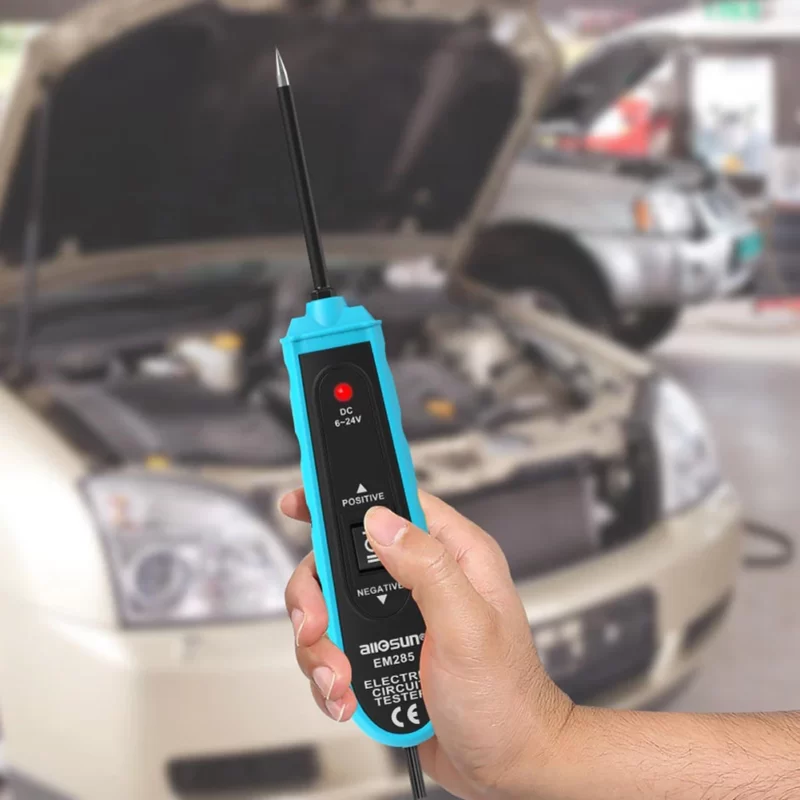

, car electrical system – battery
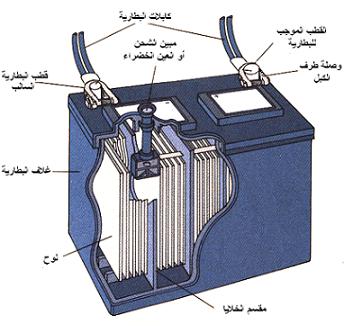
The current car battery has a plastic casing divided from the inside into cells and filled with an electrically conductive liquid of sulfuric acid called a solution. This solution reacts with the plates (metal plates containing lead) to give an electric current of 12 volts. The current passes from the positive pole of the battery through the electrical circuits of the car until it reaches the negative pole of the battery. Most of the batteries today are of the type that is tightly packed and does not require maintenance, and they have an indication of the battery charge status on the upper surface, or the so-called green eye. But batteries with covers that cover the cells are still used, and in this type the cells must be filled with the solution periodically.
Battery solution is toxic, corrosive to metals and potentially explosive. When handling, safety goggles and gloves should be used to prevent acid. To avoid explosion, do not smoke or spark near the battery. Perform regular maintenance on the battery; Corrosion around the electrodes, for example, leads to poor electrical conductivity. Change the battery if the case is broken or bulging. Do not twist or use a lever to lift the cable connections off the electrodes. If the car is left idle for 30 days or more, loosen the negative pole cable so that no battery leakage occurs.
Battery Check
 | |
| shape 2 | shape 1 |
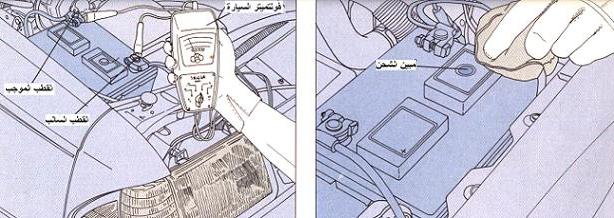
1- Reading the charging status indicator (Fig. 1):
The initial check (for the battery that does not require maintenance) is the green eye examination of the battery with the glass indicator. Clean the eye with a piece of cloth so that you can read it clearly. The eye is the visible part of the internal battery hydrometer for measuring solution concentration; Which has a green ball that floats to the top when the battery is good (more than 75% charged). If the starter is not rotating and the eye is dark, this indicates that the battery is empty. Measure it with a voltmeter step 2. A clear or yellow color indicates a low level of solution; The battery in this case needs to be replaced. For non-woven batteries with covers that can be lifted, test the solution with a manual hydrometer, adding distilled water if needed.
2- Battery measurement (Fig. 2):
First, measure the battery voltage without load. Connect the car gauge to the battery poles, the black wire to the negative (-), and the red wire to the positive (+). If the voltmeter reads less than 12 volts, charge the battery. If the meter reads 12 volts or more, perform a load test on the battery. Turn on the front high beams, the heating system and the four-wheel warning lamps for 15 seconds. Then read the meter and the lights are still on, the reading should be at least 9.5 volts; If this value is not obtained, charge the battery.
Battery charging
 |
| 3 . shape |
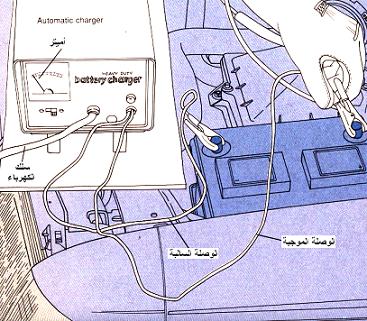
The home battery charger is designed to slowly and safely charge the battery with a charging current of 4, 6 or 10 amperes. The condition of the battery and the capacity of the charger determine the charging time of the battery, which can take from 1 hour to 24 hours. Do not charge the interlocking battery if the eye color is transparent or yellow. For charging loose batteries, make sure the surface of the solution covers the battery plates, adding distilled water if needed. Working in a well-ventilated area, disconnect the cables from the battery and connect the charger that is in the off position and not connected to the mains to the battery poles. The red wire connects to the positive (+), and the black wire to the positive (-). Then connect the charger to the mains and turn it on (Fig. 3). The charger indicator will show how much current (current in amperes) the battery is drawing. The value of the current decreases slowly in the direction of zero until the battery reaches a state of full charge. Make the charger work until the current reaches a value of 1 amp, then turn the charger to the off position, and disconnect the charger from the power source, then disconnect the charger connections to the battery, then connect the cables to the battery. The automatic charger can be left on without fear of overcharging. But for a charger that is not automatic, the charger must be disconnected if the battery is fully charged, to preserve the battery from damage or the possibility of an explosion. Battery
replacement
 Figure 4 Figure 5 Figure 6 Figure 4 Figure 5 Figure 6 |
Disconnect the negative (-), then the positive (+) electrode. Using a bead wrench, loosen the threading of the metallic battery retainer bolt as shown in Figure 4 or the lower battery retainer attachment bolt as shown in Figure 5; If there is rust that prevents the screw from loosening, add a little rust removal oil and try again after a few minutes. Loosen the nut and then the upper fastener or lift the lower fastener. In the event that there is a place that allows, insert the hands under the battery and raise them as shown in Figure 6, or raise them from the edge at the corner where they are the most bearable places. Wash the battery bottom and battery holder with a solution of alkaline soda carbonate before installing the battery again. Install the battery attachment device in the car so that it is securely secured by hand, tight installation may lead to breaking the battery wall, and light installation may lead to wear as a result of friction with the parts in contact with it.
Connecting a car battery to another car battery to manage the idled car engine (common)
 | ||
| figure 8 | 7 . shape |
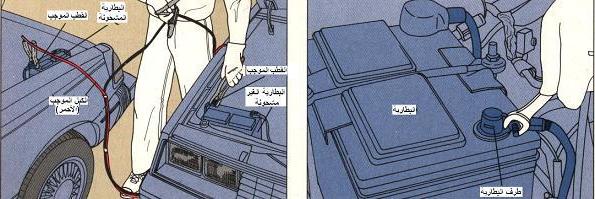
1- Ensure that the battery poles are well connected (Fig. 7):
If the starter does not work or there is difficulty in rotating the engine when starting the drive, first make sure that the car is not running out of fuel.
Tighten the hold brake or put the transmission in the hold position for automatic vehicles. Lift the hood to check the vehicle’s cables and poles.
Warning: Use safety glasses and gloves and do not smoke when handling the battery . I use a brush to clean the battery electrodes and connections. Be sure to connect the cables to the battery terminals with a wrench, be careful not to overtighten. Retry starting the engine. If the problem persists, connect the battery to another battery.
2- Connecting the positive pole of the subscriber cable (Fig. 8):
Make sure in the instruction book that your car can be connected to the subscriber. And make sure that the connection with a similar battery is the same voltage value. Place the front cars in front or side by side without touching them. Disable the ignition of the engine and all accessories attached to the two cars. Apply the hold brake for both cars, put the car into the hold position for the automatic transmission, or set the neutral for the standard transmission. Identify the positive pole for both cars, usually the larger pole, or there is a “+” sign or the word POS or there is a red ring under the pole. Connect the red cable to both positive car cables.
 | |
| 10 . shape | 9 . shape |
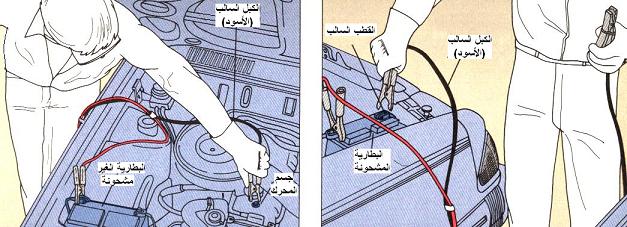
3- Connecting the negative pole of the common cable (Fig. 9):
Connect one end of the cable, which is often black, to the negative pole of the car with the charged battery (the pole of smaller diameter or marked with “-” or the word NEG. Now make sure that there is no wrong connection in the Connecting cables, which may damage both chargers in the two cars or may cause injury to the person conducting the connection. The red cable must be connected to the positive pole “+” of the charged battery to the positive pole “+” of the uncharged battery, and then one of the ends of the black cable to the negative pole. For the charged battery.
4- Charging the battery (Fig. 10):
Connect the loosening of the other black negative cable, about 30 cm away, to a place well connected to the ground of the car. An unpainted screw on the engine body or chassis.
Warning: Do not connect the negative cable to the negative pole of an uncharged battery, charger, or any electrical part . Run the engine of the charged car and slowly increase the rpm, then start the engine of the other car. Lift the cables in reverse order of connection (disconnect the black negative cable from the car with the uncharged battery, then the black negative cable from the car with the charged battery, then the red positive cable from the car with the uncharged battery, then the red positive cable from the car with the charged battery).
Warning: When making the connection, be careful not to touch the ends of the red and black cables, as well as from touching the ends of the red cable to any of the two bodies of the car, as this may lead to a spark that leads to the battery being discharged and injuring the conductor of the connection process.
There are no reviews yet. Be the first one to write one.