
checking and adjusting the brake pedal Checking and Adjustment of Brake Pedal
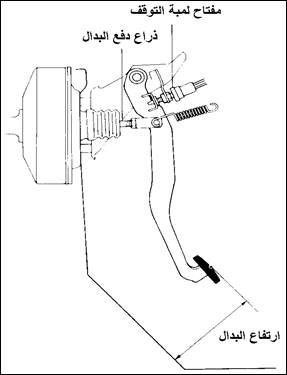
The pedal plays a large role in the performance and operation of the brakes. It must be at a specific height. In the event that it is in a high position, this requires a longer time to press the pedal, and the sensitivity of the pedal is high.
In the event that the height of the pedal is low, this will not allow the presence of a sufficient remaining distance to complete the pedal’s journey that leads to the completion of the braking force. Figure (1) shows the height of the pedal. The pedal must also have a free distance, because without this distance, the piston of the master cylinder may not be able to complete the return journey when lifting the foot from the pedal, which leads to continuous loading of the brakes as a result of the hydraulic pressure in the cylinder.
Also, there must be a sufficient remaining distance (the distance left to the pedal) when pressing the brakes, as the remaining distance leads to a long pedal travel and delays the brakes.
 |
| Figure 1: The height of the pedal |
Checking and adjusting the height of the pedal
1- Checking the height of the pedal:
Lift the extra carpet from under the brake pedal (the pedal ), and measure the distance between the upper surface of the pedal and the floor of the car, Figure (2). Compare the measured height with the vehicle’s specifications. If the specifications do not match, adjust the height of the pedal.
 |
| Figure (2): Checking the height of the pedal |
2- Adjust the height of the pedal:
A- Disconnect the wire harness (1) from the stop lamp switch (2).
B – Undo the locking nut (3) and turn the stop lamp wrench outward a few turns.
c- Loosen the tightening nut (4) of the thrust arm (5) and adjust the height of the pedal by turning the thrust lever in Figure (3).
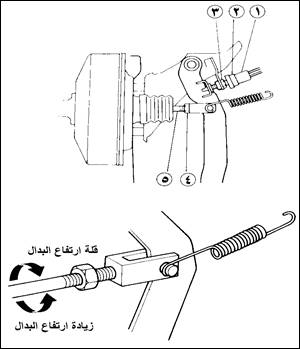 |
| Figure (3): Adjusting the height of the pedal |
D- Turn the stop lamp switch so that the pedal movement limiter touches the loading plate, then tighten the tightening nut (Fig. 4).
 |
| Figure (4): Tighten the tightening nut |
e- Connect the wiring harness to the stop light switch.
F- The correct way to install the stop lamp switch with the pedal in Figure (5).
 |
| Figure (5): Installing the stop lamp switch with the pedal |
Check and
adjust the pedal free distance After adjusting the pedal height, check and adjust the pedal free distance.
1- Checking the free space of the pedal:
a- After stopping the engine, get rid of the looseness in the servo by pressing the pedal several times so that you do not see any change in the distance left to the pedal when pressing with the same force.
B – Press the pedal with your finger until you feel the resistance, then measure the distance that the pedal moves as a result of this pressure (the free distance of the pedal) as in Figure (6).
 |
| Figure (6): Checking the free space of the pedal |
Compare the measured free distance with the vehicle’s specifications. If it does not match the specifications, adjust the free distance to the pedal.
2- Adjusting the free distance of the pedal
a- Loosen the coupling nut (4) of the master cylinder thrust lever (5), adjust by turning the thrust lever.
B – Tighten the bolt and measure the free distance again.
C – After adjusting the free distance of the pedal, check the height of the pedal and make the switch for the stop warning lamp.
3- Check the pedal clearance
a- Put a stabilizer behind the front and rear wheels of the car, release the retaining brake and start the engine.
B – Press the pedal with a force of 490 Newtons (50 kg), pressure with a high force above the medium, and measure the distance between the pedal surface and the floor of the car, Figure (7).
 |
| Figure (7): Checking the space left for the pedal |
In the event that the distance left is less than the specification, this could be caused by the presence of too much clearance between the brake shoes and the circuit, the free distance of the pedal is in the range of (3-6) mm.
c- Adjust the shoe clearance.
| CAUTION: Adjusting the clearance of shoes varies from one car to another, as well as according to the type of brakes, according to the specifications of the car. |
Test the operation of the parking lights
Make sure that the rear warning lights come on when the brake pedal is depressed and turn off when the foot is removed from the pedal, Figure (8).
 |
| Figure (8): Stop lights work test |
Brake system check Brake Inspection Check-list
Friction lining:
1. There should be no significant wear on the friction lining. The thickness of the glued bushings should not be less than (0.8 mm), while the rivet bushings should be of sufficient thickness so that the rivet head is not visible.
2. The lining must not be polished or have cracks, and there must be no indication that it is separated from the metal part in which it is installed.
3. It should not have traces of contamination with grease or brake fluid.
Wheel cylinders
1. There should be no trace of leakage (push the dust guard back to detect external leakage in the cylinder).
2. The movement of the piston inside the cylinder should be smooth.
Circuit (hoops/cylinders)
1. There should be no cracks, dents, or change in its rotation (oval).
2. Sofa oil should not have any traces of damage or leakage.
3. Pomegranate bearings for the calf must not have any traces of wear or roughness, and they must be sound and lubricated.
Hinged brakes:
1. There should be no change in the color or shape of the springs/locking springs or the tension springs.
2. The self-adjusting system must be working in good condition.
3. The clearance between the shoes and the circuit must be equal at both ends in order to obtain equal braking for all wheels at the same time.
Brake fittings/tubes
1. There should be no traces of leakage or dripping.
2. There should be no traces of damage to the cylinders.
3. Brake tubes shall be free from rust or corrosion.
4. Be careful not to bend or break the brake tubes and fittings during the installation process.
Brake wire(s)
1. The movement of the cables/wires must be smooth inside their case.
2. It should not have folds or tears.
Control valves
1. There should be no appearance of leakage.
2. It must be well fixed in its places.
Master cylinder
1. The level of brake fluid in the reservoir must be within the permissible limits.
2. There should be no apparent leakage.
3. The brake fluid reservoir cap must be in good condition.
There are no reviews yet. Be the first one to write one.