

 |  |
 |
Axles:
The axle is what connects the wheel to the rest of the car or truck. The axles of the driving wheels send power to the wheels from the transmission. Non-driving wheel hubs allow the wheels to simply rotate around the axle. Since the weight of the car rests on the wheels, the axles have an important job to do to carry the weight. For this reason, some heavy trucks (dump trucks and semis) have three or more axles. Passenger cars have two axles – one in the front and one in the rear. In general, the axles are divided into a right axle and a left axle, which are connected together (in the case of the driving axles) by means of a differential gearbox in the middle of the car. Depending on the vehicle whether it is a front-wheel drive, rear-wheel drive, or four-wheel drive, and the type of suspension axle, these axles may be: a constant velocity axle known as CV axle, or a half-shaft shaft, or solid-shaft, which may also be known as beam axle. The solid shaft that transmits power to the wheel is called a live axle.
Definition of the term axle:
In cars and trucks, the shaft that rotates with the wheel, is either bolted or has a shaft splined with the wheel and rotates with it, it is called the axle or axle shaft.
Vehicle axles:
A wheel hub is a major component of a vehicle. In a live-axle system, the axle transmits drive torque to the wheels, while maintaining the relative position of the wheels with each other and with the body of the vehicle. In this system, the axle carries the weight of the vehicle plus the weight of the load. A non-driving axle, such as the front beam axle on heavy trucks and some two-wheel drive vehicles for light trucks, has no front axle and the shaft serves only for suspension, steering, and weight bearing. Conversely, many front-wheel drive cars have a dead rear axle.
In some other types of suspension, the axle is used to transmit torque to the wheels. This is found in virtually all independent suspension cars found in modern cars, SUVs, and many in the front of light trucks. It can connect to the vehicle or the chassis, or be part of the transmission and axle assembly. The axle shaft (usually a type of constant velocity shaft) transmits drive torque to the wheels. Like in the case of the full floating axle system, the driveshaft in the front wheels of the independent suspension system does not carry any of the vehicle’s weight. 
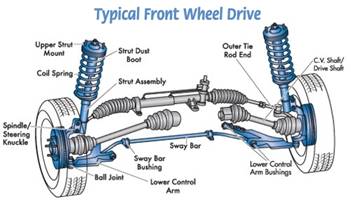
An axle is defined as a pivoting shaft for rotating a wheel or gear. In wheeled vehicles, the axle may be installed in the wheel, and rotate with it, or it may be fixed in the car, and the wheels rotate around it. In the first case, bearings or bushings are provided at the connection points where the axle is installed. In the latter case, there are ball bearings or bushings inside the wheel hub to allow the wheel to rotate around the axle. The last type of axle is called a spindle.
- Drive axle:
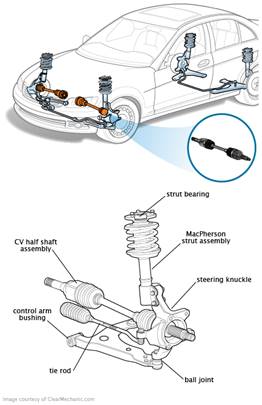
The axle of the car, which is driven by the engine, is called the drive axle. The drive axle is a split axle with a differential gearbox between the half axles.
In cars (front-wheel drive and rear independent suspension) each half-axle is connected to the wheel using a constant velocity joint. These allow the wheel assembly to move freely in the vertical direction as well as spin when entering a turn. Modern front-wheel drive vehicles typically have a combined transmission and front axle in a single unit known as the transaxle.
In rear-wheel drive vehicles, power is transmitted from the engine via the power train to the rear axle. The car axle in this case is called a live axle. Most modern cars usually use a split axle with a differential.
In a more comprehensive definition of the axle, it goes back to its definition with respect to the wheels parallel to the side of the car, without taking into account the mechanical method of their connection with the chassis or the car body. Thus, the wheels opposite the side of the car for an independent suspension system can be known as axles as well. This expression is used in toll roads or vehicle taxes from which the vehicle’s overall weight-capacity is calculated, and its effect on the road.
- Solid axles:
Solid/hard axles actually connect the right wheel to the left wheel. It usually works as a single unit and consists of two shafts connected at the differential. In this system, the two wheels work together as one unit. In the event of a bump or bump in the road causing the wheel to move, the other wheel will move in response to the movement of the other wheel. This may cause the wheel to lift off the road surface.
The advantage of solid axes is their tenacity. Durable and easy to manufacture. That is why manufacturers use it in off-road applications. Jeeps have historically used solid hubs at the front and rear. As it has a high load-bearing capacity, it is commonly used in trucks.
The solid axle that transmits power to the wheel is called a live axle. By comparison, an axle that allows the wheel to spin freely is called a dead axle. Some front-wheel drive models use a dead axle in the rear. One of the advantages of the live rear axle is that it is durable and can get high power. So even though many models switched to an independent suspension, many Ford Mustangs still insist on using the solid axle.
Solid axle may be semi-floating or full-floating. In a semi-floating design, the weight of the vehicle rests on the wheel and axle. Most cars and light trucks use a semi-floating axle. In the fully floating design, the axle housing bears the weight of the vehicle, not the axle itself. The fully floating axle is mostly used by heavy trucks.
- CV axles:
Although not as durable as solid axles, they have the advantage of allowing the wheels to move independently of each other. It is usually used on the front wheels as it improves steering and handling. Those hubs are an important part of the independent suspension. Each half-shaft can move up and down on its own under the influence of bumps and bumps in the road and under the influence of suspension. This improves handling compared to the case where the two wheels are rigidly connected together. In this case, it will not lead to the case of lifting a wheel from the ground, as it is more important for the driving front wheels, since the thrust and steering are done by the same wheel.
In front-wheel drive vehicles, the CV axle transfers power from the transmission and differential to the wheels. Transferring all the rotational power the driving axles carry high torque stress. The fixed speed joint hub has two CV joints, one on each end. These allow the axle where necessary to steer, suspend and transfer power through the half shaft at a constant speed. In recent years, many cars with independent suspension in the rear use fixed-speed axles in the rear as well.
- Straight axle: The
wheels of trains are attached to a straight axle, so that both wheels rotate together, which is called wheelset.

- Straight axle:
It is a solid pillar that connects the wheel in Yemen to the wheel in the north of the vehicle. This design keeps the position of the calf stable under the influence of high stresses, which can carry high loads. The straight axle is used on train wheels, and on the rear axle of commercial trucks. The shaft may be protected by surrounding it with an empty housing.

- Split-axle:
In the split-axle design, the wheels on each side are connected to a separate shaft. Modern cars have split steering columns. In some designs, these allow for an independent suspension for the left and right wheels, resulting in a comfortable ride. Even when the suspension is not independent, the split axles allow the use of a differential, which allows the left and right wheels to be driven at different speeds when the vehicle is turning, improving traction and increasing tire life.

- Half shaft:
It’s basically a drive axle, so named because it does half the work, running from the transmission and the transaxle to the wheels. Half of the column on the other hand completes the set. 

- Tandem axle:
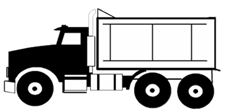
It is a group of two or more axes (3 triaxle) located close to each other. Truck design uses such a structure to provide more weight capacity than a single axle setup. Semi-trailers usually have a tandem axle at the rear. 

- Beam axle:
Also known as a rigid axle, or a solid axle, a solid axle is a dependent suspension design, to which a group of wheels are connected horizontally by a single beam or shaft. This type was commonly used in the rear axle of cars, and is also used in the front wheel “steer axle” in rear wheel drive cars.

- Dead axle (lazy axle):

It may be called the driven axle. It is not part of the drivetrain but instead the non-driving axle. The rear axle of a rear wheel drive vehicle is usually a dead axle. Many trucks and trailers use dead axles for the purpose of carrying cargo. The dead axle that is directly in front of the driving axle is called the pusher axle. The dead axle that is directly in front of the driving axle is called the pusher axle. The trailing axle tag axle is a dead axle located after the leading axle. Dead axle is also found in semi-trailers, agricultural equipment, and some heavy construction equipment. In some designs the lagging axis may be steerable. In some designs, wheels on a lazy axle contact the ground when the load is high, providing undue tire wear. Many trucks use this type of axle to increase payload.
 |  | |
| Airlift pusher axle | 1- Front Steering Axle 2- Pusher Lift Axle 3- Tandem Axle Group 4- Tag Lift Axle | Steer axle, drive axles, tandem axles |
- Live axle:
It is a shaft that provides motors with thrust – and transmits the power generated from the engine through the transmission/power line to the driving wheels of the vehicle.


- Lift axle:
Some dump trucks and trailers are outfitted with a raised axle (also known as an airlift axle or drop axle), which may be raised and lowered mechanically. The axle is lowered to increase weight capacity, or to distribute the weight of the load on more wheels, for example over a bridge with a limited load on wheels. When not needed, it is raised from the ground to prevent tire and axle wear, and to increase traction and traction for the remaining wheels. Axle lift reduces auxiliary axle lateral friction when cornering, allowing the vehicle to turn smoothly. Some manufacturers provide a computer controlled axle lift in the air, whereby the dead axle is automatically lowered when the load on the main axle reaches the permissible weight limit. And with the possibility of raising the axle by pressing a button when needed, to improve maneuverability. Early on, the axle was lifted mechanically.
 |
Drive shafts:
§ Drive axle:
§ Front drive axle: The
axle that rotates by the motor or the main thruster is called the driving axis. Modern front wheel drive cars actually assemble the transmission (gearbox and differential) and front axle into a single unit called the transaxle. The driving axle is a split axle with a differential and universal joints between the half axle. Each half axle is connected to a wheel by the use of a constant velocity (CV) joint which allows the wheel assembly to move freely in the main direction and to act as a pivot when turning.
The drive shaft connects the front and rear wheels to the independent suspension system. In most cases the columns are of equal length, usually 20-25 mm in diameter, of nickel-chromium steel. But with a transversely mounted engine-transaxle unit, unequal lengths are required. The longer shaft may be some or all of a tube having a larger diameter to equal the torsional rigidity and vibrational properties with the shorter unvacuated shaft.
- Rear drive axle:
In rear wheel drive cars and trucks, the engine via a gearbox drives a shaft (also called a propeller shaft or tail shaft) driveshaft that transmits rotational force to the rear driving axle of the vehicle. The driving axle may be a live axle, but modern rear-wheel drive cars generally use a split axle with a differential. In this case, the half-axle or half-shaft connects the crankshaft case to the left rear wheel, and another half-shaft does the same to the right rear wheel. Thus, the halves of the axles and the differential form the rear axle.


Rear axle construction:
In the case of non-independent suspension, the type of axle used is dead axle or live axle. The former bears the weight of the car, while the latter does that job. In addition, it contains a set of gears and shafts to drive the wheels.
§ Axle shaft:
or called half shaft transmits motion from the differential sun wheel to the rear wheel hub.
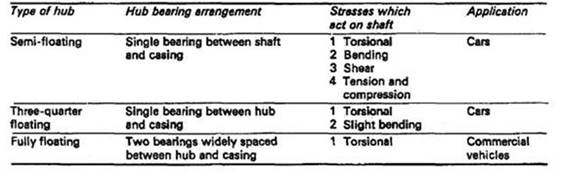
The different types of axes can be compared taking into account the stresses that the shaft bears.
Half of the shaft is subjected to the following stresses:
1- Torsional stress caused by thrust and brake torques.
2- Shear stress caused by the weight of the car.
3- bending stress caused by the weight of the car.
4- tensile and compressive stress resulting from bending force.
Types of axle shaft:
In addition to properties related to their general mounting, rear drive axles are categorized into three groups depending on the type of bearing mounting used to support the hubs. The three types are classified as follows:
§ Semi-floating axle
§ Three-quarter floating
§ Full floating
- Semi-floating axles:
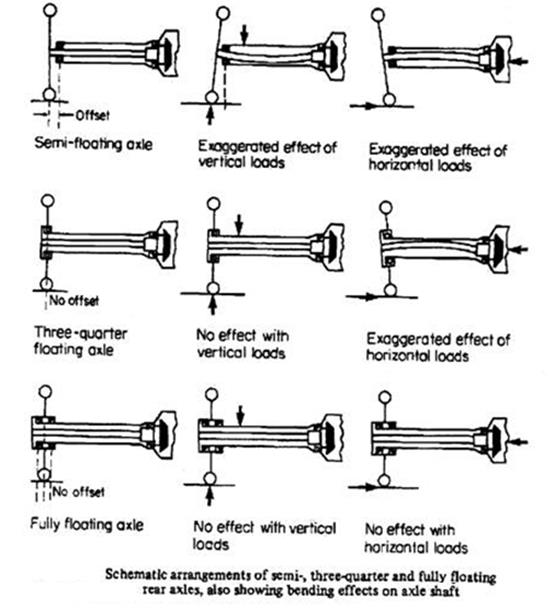
It has one bearing at the end of the hub between the shaft and the casing, and in it the shaft resists all stresses (shear, bending, torsional). In this combination, if the shaft is broken, the driving wheel will come out of the shaft blank.
- Three-quarter floating axles:
In this combination the only bearings are located between the hub and outside the shaft blank. This removes the shear and bending loads caused by the car’s weight from the shaft, but it is still subject to the bending load due to lateral thrust during cornering, as well as torque. If the shaft is broken, the wheel will remain in place and clamped but the lateral forces will cause the wheel that is attached to it to sway on the bearing.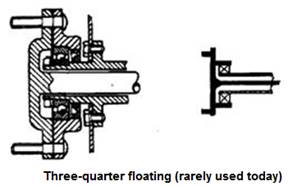
- Fully floating axles:
This shaft assembly is supported by double taper-roller bearings mounted on the outside of the shaft. In this combination, the axle shaft transmits only torque. In the event of breaking or pulling the axle, this will not affect the wheel, as the axle is installed at its end with the wheel hub and the wheel is installed on the shaft blank by means of a ball bearing, and the damaged car can be dragged to the maintenance workshop to replace the shaft. This type is often used in heavy vehicles. The floating axle can be identified by the large outward hub at the end of the shaft. These axes can carry more weight than other axles.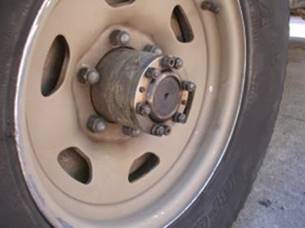

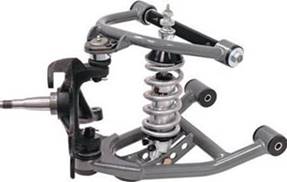
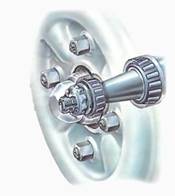
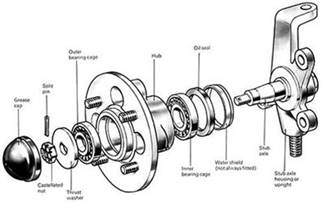
- Spindle:
In a car, the rotating shaft is part of the suspension system that bears the image of a wheel hub and communicates with the lower and upper arms of the control arms. The shaft is called upright in British cars and countries that use British cars such as Australia, New Zealand…etc.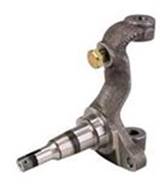
- dropped axle:
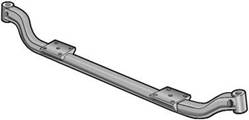
The axle of the car is curved upwards at both ends, and thus results in a lower ‘dropped’ middle part. This has two advantages: it lowers the body’s center of gravity, relative to the wheels, which improves stability; Secondly, a large diameter wheel can be used, which provides a comfortable ride on unpaved terrain. 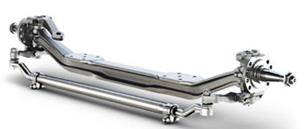
Hub reduction axle:
The driving axle on trucks and military vehicles (rear-wheel drive vehicles) provides a final gear reduction from the propeller shaft before it is transferred to the wheel. This is usually done by means of a pinion gear and crown wheel. Depending on the number of teeth of the pinion gear and the crown gear, the speed may usually be reduced from 3 to 7 times. This is known as single reduction (all gear reductions are achieved when the bezels are engaged with the crown gear). This is sufficient in cars and trucks with low engine revs, but it can mean an increase in the diameter of the crown gear and the half shafts that drive the wheels to carry the torque transmitted*.
If a smaller crown is required (to increase ground clearance) another reduction gear is used in the drive hub. In the event that this reduction is 3:1, for example, half of the axles/shafts will carry one third of the torque transmitted (in the absence of wheel thrust reduction) which therefore means axle less in dimensions and weight. The crown gear can be smaller, resulting in improved ground clearance. In some military applications that require a significant increase in ground clearance, the hub reduction assembly can provide a distance between the shaft and the center of the wheel, thus raising the axle higher. This is called the portal axle. 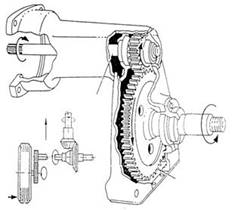
- Portal axle:
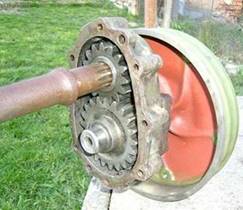
A gate hub (or portal gear) is an off-road technology where the axle tube is empty over the wheel hub where the hub is lowered. These give two advantages: Increased ground clearance, especially under differential, reduction allows the shaft to transmit the same power but with reduced torque (increased shaft speed). This reduces the load on the shaft and the crown by differential.
The gate axle is sometimes called the drop gear or drop gear set combination (although similar to the term dropped axle, it has the opposite effect).
Compared to a normal setup, the gate axle gives the car an increase in ground clearance, relative to axle and differential clearance.
Due to the reduction in the gear reduction in the wheel, this leads to a reduction in the torque transmitted to all parts and components of the drivetrain, and therefore the differential casing can be reduced, which also increases the ground clearance. In addition, all transmission components, particularly the transfer gearbox and drive-shafts, can be made lighter. This lowers the center of gravity with respect to the given ground clearance.
However, this required a more complex and rigid hub assembly, as this system could increase the unsprung weight and require a more robust control assembly for easy handling. In addition, at higher speeds the assembly can overheat.
*This wheel reduction differs from the so-called double reduction found in the differential/differential for heavy vehicles (the system allows the use of a smaller crown gear (first reduction), as well as the second reduction (which may be a planetary double set). -reduction gearing or spur gear set.

There are no reviews yet. Be the first one to write one.