
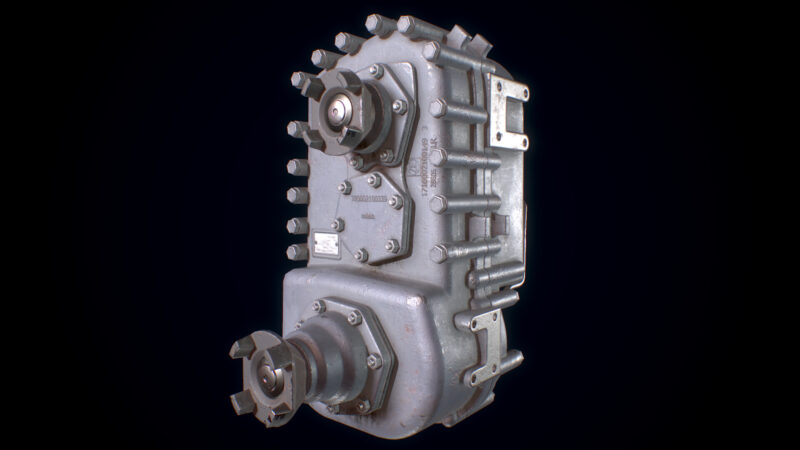
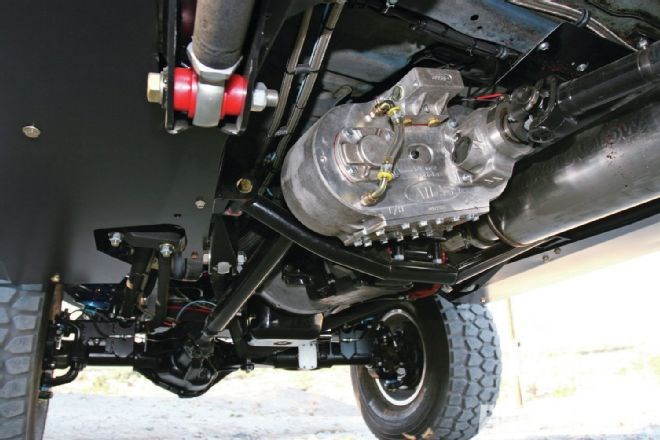
Additional gearbox/ Stitching box (transfer case ) Transfer case

Transfer case : The transfer case
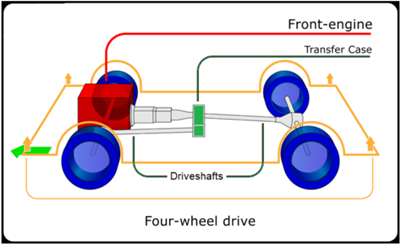
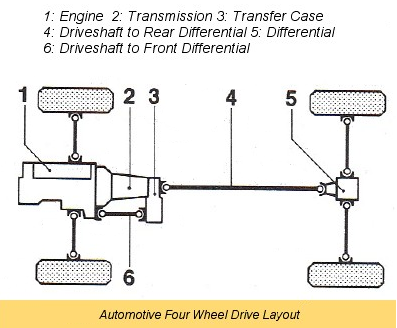
is part of the drivetrain, which is a gearbox that splits power between two separate shafts in a four-wheel-drive and all -wheel-drive system. drive , and other cars with multiple payment axes multiple powered . The transmission case transmits power from the transmission to the front and rear axles via drive shafts . They also match the speed of rotation of the front and rear wheels, and can have one or more low range gears.Commonly called dual-range transfer cases – which make the vehicle capable of off-roading . As the first gear with a normal gearbox is not enough in off-road situations.
Packet switching switch that is where the mode of payment binary two-wheel drive and four – wheel drive four-wheel drive cars that have that property. On many part-time 4WD vehicles , the transfer case transfers power from the full-time rear-wheel-drive assembly. to the front wheels. Depending on the type of car, the driver switches between two-wheel drive and four-wheel drive by means of either a mechanical lever, usually located on the floor of the car, or an electric switch that activates the electromagnetic or vacuum clutch located inside the transfer case. Some cars automatically/automatically switch between four-wheel drive if a skid is detected.

Transfer Case Functions :
- The transfer case gets power from the gearbox and sends it to both the front and rear axles. This can be done with gears , hydraulics , or chain drive . In some vehicles, such as four-wheel drive trucks or off-road vehicles, this feature can be controlled by the driver. The driver can put the transfer case in two-wheel-drive or four-wheel-drive mode . This can be done via the shifter , similar to that of a manual transmission . In some cars this can be achieved electronically via a key. In the cases of sports cars SUV All-wheel drive, with transfer cases whose gears cannot be selected. Like a permanently locked transmission in all-wheel drive mode.
- Designed transport boxes to allow for use on normal roads doing coincided with the front and rear wheels spin, the same way that you make the difference gear box differential on a particular axis. This is necessary because the front and rear tires do not rotate at the same speed. Different rates of tire rotation may be due to different tire diameters (as front and rear tires usually have a different rate of wear), and there is a different percentage of reduction in the front and rear as manufacturers usually make a small change in the ratio of the front to the rear to help with Control (eg 3.55:1 in the rear differential and 3.54:1 in the front differential). If the transmission case does not compensate between the revs, the transfer case will be damaged.

- A transfer case designed for off-road use can lock the front and rear axles together when needed (eg when one axle is on a slippery surface, or stuck in mud, and when the rest of the wheels have better grip). This is similar to the differential lock .
- The transfer case may contain one or more sets of low range gears for off-road use . The low-range gears are engaged via a shifter lever , or an electronic switch . In many transfer cases, the driver himself chooses to operate 2WD or 4WD . This feature is not present in all-wheel-drive cars . Some large cars or the like, have more than one set of discounts.
Methods of operating the Drive Type :
There are two different types internal mechanism found in most transport cans.
- Payment Geared Gear- the drive :
The transmission case used for gears uses a group of gears to operate any of the front drive shafts or both front and rear. It is usually a strong, heavy unit used in large trucks, but there are several units of gearboxes currently used in passenger cars.
- Payment Paljnzir Chain- driven for :
Transfer boxes usually use a chain to drive one axle, but can drive both axles. These cases are quieter and lighter than those driven by gears. It is used in pickup trucks, jeeps, and SUVs .

Empty Type Housing Type :
empty transport boxes are classified as separate / independent Kavargh divorced / independent or mating Married .
- Married type :
Mating type connects directly with the gearbox Transmission , usually between the gearbox output shaft and the rear end of the column of the main payment. In some cases this type is an integral part of the gearbox and the two components share the same blank.

- Divorced/independent type :
This type is completely separate from the gearbox. The transfer case is located in the power transmission line beyond the mating type and is connected to the gearbox via a short shaft connected to the output of the gearbox. This type of transfer case is used in vehicles that have a large wheelbase vehicle , such as trucks and military vehicles.
Mode of transport in the transport tray (types of transport boxes) Transfer Case the shift Types :
used transport box cars partial use of part-time cars traction drive for off – road the four-wheel drive the drive Off- at this point Vehicles , which allows the driver to choose bilateral and SUV, in addition to transportation low and high. The types used in SUV sports cars and performance cars are not visible to the driver as there is no selector lever in them.
- Of Transport Manual cans Manual Shift On-the-Fly MSOF her arm choice in high transport floor of the car next to the driver ‘s driver’s side floor transmission hump and can be done either two hub closed locking hubs self – front or two axis traverse manually choose “to close the LOCK is ” or “ UNLOCK ” or “ FREE ”.
To engage the four-wheel-drive system , the vehicle must be traveling at a low speed. This is only for the four-wheel-drive high setting . To engage the car in four-wheel-drive low , the car must be stationary and the gearbox must be neutral , then the four-wheel drive low gear is selected.


- Transport cans of transport FREE the Electronic . On the Shift-The-Fly , have a key to choose the dashboard or button controls the hub lock or self – Flanjh pay the drive Flanges . Unlike the manual case, this system contains a transfer case motor .
 |  |
| An encoder motor is an electric motor that is used to convert a transfer case from high gear to low gear. |
Gears / tray Aldfranc Central / Third Center (3rd) , Differential :
aregears Vrgih (third) and often pack ride inSUV the four-wheel drive the drive (4wd) . It is located in the middle between the front axle and the rear axle, it is often found in an extension of the gearbox, and is located in the transfer case . It splits the thrust 50/50 to the front and rear axle without damage to the transmission system parts. It allows for full-time operation on dry pavementWithout participation from the transmission line. The center differential is similar only in that it splits power between the front and rear axle. Under normal driving conditions, all wheels have power and allows you to make tight turns with the four-wheel drive without any problems between the two axles, with different speeds.
In addition to taking into account the difference in axle speeds due to ripples in the terrain and cornering, it allows for any difference in the turning diameter of the tires for each axle. The differential can be any of the known types including Limited Slip LSD , which controls the distribution of thrust between the axles. The center diffuser often has a differential lock to overcome the complete loss of traction in the event that one of the wheels of one of the axles slipped. The differentials between the axles are often a torque-proportioning diff .
Aldfranc CSS Locking differentials :
Aldfranc average good on dry surfaces dry the Pavement , but it may negatively affect the performance of surfaces with interproximal little. Measures used to combat this include the central diffuser lock , some mechanical limited-slip system ( LSD) or ABS-based four-wheel traction control .
- The center differential control allows the driver to lock the front and rear axle together – as if there was no differential – either manually or by pressing a button. The 50/50 power distribution works as standard, and in part-time 4WD, it is effective in low grip conditions.
- Limited Slip Control ( LSD) uses technology similar to that used in the rear differential, with self-propelled clutches in the center differential and both axles so that power can be directed to any of the four wheels. All all-wheel drive systems direct power in this way, but actually transfer power between the front and rear axles, not from side to side.
- Traction control traction control based on traction control for four wheels to achieve the same end by observing the calf rotation and apply the brake to any of the wheels that spin without movement Spinning Wheels . Power goes automatically to the wheels that have contact.
Center differential . types of gearboxes
- Differential Open Central Open center differential
The system divides the torque input into two output torques (front axle and rear axle) and allows them to rotate at different speeds. But the open differential can reduce the difference in speed between the axles, and the torque is free to follow the path that has the least resistance.
(+) It is simple and cheap (-) It has limited control over torque distribution. Available in: Jeep Grand Cherokee Laredo, Mercedes-Benz G-class
- Limited Slip Differential Central Limited-slip center differential
This type of passive center differential (interacts with torque at the wheel or at the engine) directs the torque to the axle with greater contact. Through sensors and actuators, it can change the ratio of the torque distribution of the front axle to the rear axle, and it comes in different designs:
- Viscous center differential
This limited-slip differential connects the front and rear driveshafts by means of a set of discs soaked in synthetic fluid inside a knitted case. When the wheel slips, the speed of one of the shafts increases dramatically, which changes the properties of the fluid, which leads to the two shafts rotating at close speed.
(+) Inexpensive, light weight, easy to operate (-) Needs wheel slip to provide locking force. Available with: Subaru WRX and Crosstrek with manual transmission
- Differential medial spiral Helical center differential
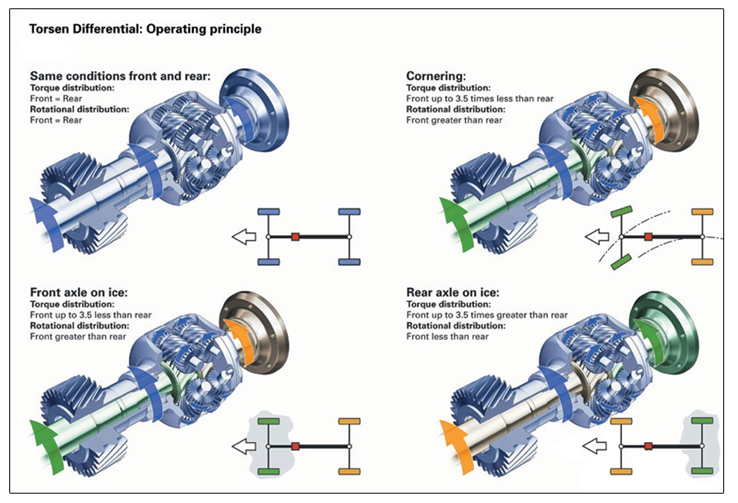
This type of limited-slip differential, called a Torsen , is more complex. It uses a range of planetary-gear arrangements that have helical teeth that apply pressure to friction discs to reduce wheel slip and adjust torque distribution. The differential is designed to distribute different torques forward according to the gear ratio to drive the front and rear axle.
(+) Reacts to the torque change from both the motor and the sliding wheel (-) It cannot be adjusted – the closing value depends on the gear angle, the torque acting, and the resistance at the wheel to act the lock. Available in: Audi A8, Bentley Continental GT, Land Rover Range Rover Sport

- Differential Central with a specific electronic control slip Electronically controlled limited-slip center differential
It operates similarly to a negative differential, and uses hydraulic or electric (or both) actuators to operate/activate the clutch that reduces slip between the shafts. The advantage here is the ability to operate without depending on engine torque or friction from the wheels. Through a set of sensors and control from the computer, it is possible to provide an integrated range of work from full opening to complete closing according to operating conditions.
(+) Can be fine-tuned (-) Complicated, expensive. Available in: Subaru WRX STI

- Arrived / WEDDING when / Custom On-demand coupling
All previous systems talk about systems that drive four wheels all the time. This type uses a different method, where it initially pushes one axle until the other axle is connected to help. The clutch assembly is used here in addition to the dog gears . Often the unit is located in front of the secondary axle and gradually increases the axle assist as needed.
(+) Improves efficiency compared to full-time four-wheel drive systems (-) Not full-time four-wheel drive. Available with: Mazda CX-5, Volkswagen Golf R

- Links / WEDDING double rear axle when / Custom On-demand twin rear-axle couplings
This type has clutch assembly for the left and right rear axles, the rear axle has a box with crown and pinion gears but no differential gearbox. Since the clutches provide a quick coupling and partial engagement, this overcomes the problems of four-wheel drive.
(+) Torque distribution on the left and right wheels as well (-) The clutch assembly needs thermal care to get rid of heat. Available in: Acura TLX, Ford Focus RS

- Effective dual – wheel drive clutch Active Twin Clutch (ATC) AWD
Consisting of a pair of electronically controlled clutches located in the rear gearbox, the system can operate both the rear wheels partially or completely separately to increase traction on slippery roads and provide rear axle torque to the tightest wheel.
Available in GMC Acadia 2017


Transport service pack Service Of Transfer Case :
Symptoms of problems and damage to transport tray:
- Lighting the ” Service 4WD ” light bulb
- Abnormal noise from the middle of the car when driving
- Zen sound when turned on
- liquid leakage
Maintenance and repair recommendations:
- The transfer case contains gears and bearings that need to be lubricated. All oils and fluids in the car must be changed according to the manufacturer’s recommendations, or more often if the car is used for towing or carrying high loads.
- Always use the type of oil recommended by the manufacturer when servicing the transfer case.
- There are transfer cases designed with one or two moves. Two-speed transfer cases are often found in trucks, and they have a low range, which should be used in severe situations.
There are no reviews yet. Be the first one to write one.