




It is the last part of the transmission system, in which the angular torque is converted from the engine through the transmission system into a driving force/ tractive effort for the car, as well as the rotation of the wheel is converted into a linear velocity of the car.
- Convert torque to thrust
- Convert the rotational speed of the wheel to the linear speed of the car
The wheel performs several other functions in addition to its work as part of the transmission system, including:
- Car weight bearing (part of the suspension)
- Vibration damping
- Vehicle brake (part of the brake system)
- Vehicle steering (part of the steering system)
- Maintaining vehicle stability caused by lateral force when cornering
- Glossary of Wheels and Tires Terminology
Wheel Type:
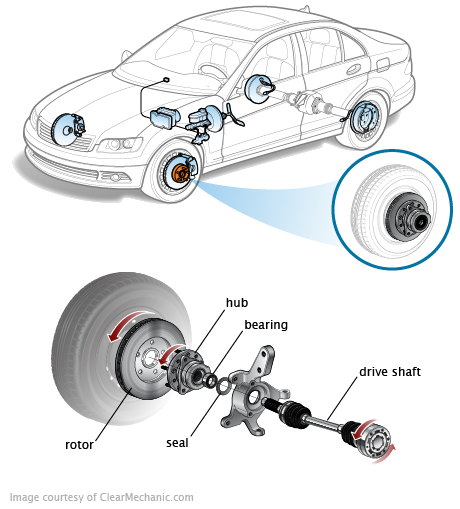
Wheels are classified according to their function in the car as driving wheels (that push or pull the car), and driven wheels that are driven by a fixed axle and rotated by a pomegranate.
 |  |
 | |
| wheel hub (top ) | Front wheel drive (drive shaft, hub and rim connection) |
Vehicle configuration: The
type and number of axles: The
wheel is connected to the car axles as follows: with the car’s drive axles (driving wheels), or with the fixed axles above the pomegranate (the driving wheels). The number of wheels in passenger cars is usually 4 (3 wheels for some light cars), and the number of wheels increases with the number of axles (two tandem axles) for heavy cars and trucks. The wheels are mounted on the axles as one wheel on each side of the vehicle or as two dual tires together on the same side.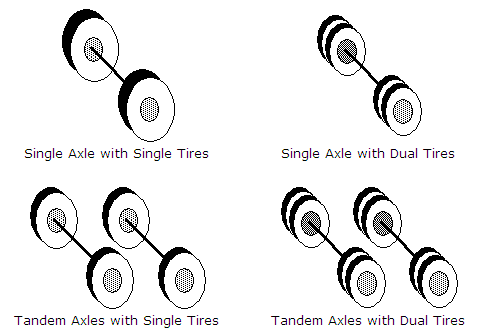
Engine location, position and drive wheels:
The vehicle is propelled by driving wheels, which are connected to the driving axles. The other driven wheels are mounted on stub axles using pomegranate balls. Passenger cars are classified according to the location of the engine and drive wheels as follows:
- Front engine Front wheel drive (FF)
- Front-engine Rear-wheel drive (FR)
- Mid-engine Rear-wheel drive (MR)
- Front-engine All-wheel drive (F4)

The following figures show the designs according to the position of the engine ( Longitudinal engine , Transverse engine )

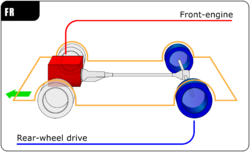


Number of axles and number of wheels:
The following figure shows the different types of vehicles according to the number of axles, as well as they may be classified according to the number of wheels, such as: 18-wheeler vehicle.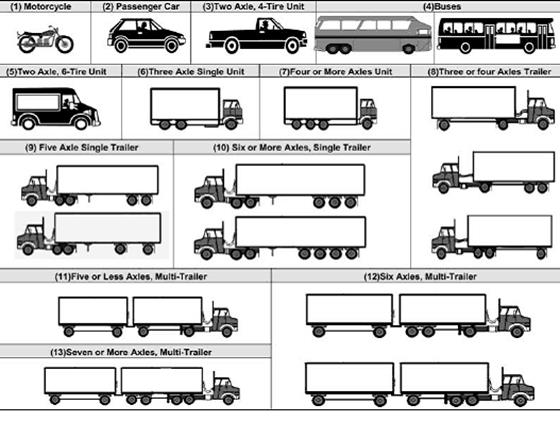
Wheel components:
The car wheel consists of wheel/ rim and tire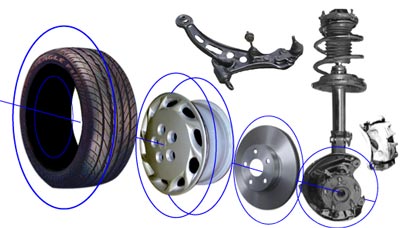
The rim and the tire and the following:
 |  |  |  |  |  |
| rim/wheel rim | Tire frame | Wheel wheel | Wheel Hub Hub Wheel | Stub axle axis ends of | Hubcap wheel cover/ rims |
 |  |  |  |  |  |
| Wheel speed sensor sensitive speed calf | Tire Valve Stem valve inflatable calf | Lug nuts nuts calf | Half axle wheel hub, a half column | CV axle fixed speed axle | Center cap central / hub cover |
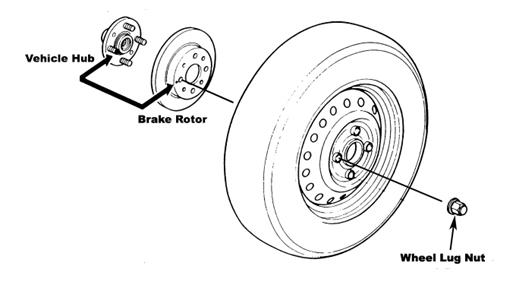
Attached to the wheel is the wheel brake, service brake: drum brake, disc brake, and the parking brake.
  |  | 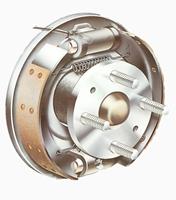 |
| Wheel brake | Disc brake | Drum brake |
Wheel . Terminology
| Wheel A wheel is a simple machine consisting of a circular body with diagonal shafts or a solid disc, that can rotate on a shaft or axle (in many applications such as automobiles and machinery). To make the wheel spin you need to apply a torque to the wheel (leading wheel), or to push the axle of the wheel connected to the ground and the wheel spins freely on it by means of a bearing wheel. | 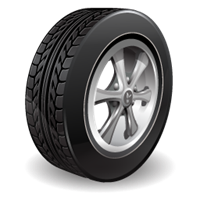 | |
| Wheel alignment is part of basic vehicle maintenance that includes adjusting the wheel angles according to the vehicle manufacturer’s specifications. The purpose of this adjustment is to reduce tire wear, and to ensure that the vehicle runs in a straight line without yaw. |  | |
| Wheel angles Wheel angles are angles that the wheels make with each other or with the car body, in order to improve performance and stability. These angles are the camber angle of the wheel about the horizontal axis of the wheel. The toe angle of the wheel about the vertical axis of the wheel. The caster angle is the angle of inclination of the vertical axis of the wheel. Some of these angles are fixed (made fixed) and do not accept adjustment, and some can be adjusted by wheel alignment. The amount and direction of angles vary from car to car (refer to the car owner’s manual). The presence of corners improves performance and stability and reduces tire wear. |  |  |
 |  | |
 |  | |
| Wheel balancing refers to the balancing of the wheel relative to the vertical axis by means of lead weights for steel rims and fixed by means of hammering, and by weights glued to aluminum and alloy rims. This is to compensate for the uneven distribution out of balance for the rim and tire weights. Wheel imbalance can cause the car to vibrate at certain speeds and lead to uneven tire wear. To balance the calf, a computer is used to identify the amount of weights to be used and where they are attached to the rim edge. And the work of static balance and dynamic balance of the wheel. These weights are used to counter-balance the heavy spots on the tires and wheels. |   | |
| Wheel weights are weights (mostly lead, possibly other metals) that are attached to the wheel to balance the tire and rim assembly. Weights can be installed on the inside or outside of the wheel and can be clipped or attached to the rim. Modified aluminum rims are balanced in the same way as steel rims, but weights with adhesive are usually used instead of hammering to install them. |   | |
| Base Calf Wheelbase wheelbase is usually the distance between the front and rear wheels centers. In road vehicles with more than two axles (some trucks), wheelbase is defined as the distance between the front steering axle and the center point of the rear axle assembly. |   | |
| Wheel speed sensor The vehicle speed sensor (VSS) is a type of tachometer. It is a transmitter that reads the rotational speed of the car’s wheels. Often consists of a toothed ring and a pickup. The wheel speed sensor is used with the ABS system, which is linked to the electronic stability control system. |  | |
| Drive wheel The driving wheel is a car wheel that transmits force to drive the car, converts torque into thrust from the tire to the road, leading to the car’s motion. The powertrain system provides enough torque to the wheel to overcome the stability forces, causing the car to move forward or backward. Driving wheel types/types in cars: two-wheel drive, four-in-two 4×2, front-wheel drive (FWD) or rear-wheel drive (RWD). four-wheel drive (4×4), all-wheel drive (AWD). |  | |
| Spare wheel/tire The spare wheel is a wheel (rim and tire ), which is kept in the car (in the luggage compartment, in the engine compartment or installed outside the back or under the car), in the event of damage to the flat tire and there is a need to replace it. Some spare wheels are less space-saver than the original wheel. The small spare wheel varies in diameter and differs in inflation pressure and is recommended for use over short distances and at limited speeds. Some modern cars have completely abandoned the spare wheel, as they use tires that can run without inflating a run-flat tire. Or providing the car with self-inflating tires, or replacing them with a means of inflating the tire and sealant kit, or a portable air compressor. | 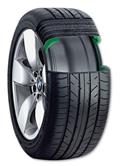  | |
Wheel/tire removal & installation:
1- Park the car on a flat surface
2- Prepare the jack, the tire iron key/lever, as well as the spare tire and take them out of their whereabouts in the car.
 |
| Usually the cross wrench is suitable in the process of dismantling and installing the rims, but it is recommended to measure the torque using a torque wrench |
 |
| tire iron key |
3- Refer to the owner’s manual for jacking points in your cars. Then put the lever in the appropriate place.
 |  | 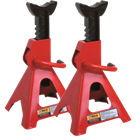 |
| Carjacking points | car jack | Fixed Jack stand |
4- In the case of a lug nut trim cap, remove it either by threading or pulling from the wheel bolts. You can refer to the car owner’s manual when necessary.
5- In the case of a wheel cover, make a suit. In most cases there is a slit in the cap lip, insert the jaw lever and loosen the cap.
 | 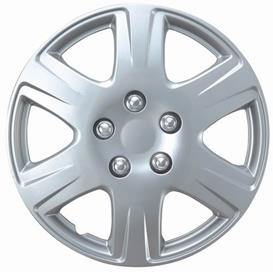 |
| Wheel Center Hub Trim | Wheel cover |
6- Apply the parking brake, and secure the wheel block to the diagonally opposite wheel using the wheel chock or similar.
 |  |
| Wheel chock |
7- If the car has an automatic transmission/transaxle, put the selector lever in the P or Park position, if the car has a manual transmission/transaxle, put the selector lever in Reverse.
8- And the tire is still on the ground, loosen only the nuts and bolts without loosening them.
Note: If the nuts are stuck, do not use heat to loosen them, heat may damage the tire and wear. In this case, a sledgehammer can be hammered into the end of the nut, which will remove the rust. But continuous hammering can damage the brake drum, brake disc or wheel bearings.
9- Use the crane and raise the car until the tire is not touching the ground.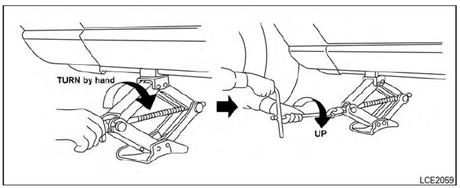
10- Loosen the lug nuts, then remove the wheel and tire assembly from the vehicle.
Installation:
11- Ensure that the wheel surface, wheel hub, and wheel lug studs are clean and free of impurities. Failure to do so may make the jaw process difficult and may affect the fixation of the calf.
12- Install the tire and wheel and tighten the nuts by hand.
13- Use the tire wrench to tighten the nuts, in the manner shown in the drawing.
14- Use the lever and lower the wheel. (If using a jack stand) Use the jack to raise the car slightly to raise the fixed jack from under the car, then lower the car using the jack.
15- Tighten the bolts with a bolt wrench, and follow the order shown in the following figure to ensure that the rims are fitted correctly with the wheel hub.

Note:
Nuts must be threaded tightly (according to specifications) so that they do not loosen during work, and most importantly, they must be threaded evenly.
Warning:
Do not tap the nuts too much, as this can break the wheel bolts. Excessive tapping, uneven tapping, or tapping in a different order can cause brake drums or disc rotors.
16- In the case of the presence of the rim cover or the hub cover. Make sure the inflation valve is out of the hole and screw the cap into place.
17- Pull the lever from under the car. Then put the damaged tire and equipment in their place in the car.
18- Raise the wheel stabilizer from the front and rear of the tires.
19- Drive the car and make sure the handbrake is applied. Take the damaged tire to the service place for repair or replacement as soon as possible.
 |  |
| Torque wrench |
Wheel/tire service: Wheel or tire service
includes the following:
- tire rotation
Every 10,000 km or more often with an oil change (refer to the owner’s manual)
- Tire inflation check, inflation adjustment
It is recommended to do it once a month (refer to the car owner’s manual)
- tire replace
Performed if tire is damaged or tread/tire wear is detected (refer to vehicle owner’s manual)
There are no reviews yet. Be the first one to write one.