
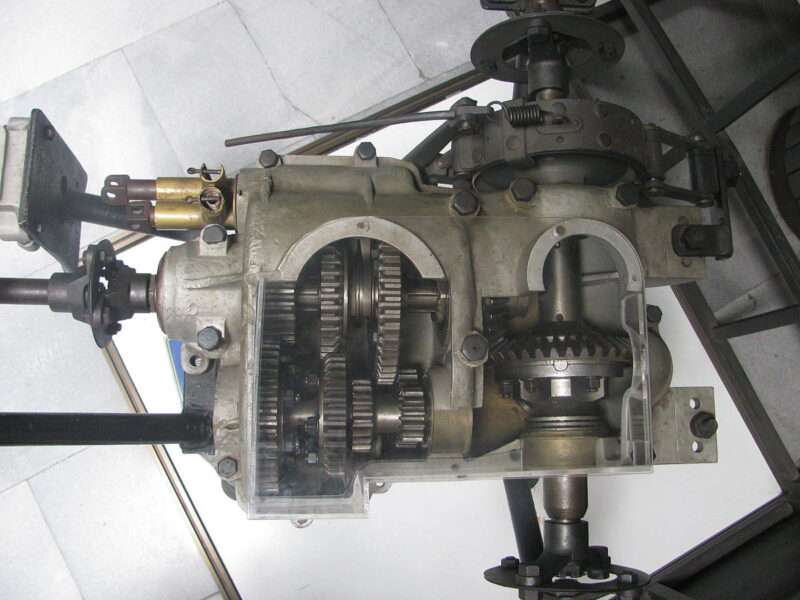

is an assembly of the transmission and differential in a single vehicle unit that connects directly to the drive axle. Here it can be said that most cars with drive wheels and engine in the same area (front or rear) use a powertrain and axle.
Most drivetrain and axle are designed mostly for transverse engines. It attaches the powertrain and axle to the rear of the engine. Thus, it is one unit (engine + group) to generate and transmit power. In this unit, the engine torque is generated and from it is transmitted to the transmission of the group, from which it is transmitted to the differential and from there to the axles to drive and drive the wheels.

Transmission and axle Transaxles range:
in the automotive field, group transmission axis is an important element that combines transmission transmission gears difference differential components associated with the shaft axle commander in the unit integrated one. Group transmission and axle used almost in most of the cars of the engine and the wheels leading the same end: Drive Front and Front Drive Front- the engine, Front-wheel drive the drive the layout , engine rear Rear rear- the engine, rear-wheel drive the drive the layout , engine medial and push the rear rear mid-engine, rear-wheel drive layout .
Many mid- and rear-engined cars use a transverse engine transverse engine, powertrain and axle similar to the front traction unit. Other cars use a longitudinal engine with the transmission and axle, such as the Ferrari of the year 1989, the Mondial t, which uses a T combination with the longitudinal engine connected to the transmission and the transverse transaxle. Front-wheel drive Audis and Volkswagens also use a similar setup, but use a longitudinal transaxle.
The powertrain and axle are distinguished from the traditional system consisting of a transmission and a separate differential by:
Improving efficiency and reducing the weight of the transmission system
Increasing traction on slippery terrain by concentrating the weight on the drive axle
Increased passenger space (there is no height in the middle of the car floor, for
a driveshaft like in a rear wheel drive) Improved ride (since the unsprung weight is small – the weight that must move under the influence of the suspension)
Less noise
Improved safety ( by increasing the mass at the front of the car)
Classification of the drivetrain and axle is as follows:
Depending on where the car is positioned: front transaxle, or rear (located in the rear axle)
according to the direction it is positioned in the car: longitudinal transaxle, or transverse (perpendicular to the car axle) transvers transalxe
Depending on the type of gearbox in which it is located: manual transaxle, or automatic transaxle
Depending on the type of transmission from the differential gearbox: chain, or bevel gear set pinion and crown gears, or spur gear set.
Front-engine, rear-wheel drive transaxles: front-engine, rear-wheel drive
vehicles Front-engine, rear-wheel drive has a transmission located directly after the engine, but in some cars the front engine drives the rear-mounted powertrain and axle. This is done due to the desire for better weight distribution on the axles, and is commonly used in sports cars. Another advantage of this layout is that the driveshaft rotates at the speed of the engine and therefore it bears only the engine torque, instead of multiplying this torque by the first move, and therefore it needs a shaft with smaller dimensions and less weight. Also, this gearbox position is not suitable for the live axle (due to the increased un sprung weight ), so in this design the rear suspension is either an independent suspension or uses a de Dion tube de Dion tube .
Rear-engine, rear-wheel drive transaxles:
Modern Volkswagen and Porsche vehicles make extensive use of powertrains and axles in their rear- and mid-engine vehicles.
Four-wheel drive:
in all Audi cars with longitudinal engines, and four-wheel drive (4WD). The package is mounted (longitudinally) after the front-mounted engine and includes a gearbox that may be (manual, automatic, direct -shift gearbox (DSG) , or continuously variable transmission (CVT)), with a center differential, front differential, and rear final drive unit.
 |  |
| Automatic transaxle | Electric transaxle for heavy trucks |
http://thecartech.com/subjects/auto_eng/Transaxles.htm Transaxles
https://en.wiktionary.org/wiki/transaxle Transaxle|
http://www.crankshift.com/transaxle/ Transaxle
www.cengage.com/resource_uploads/downloads/1111128618_277002.ppt Front-Wheel-Drive (Transaxle and CV Joint) Fundamentals
http://arrc.ebscohost.com/ebsco_static/ repair-tips/8852CH20_TRANSAXLES.htm Transaxles Package
Components:
All-indirect gearbox:
The drivetrain and axle utilize a two-stage shaft gearbox in both the longitudinal- and transverse-engined front-wheel drive case. But there are many first-case motors (transverse motor) that often use a single-phase all-indirect gearbox. which does not have a direct 1:1 shift.
With the increase in the popularity of front-wheel drive cars , the all-indirect gearbox has become dominant (for longitudinal and transverse engines of front-wheel drive). It is a two-shaft gearbox (input shaft and output shaft) in which transmission is carried out by only two gears of each ratio, shaft gear and output shaft gear. This is (instead of the normal three-shaft (input shaft, passive/manipulator shaft, and output shaft), which is a two-stage layshaft gearbox). It is used for both transverse engine layouts, since the displacement between the two shafts is more suitable than the in-line arrangement of the layshaft gearbox. Although there is no direct shift that has 0% power loss when traveling at high speed, using the unit compensates for that loss in other reduction ratios, so instead of losing 4%, it loses only 2%. Also, the operating noise in this design is less.
 |  |  |
| Transmission and axle assembly for longitudinal motors Single stage gearbox (without shaft) | Transmission and axle assembly for transverse motors single stage gearbox (without shaft) | Powertrain and axle (automatic) transaxle, chain-controlled |
Manual transaxle:
The combination uses a conventional transmission and clutch. It uses a clutch pedal that controls the coupling of the engine to the power train and the axle when engaged. It also uses a manual transmission lever to make the required gears. The basic parts of the assembly are in most designs as follows:
The input/main shaft has splines attached to the clutch disc and serves to rotate the gears of the drivetrain and axle
The input gears are fixed or rotate freely on the input shaft and engage with gears Output
Output gears- be fixed or rotate freely on the output shaft by input gears, and the output shaft is connected to the differential by means of a gear (bevel, or inclined) or by a sprocket chain and differential
synchronizers- with shafts that can fix free-spinning gears on their shafts to work
differential- transmits the torque of the transmission / gearbox to the drive axles (right and left shafts) at different speeds when rotating. The ring gear is connected to the differential case. The differential has spider gears Bearings-
to support the rotation of the axles
Bolts and
gaskets Oil seals and gaskets Transaxle
fluids
Empty case- usually made of aluminum and contains On the parts of the powertrain and axle
CV axles with CV joints at both ends – they have a rubber protective sleeve (with grease) and the axles are connected to the differential side gears at one end and to the driving wheel of the car at the other end.
The transmission and the automatic transaxle:
which is an assembly of the transmission Self and hubs in one unit. Parts of the main group transmission and self-axis are often as follows:
· torque converter torque converter- works by connecting separation column engine and shaft income for transmission output
· Oil oil pump- pump to provide hydraulic pressure to run, lubrication, cooling group transmission and self-axis
· valve body – controls the flow of fluid to the pistons and servo, and includes a group of hydraulic valves
A set of clutches and brake belts – to operate a planetary gear
set Planetary gear sets – provides transmissions with different reduction ratios forward and reverse gear
Differential – transmission of power from the transmission to the axles
in addition to bearings, hakes, gaskets, couplings and fluids Lubrication group, located inside a single aluminum hollow.
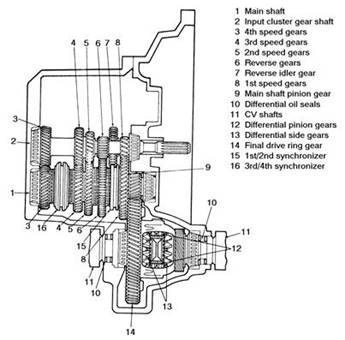


Transaxle orientation: The
position of the gearbox and the axis can be longitudinal or transverse. Transverse mode is used by transverse engines in most modern front-wheel drive vehicles, which put all of the powertrain and drive wheels at the front of the vehicle.


Rear-wheel drive vehicles with a powertrain and axle that have either a mid-drive or rear-wheel drive use a transverse axle drivetrain. The overall configuration of the rear-engine kit is very similar to the front-engine layout with the power train and axle.
In two-wheel-drive vehicles that have the engine and driving wheels on the same end of the car (front-wheel drive, front-wheel drive, rear-wheel drive rear-wheel drive, middle-drive rear-wheel drive) a powertrain and axle are usually used, in addition to some of the motor vehicles Front and rear drive, in which the drivetrain and axle are used, as it benefits from the appropriate distribution of weights on the axles and uses a drive axle shaft with less dimensions as it only transmits the engine torque without amplification.
http://www.carid.com/articles/transaxle-vs-transmission.html Transaxle vs transmission
Service the transaxle:
The assembly encounters many problems during its service life, which must be taken into account as a source of group wear:
transmission fluid burns
clutch slip transmission
noise (especially in neutral)
excessive vibration at Making shifts Loud
noise when starting from a complete stop
The transmission fluid must be checked regularly, and the assembly must be checked at the first sign of problems.
http://www.napaautocare.com/preventive-maintenance/axles.aspx Axles Repair & Maintenance
Constant-velocity joint:

The CV joint allows the drive shaft connected to the wheel to transmit power through different angles, at a constant rotational speed, without increasing friction or clearance. It is a flexible articulated joint that delivers power from the powertrain and axle or differential to the CV axle half shafts and from there to the wheel.
The linkage is mainly used on front wheel drive cars, and some modern rear wheel drive cars, with the use of an independent rear suspension. Fixed-speed couplings are also used at the ends of the rear axle and halfshafts. In addition to their use in some propshafts. Front-wheel drive cars have two fixed-speed axles at the front, rear-wheel drive cars with independent rear suspension have two fixed-speed axles at the rear, and AWD cars have four fixed-speed axles connected to the driving wheels.
The fixed speed joints are protected by a rubber boot from dust and contamination, often filled with molybdenum disulfide grease . The presence of cracks or cuts in the protective cover leads to contamination, which leads to rapid wear of the joint.


In addition to providing a constant speed. These joints operate at a nearly double angle (40-45o) to the universal “U” joint .


Symptoms indicating that the coupling needs to be replaced if any of them appear when driving the vehicle;
A buzzing or crackling sound coming from the vehicle when accelerating or decelerating with the engine loading Cracking
sound when turning/turning the vehicle Clicking
sound when taking a U-turn
Noticeable vibrations inside the cabin when accelerating
Smell of fire (may be due to a leak Coupling grease on the exhaust pipe or wheel brake parts)
Seeing traces of damage, cracks or cuts in the coupling protective cover (this can be seen on visual inspection)
There are no reviews yet. Be the first one to write one.