

Automotive Engineering
Automotive Engineering

Automotive Engineering 1- Automotive Engineering I
- an introduction
- Physical Quantity
- SI units
- Car Drive System
- Engine
- Power transmission (conventional, transaxle, manual transmission: clutch, gearbox/transmission, propeller shaft, deferential, axles)- ( Automatic transmission: hydraulic coupling, torque converter, automatic transmission.

- Clutch (transfer of torque and motion from the engine to the transmission). working theory, parts, types
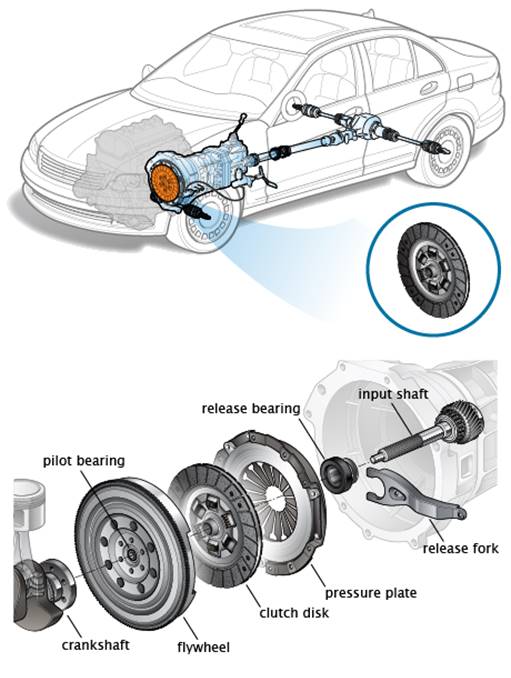

- The clutch is a mechanical device that connects and separates the power to the transmission. The function of the clutch in the simplest applications is to connect shafts (the “flywheel” input shaft, and the “transmission input shaft”) output shaft. The vast majority of clutches rely on the force of friction in their work. The purpose of friction clutches is to connect a rotating part with another part at different or stopped rotational speeds, to match the speeds, or to transfer power, often requiring as little slip as possible in the case of different speeds between the two parts. There are different clutch designs, but most rely on one or more friction discs pressed together or applied to the flywheel using springs.
On manual transmission vehicles the clutch is actuated by a left-foot pedal/pedal that uses a hydraulic coupling or cable between the pedal and the clutch. The normal/default clutch is the connection state between the engine and gearbox, unless the driver depresses the clutch pedal completely to disconnect. If the engine and transmission are running in neutral, the engine will drive the gearbox’s input shaft, but there will be no transmission of power to the wheel. The clutch is located between the engine and the gearbox, where it is required to shift gears. Although the gearbox does not stop rotating during gear shifting, there is no torque transmitted, thus reducing the friction between the gears and the gearing. The output shaft of the gearbox is in permanent contact with the differential gearbox, and from there to the wheel. With the clutch disconnected, the gearbox input shaft is free to change its speed according to the selected reduction ratio.
Clutches in an automobile are usually mounted against the engine flywheel, which provides a steel disc of a suitable diameter that acts as the driving disc of the clutch. Both the clutch and flywheel are housed in a bellhousing, which in rear-wheel drive cars usually provides a place to install the transmission. On many cars, the front engine and front traction clutch are fitted with a combined transmission and axle transaxle.
- Manual Transmission / Gearbox
- Automatic Transmission.
- Propeller shaft (transmission).
- Differential gearbox (torque increase – speed reduction, torque transmission to the wheels).
- Axles (transmission).
- Wheels (converting torque and speed of rotation into thrust and linear velocity). (Tire dimensions and specifications, traction force calculations, vehicle linear speed)
- Input (fuel power) and engine output (torque, power. Calculations, equations
- Engine performance measurement (Engine Dynamometer/Dino). Engine performance curves (torque, power, fuel consumption, engine efficiency – with speed)
- Traction Effort Calculations
- Vehicle performance measurement (Chassis Dynamometer/Dino, Wind Tunnel, Road Test).
- Finding the Gearbox and Final Drive Ratios and Efficiencies.
- Vehicle dimensions and weight:
- Vehicle mass & weight, Frontal area
- Road/motion resistance:
- Air/wind resistance, Rolling Resistance (RR), Gradient Resistance (GR)
- Free-body diagram
- Equations of Motion in a Straight Line (Relationship Between Force, Mass, and Acceleration)
- Car performance curves (determining the maximum speed of the car, determining the maximum mileage of the car, determining the maximum acceleration of the car, determining the traction force for different speeds of the car, determining the optimal fuel consumption speed)
Automotive Engineering II
- Engine position (front, center, rear)
- Traction types (front-wheel drive, rear-wheel drive, 4×4, all-wheel drive)
- Vehicle dimensions and weights (distribution of loads on axles and wheels, Center of Gravity (CG))
- Vehicle systems (working theory, parts, types).
- Suspension System.
- Equations of motion with uniform acceleration
- Distribution of loads on the axles during movement (inertial force, weight transmitted)
- Braking System (slow and stop the vehicle).
- Grip force between tires and the road (slip)
- Wheel Antilock System.
- Collision (Equations of Motion)
- Steering System
- Vehicle handling characteristics (steering angles, wheel angles).
- Suspension System Working theory, parts, types (springs, torsion shafts, servers, anti-roll bar)
- Motion in a Circular Path (Equations of Motion, Inertial Force)
- Lateral slip (speed, side slope of the road)
- Rollover
- Oversteer and Understeer
- VSC, electronic stability control system, ESC. Traction control system TCS, working theory, parts, types
There are no reviews yet. Be the first one to write one.