
what do the frame symbols mean?
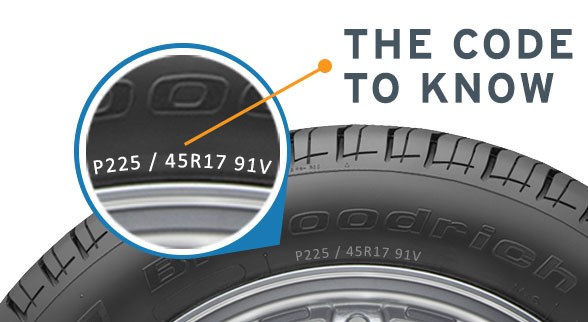
Tire codes contain numbers and letters, which are often written on the tire sidewall (tyre side surface). These symbols represent tire dimensions, and some tire operating limits such as maximum load, maximum speed, allowable tire inflation pressure, and other information. Sometimes some information is written on the inner wall of the frame, which is not recorded on the outer wall.
The information on the tire sidewall contains important and useful information for tire users. The information contains and may add to the following:
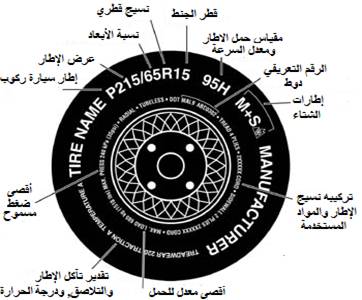 |
Manufacturer Brand
Model
Tire Model Size (tire dimensions) Tire Sizing (tire dimensions)
tire types tire types
Service description, (speed ratings, load indicator load index)
Maximum inflation pressure Tire assembly
type Construction type
Quality rating Uniform Tire Quality Grading (UTQG)
DOT Serial No.
Passenger Tire Sizes
Most passenger cars have tires that follow either the P-Metric or Euro-Metric tire size systems.
P-Metric
In this system, the width of the tire is written in millimeters. To convert millimeters to inches, divide the number by 25.4. Aspect ratio suppresses (the frame section height divided by the frame width), gives additional information over the frame size information.
The aspect ratio is given as a percentage (75%, 70%, 60%, ….) and is usually referred to as tire series (75, 70, 60, ….). Small aspect ratio appears as less height and more width.
The Euro-Metric
system Europe is the source of this system and is therefore called the European metric system. Most European tire manufacturers make tires that follow this system. This system is similar to the P metric system, except for the amount of load carrying capacity.
A table showing the difference between the P-metric system and the European metric system in terms of load indication for the same tire size and at specific pressures.
| System System | Frame Size | Pregnancy shown Load Index | 26 psi | 29 psi | 32 psi | 35 psi | 36 psi | 44 psi |
| P-Metric | P195/70R14 | 90 | 1135lbs (515kg) | 1201lbs (545kg) | 1257lbs (570kg) | 1312lbs (595kg) | 1312lbs (595kg) | |
| Euro-Metric | 195/70R14 | 91 | 1047lbs (475kg) | 1135lbs (515kg) | 1224lbs (555kg) | 1312lbs (595kg) | 1356lbs (615kg) | |
| P-Metric | P205/60R15 | 90 | 1124lbs (510kg) | 1190lbs (540kg) | 1246lbs (565kg) | 1301lbs (590kg) | 1301lbs (590kg) | |
| Euro-Metric | 205/60R15 | 91 | 1047lbs (475kg) | 1135lbs (515kg) | 1224lbs (555kg) | 1312lbs (595kg) | 1356lbs (615kg) |
The previous example also shows that there is another difference between the two systems in terms of maximum tire pressure. The pi metric system has a maximum pressure of 35 psi. The European metric system is at 36 psi.
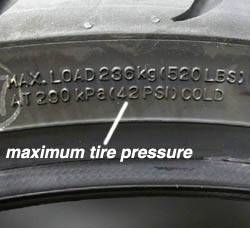 |
Some high-speed tires have a maximum inflation rate of 44 psi, and they have been added to improve performance at high speeds.
* The number written (42 PSI) COLD means that this is the maximum inflation pressure allowed for the tyre. It is measured while the tire is cold (the car has stopped running on it for a long time (stop during the night), or the mileage after stopping is not more than 2 km).
This is not the pressure to set the tire to. The recommended vehicle pressure differs from the maximum tire pressure. The recommended pressure value for your vehicles can be found in the vehicle owner’s manual and vehicle stickers.
 |
Explanation of
Tire Codes: Tire size, rim, load and speed Tire size, Load and Speed Ratings
P-Metric:
| P215/65R15 80H | ||||
| P | Extra character (optional) to indicate vehicle type | Intended use or vehicle class for the tire | ||
| 215 | Frame section width in millimeters | Section Width in Millimeters | ||
| 65 | aspect ratio | Aspect Ratio | ||
| R | Diagonal combination of frame fabric layers | Radial Construction | ||
| 15 | rim diameter in inches | Rim Diameter in Inches | ||
| 80 | (operating statement) | pregnancy rate | Load Rating (Index) | (Service Description) |
| H | swift code | Speed Index (Symbol) |
P215/65R15 80H
P*:
Additional letter or letters indicating the type of vehicle the tire is to be fitted with:
– P: Passenger
passenger car -LT: Light Truck
-ST: Special Trailer
-T: Temporary (for additional small size tires Space-Saver spare wheel
Use of letter means that the tire follows American specifications TRA, and the absence of letter means that the tire follows European specifications ETRTO.
* 215 is a 3-digit number, indicating the width of the tire in millimeters: 215 mm, the widest distance between the two side surfaces of the tire.
*/ symbol for separating two quantities.
* 65 2- or 3-digit number ” aspect ratio” The ratio of tire wall height to tire width, as a percentage, without the % sign. If this information is not mentioned, this means 82% (82). If the number is more than 200, this number indicates the tire diameter in millimeters (Japanese specifications).
* :R is an optional letter indicating the combination of tire texture layers.
– B: Bias
– Diagonal – D: Diagonal
– R: Radial
In the absence of this letter, it means that it has cross layers. Cross ply
* 14: A two-digit number, indicating the diameter of the rim on which the tire is installed in inches. There are a few cases where the diameter is mentioned in the metric system. 390 means that the rim diameter is 390 mm.
* 80: a numeric symbol (a two- or three-digit number), indicating the load index (scale). The load scale table is used to indicate the maximum load that a tire can bear based on that numerical symbol.
* H: A symbol containing a single digit or containing a number and a letter, indicating the speed rating.
* Additional codes:
There are many signs and symbols that may contain the following:
– M+S or M&S: Mud and Snow. This tire has a higher than average grip in mud, light snow and low ambient temperatures. But they are not winter tires unless they are marked with a snow mountain or snow symbol. Tires equipped with studs (metal inserts) have an additional letter “E” (M+SE). 
– BSW: Black SideWall Frame Wall
– WSW: White SideWall Frame Wall
– OWL: Outlined White Lettering (Outer White Lettering)
– E4: Approval (approval) of the framework as per
Economic Commission for Europe (ECE) regulations and the number indicates the approved country.
– 030908: tire approval number
DOT Code: All US tires must have a code required by the Department of Transportation (DOT). The code identifies the company, manufacturer, model, lot number, and production date (two digits indicate the week number plus two digits indicate the year number or two digits indicate the week number and a number indicates the tire year of manufacture for tires manufactured before the year 2000).
– TL: Tubeless
– TT: a tire that must be used with a tube
Made in: Country of Manufacture
– C: commercial for vans (example: 185 R14 C)
– B: Diagonal Motorcycle Tire Tire (Ex. 150/70 B 17 69 H)
– SFI or Inner: the surface opposite the inside, for tires that have one direction of installation
– SFO or Outer: the surface facing outward, for tires that have one direction of installation.
TWI: Tread Wear Indicator, Tread Wear Indicator.
– SL: Standard load, for normal use and normal load.
– XL: a tire for cars with a high standard weight eXtra Load
– RF: Reinforced tires
Arrows: directional arrows. Some tire treads are designed to work best when they are turned in a certain direction (clockwise or counterclockwise). These tires have arrows to indicate the direction of rotation. Tires that turn clockwise should not be placed on the left side of the vehicle, or that rotate counterclockwise on the right side of the vehicle.
– M0: Original tires for the car (Mercedes-Benz)
– N*: original tire (Porsche)
– “Star”: the original BMW tire
* To facilitate the balancing process, most high performance tires place a red dot (evenness) and a yellow dot (weight) on the tire sidewall to ensure the best balance of the tire and rim combination.
Tire load gauge table: Load Index
| code | load (kg) | code | load (kg) | code | load (kg) | code | load (kg) | |||
| Code | Load (kg) | Code | Load (kg) | Code | Load (kg) | Code | Load (kg) | |||
| 60 | 250 | 80 | 450 | 100 | 800 | 120 | 1,400 | |||
| 61 | 257 | 81 | 462 | 101 | 825 | 121 | 1,450 | |||
| 62 | 265 | 82 | 475 | 102 | 850 | 122 | 1,500 | |||
| 63 | 272 | 83 | 487 | 103 | 875 | 123 | 1,550 | |||
| 64 | 280 | 84 | 500 | 104 | 900 | 124 | 1,600 | |||
| 65 | 290 | 85 | 515 | 105 | 925 | 125 | 1,650 | |||
| 66 | 300 | 86 | 530 | 106 | 950 | |||||
| 67 | 307 | 87 | 545 | 107 | 975 | |||||
| 68 | 315 | 88 | 560 | 108 | 1,000 | |||||
| 69 | 325 | 89 | 580 | 109 | 1,030 | |||||
| 70 | 335 | 90 | 600 | 110 | 1,060 | |||||
| 71 | 345 | 91 | 615 | 111 | 1,090 | |||||
| 72 | 355 | 92 | 630 | 112 | 1,120 | |||||
| 73 | 365 | 93 | 650 | 113 | 1,150 | |||||
| 74 | 375 | 94 | 670 | 114 | 1,180 | |||||
| 75 | 387 | 95 | 690 | 115 | 1,215 | |||||
| 76 | 400 | 96 | 710 | 116 | 1,250 | |||||
| 77 | 412 | 97 | 730 | 117 | 1,285 | |||||
| 78 | 425 | 98 | 750 | 118 | 1,320 | |||||
| 79 | 437 | 99 | 775 | 119 | 1,360 |
* The tire load scale is a numerical code to indicate the maximum load (mass or weight) the tire can carry.
In the “B” load range according to
ETRTO European Tire and Rim Technical Organization specifications,
this tire load is at a pressure of 36 psi.
For the US TRA Tire and Rim Association, this tire load is at an inflation pressure of 35 PSI.
* There are slight differences between the two standard specifications for different tire inflation pressures.
Speed Rating Table:
| code | Speed (km/h) | code | Speed (km/h) | ||
| A1 | 5 | L | 120 | ||
| A2 | 10 | M | 130 | ||
| A3 | 15 | N | 140 | ||
| A4 | 20 | P | 150 | ||
| A5 | 25 | Q | 160 | ||
| A6 | 30 | R | 170 | ||
| A7 | 35 | S | 180 | ||
| A8 | 40 | T | 190 | ||
| B | 50 | U | 200 | ||
| C | 60 | H | 210 | ||
| D | 65 | V | 240 | ||
| E | 70 | Z | over 240 | ||
| F | 80 | W | 270 | ||
| G | 90 | (W) | over 270 | ||
| J | 100 | Y | 300 | ||
| K | 110 | (Y) | over 300 |
* The code consists of a letter, two letters, or a letter and a number. This gives the maximum permissible speed the tire can withstand for 10 minutes without being compromised.
* Prior to 1991, the average velocity was written inside the tire size symbols, before the tire texture layer symbol “R”. For example SR (radial- 180 km/h), HR, VR, ZR. The ZR symbol is still used and is often associated with the W and Y symbol for speed.
* For tires with a speed limit greater than (300 km/h), the speed symbol is often written in parentheses as (86Y).
Light truck tires:
Some truck tires follow the metric system, which begins with the letters LT, instead of starting with the dimensional specifications.
- The tire diameter is not given in the metric system, but in the other system it is written as follows:
- 2 digit number: indicates the tire diameter in inches.
- x symbol: symbol to separate symbols
- 3 or 4 digits: indicates the tire width in inches. If the tire diameter is not given, the number denoting the tire width ending in zero (eg, 7.00 or 10.50) indicates that the aspect ratio is 92%, while the number denoting the tire width does not end with zero (eg, 7.05 or 10.55) This indicates that the aspect ratio is 82%.
- Letter denoting the tire texture combination (B, D, R):
- B-oblique bias belt
- D-axial diagonal
- R-Diagonal Radial
- Two-digit number: rim diameter in inches
- The symbol LT: indicates that the tire is to be used in Light Truck
- Some tires have a load indicator, speed rating, which is not required for this type of tire, but some tire manufacturers put it on the side of the tire:
- A number of one or two digits: indicates the indication of pregnancy (see the following table).
- A one- or two-digit number with an appendix of a speed estimate (see table)
Load range
The load scale for light truck tires indicates the number of inner fabric layers and the load pressure (lbs/inch2). Tire pressure is also measured in kilopascals or bars. 1 pound/inch (2 psi) equals 6.895 kilopascals. 100 kilopascals equals 1 bar.
Loading table
| Overhead Load Range | Mekdardobqat fabric Ply Rating | Load Pressure ( lbs/inch2) Load Pressure (PSI) |
| B | 4 | 35 |
| C | 6 | 50 |
| D | 8 | 65 |
| E | 10 | 80 |
| F | 12 | 95 |
Tire width:
Tire rated “P-metric” or “P-rated” are measured in millimeters. In this classification the relationship between the width of the tire and the rim is different, not like the American letter symbols.
Recommended tire width table for rim width
| Frame width | rim width | Frame width | rim width | |
| P185 | 5 inch | P255 | 7 inch | |
| P195 | 5.5 inches | P265 | 7 inch | |
| P205 | 5.5 inches | P275 | 8 inch | |
| P215 | 6 inch | P285 | 8 inch | |
| P225 | 6 inch | P295 | 8 inch | |
| P235 | 6.5 inches | P305 | 8 inch | |
| P245 | 7 inch |
Writing the tire diameter instead of the tire height:
This method is less used in America and Europe (mostly in Japan).
Tire example 195/55R16:
the rim diameter will be 16 x 25.4 = 406 mm, add to it twice the height of the tire (the width of the tire in the ratio of dimensions (height / width) tire height = 195 x 0.55 = 107 mm)
so that the diameter of the tire = Rim diameter + 2 tire height = 406 + 2 x 107 = 620 mm.
Thus, the corresponding tire dimension code is 195/620R16
To differentiate between the two systems, and whether the number after the symbol “/” is the aspect ratio or the wheel diameter in mm, the aspect ratio is always less than 100% and is therefore less than the number 200 (mostly all car tires have a diameter greater than 200 mm), and therefore in the case of the presence of the number After “/” is greater than 200, this means that this number indicates the diameter of the tire, and in the event that the number is less than 200, it means the number indicates the proportion of dimensions and follows the European and American system.
Examples of car tires:
– BMW Mini Cooper
tires, bearing the words: P195/55R16 85H
P = This is a passenger car tire, ‘P’ stands for US System B
195 = Standard width approx. 195mm at widest
/ = Separation mark
55 = Dimensional ratio (tyre sidewall height is 55% of width – 195 x 0.55 )
R = combination of the fabric frame type (R = radial = diagonal)
16 = diameter rim inches
85 = load frame scale (515 kg) , the
h = average speed (210 km / h)
– car tires Hummer 1 Hummer H1 HTML is written by 37X12.5R17LT
37 = window diameter inches
X = separation code
12.5 = frame width 12.5 inches
R = frame type combination (R = radial = diagonal)
17 = diameter rim inches
lT = frame this light truck (lT = light Truck = light truck (
tire tractors :
The numerical code written on tractor tires since 1955 requires two or three numbers. WD or H/WD where ‘W’ width rim width in inches, ‘D’ diameter rim diameter in inches, ‘H’ aspect ratio (the percentage of height over width without the % sign).
Example 5.00-15
means a tire mounted on 15 inch rims , and it has a width of 5 inches.
Example 25/5-16
means a tire installed on rims with a diameter of 16 inches, rims width of 5 inches, and its height is 25% of the width.
Tire specification: Uniform Tire Quality Grading (UTQG):
A quality evaluation designed to facilitate the consumer’s tire purchase decision. It is intended to provide easy-to-understand comparative information. However, the assessment is based on the results of tests obtained under special circumstances. The lack of understanding of the results when compared to the driver’s conditions in terms of driving style, driving conditions…etc. may lead to this possibility. For this, the consumer should seek the assistance of specialists in the field of tires.
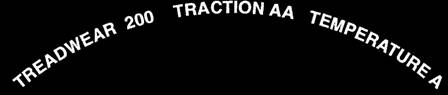
Quality assessment links tire performance equations to specific government tests, and is determined by tire manufacturers. Tire companies were asked to rate tires for three factors:
1- Treadwear
2- Traction
3- Temperature
 |
Treadwear evaluation
Tread wear is a comparative measure of wear rate when tested under controlled conditions on a 6,000-mile (96,600 km) government test track. For example, if the wear degree is 150, this means one and a half times the wear that occurs to the tire tested on the government track and has a degree of 100. The performance comparison for the tire depends on the actual condition of operation, and some move away from the usual due to the difference in driving style, maintenance, and the difference in the condition The Road.
Traction Rating AA, A, B, C Traction
grade from top to bottom are AA (Top), A, B, and C. It indicates the tire’s ability to stop on wet pavement as measured under controlled conditions on government-tested asphalt surfaces. And cement.(It is noted that the degree of grip is based on the tire braking test on a straight road and not the grip in the case of steering (cornering).
Temperature A, B, C
The temperature rating is the tire’s resistance to heat generation and its ability to release heat when tested under controlled conditions in special laboratories. Heat retention can damage tire material and reduce tire life. An increase in tire temperature can lead to tire failure (blowout). Rating C corresponds to the performance rating of passenger car tires required by the requirements of the Federal Motor Vehicle Safety Standard. A and B represent a higher level of performance for lab tires than the minimum requirement by law. This rating is for the tire at the correct inflation pressure and exact load. Excessive speed, low inflation pressure, and overloading can cause the tire to overheat and cause it to explode.
DOT Quality Grades
All tires must comply with federal requirements in addition to these ratings:
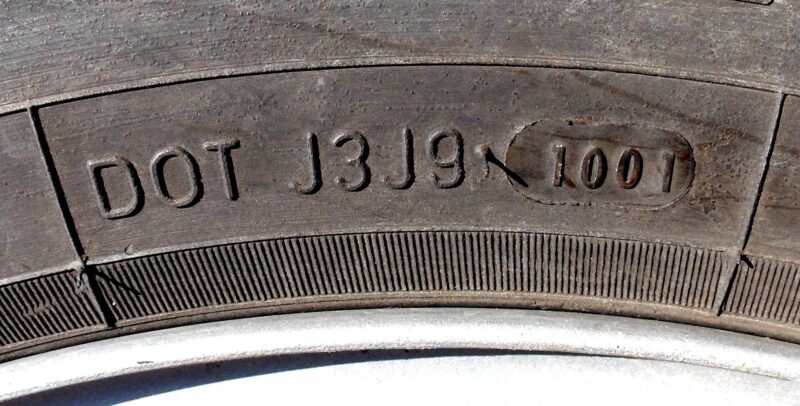
Next to the word “DOT” written on the wall of the tire, you will find the DOT codes consisting of 10 to 12 symbols. The code can be made up of a combination of letters and numbers.
| DATE OF TIRE SIZE DEPT. OF TRANSPORTATION MANUFACTURE CODE  MANUF. GROUP OF PLANT CODE OPTIONAL CODES |
The first 2 boxes
indicate the tire factory manufacturing plant 2 The next box indicates the tire size is tire size
3 or 4 The next boxes have a symbol for the tire type The
last 3 or four boxes indicate the date code
The date code for the manufacturing date must be on one surface only – It can be written as part of the dot symbol, provided that the dot symbol is written entirely on one of the surfaces of the frame.
Tire Manufacture Date:
Tires before the year 2000 (three digits), the first two digits indicate the number of the production week and the last digit indicates the number of the year after 1990.
(16 = week 16 of the year, 4 = 1994)
tires after year 2000 (four numbers), the first two digits indicate the number of the week of production and the other two digits indicate the year.
(42 = 42nd week of the year, 02 = 2002)
 |
There are no reviews yet. Be the first one to write one.