

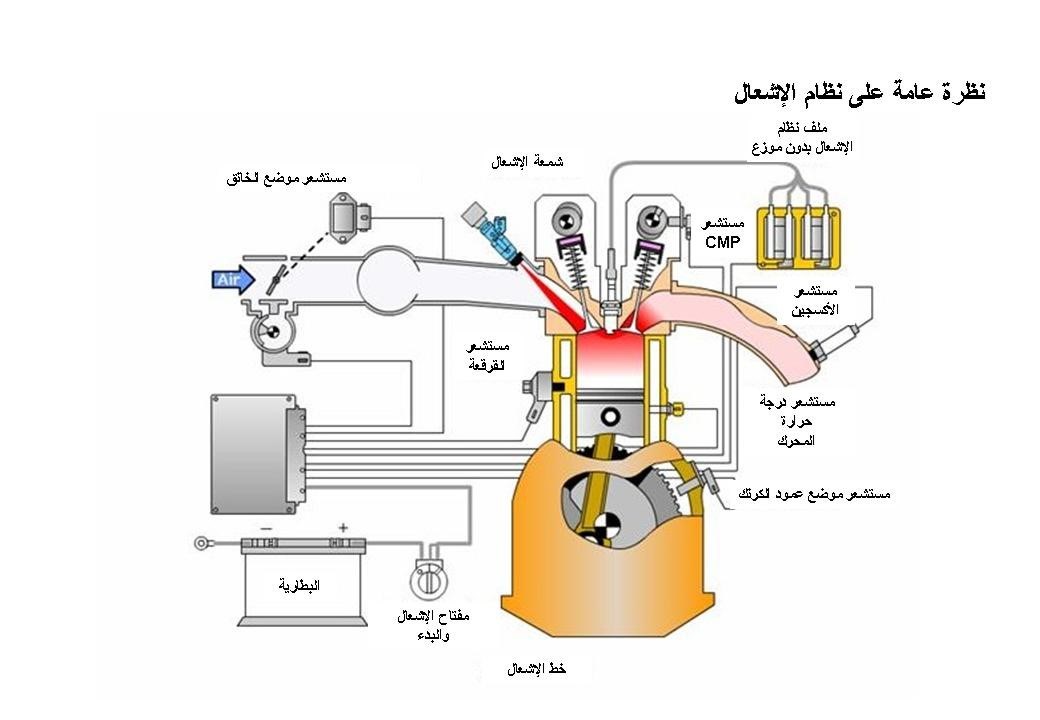
In a computer controlled ignition system, the engine is provided with nearly perfect ignition timing features. The electronic control unit sets the ignition timing based on sensor inputs. The internal memory of the ECU contains the optimum ignition timing for each engine operating condition. Despite the fact that the ignition system is integrated and controlled by the engine management system, the components are somehow independent of the injection system, although they do share some input signals. But there are also some sensors used specifically for the ignition system. So let’s take a look at controlling the ignition system.
Ignition systems are divided into two main categories:
1- Distributor type.
2- Distributer less Ignition (DLI) system.
All newer models use a distributorless ignition system.
The main components: 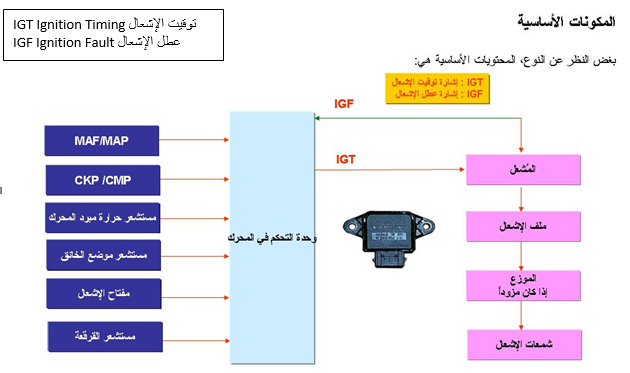
The purpose of the ignition system is to ignite the air/fuel mixture in the combustion chamber at the right time. To achieve maximum engine output efficiency, the air/fuel mixture must be ignited so that the maximum combustion pressure appears at approximately 10° beyond the upper final middle position. The required ignition timing depends on: engine speed, mixture, etc.
The picture shows the main input signals needed to control the ignition timing, which are:
1- Throttle Position Sensor (TPS)
2- Input of the Mass Air Flow (MAF) sensor or the manifold pressure sensor (sensor) MAP Manifold Absolute Pressure Sensor
3- Engine Coolant Temperature ( ECT ) Sensor
4- Crank Shaft Position Sensor ( CKP )
5- Ignition key (contact).
6- Cam Shaft Position Sensor (CMP)
7- Knock Sensor.
Based on the input, the control unit sends an Ignition Timing (IGT) signal to the igniter (power transistor). When the ignition timing signal is cut off, the igniter turns on and disconnects the main current in the ignition coil which then generates a high voltage spark (7 kV-35 kV).
Advanced and static angle control:
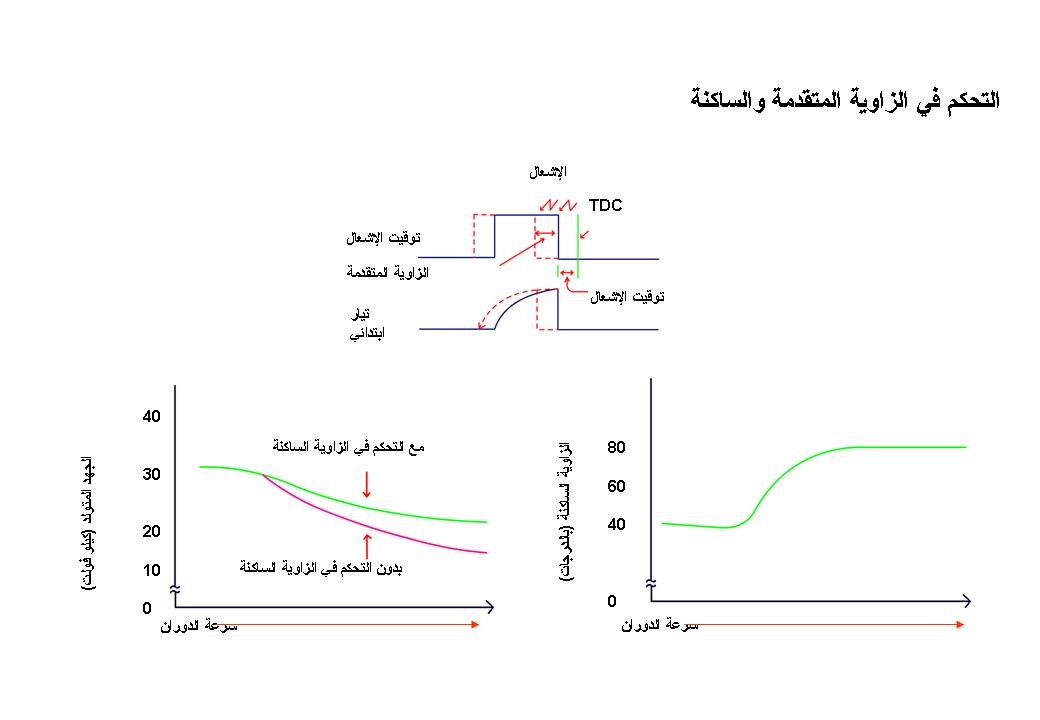
( TDC ) Top Dead Center The highest dead point the piston reaches in the engine cylinder
static control
Generally speaking, the time available to supply current to the primary winding decreases as engine speed increases. So the induced voltage in the secondary winding also decreases. To keep the secondary voltage as high as possible, the controller extends the operating time as much as possible (static angle) to minimize this adverse effect.
Anti-lock
The power transistor is turned off if it is locked (if current continues to flow longer than specified), to protect the ignition coil and power transistor.
Overvoltage prevention circuit: cuts off the power transistor(s) if the power supply voltage becomes too high, to protect the ignition coil and power transistor.
Advanced Sparks Strategy: 
Ignition spark progression varies according to many factors. To provide optimum spark progression in a variety of engine operating conditions, the spark progression chart is stored in the engine control unit. This scheme provides accurate spark timing during any combination of engine speed, load, coolant temperature and throttle position while using the signal from the knock sensor to adjust fuel octane changes. The engine control unit provides the spark angle for cold engine starting and delays it in conditions of excessive temperature and high-altitude operation, especially if a knock is detected.
Effective ignition timing = prime ignition timing + ignition main advance angle + ignition corrected advance angle (delay)
Ignition main advance angle:
Ignition main advance angle:
The ECU calculates the main advance angle by estimating the engine speed and intake air volume signals. These sensor signals have the greatest effect on calculating the basic timing.
Other sensor inputs also affect the main advance angle of the sparks. The A/C compressor clutch signal advances the main spark angle when the idle switch is engaged and on some engines the main advance angle is retarded/admitted if the ECU estimates regular fuel is in use, based on signals from the engine knock sensor.
Engine temperature correction:
To improve drivability if the engine is cold, the ignition angle is advanced. The ECU takes into account the volume of intake air and the condition of the immobilizer, to determine the amount of cold advance to be added to calculate the primary spark.
Non- clutch stability correction: To prevent a run-up due to a changing closed-loop air/fuel ratio, the ECM advances the timing if the mixture is commanded to lack the injectors (fuel injection volume decreases). This very small amount of headway added to the main advance corner stabilizes the idle speed.
Timing correction:

EGR flow correction:
The timing is presented from the base calculation when the neutral switch is on and EGR is active.
High Altitude Correction:
Improves engine performance and neutral gear during high altitude operation with additional advanced timing (some systems only).
Electronic shift shift correction (transmission):
In some applications with the integrated electronicshiftfunction (electronically controlled transmission), the engine and transmission ECU will temporarily delay the main advance angle during gear shifting. This strategy helps reduce shift shocks by reducing engine torque.
Correction of the engine bearing idle stability:
When the idle speed changes due to an overload, the ECU adjusts the timing to stabilize the idle speed. The electronic control unit constantly monitors and calculates the average engine speed. If the velocity rate is less than the target rotational speed, the ECU adds progression to the main spark angle.
Correction of overheating: 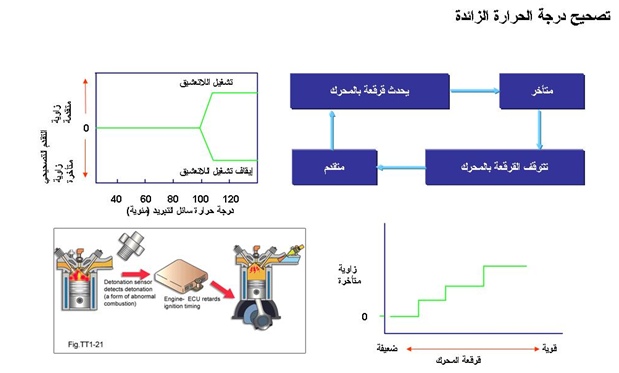
When the engine temperature reaches too high, the ECU advances the timing if the neutral is on to prevent overheating. When neutral is off, the electronic control unit delays sparks to prevent an explosion. With the knock sensor, the engine and ignition system can be started at maximum efficiency close to the knock limit. If a knock is sensed, the timing is delayed based on the scheme value stored in the ECU, after which it will try step by step to return to the base value. If a knock is detected again during this process the timing is delayed again, otherwise the progression will continue until the base value is reached. If the difference between the knock signal and the noise level is below or above the limit during a specified period of time, the DTC and ignition delay are set to a constant value. The knock sensor needs to be tightened to the torque specified in the workshop manual.
Knock Correction: The ECU constantly monitors the signal from the knock sensor to detect any knocking. If a knock is detected, the main advance angle is delayed according to the signal strength of the knock sensor. Once the detonation stops, the ECU gradually returns to the main advance angle. The detonation correction strategy allows the engine to operate at optimal timing regardless of fuel octane, maximizing engine performance when using high octane fuel.
Knock control and ion current exploration:
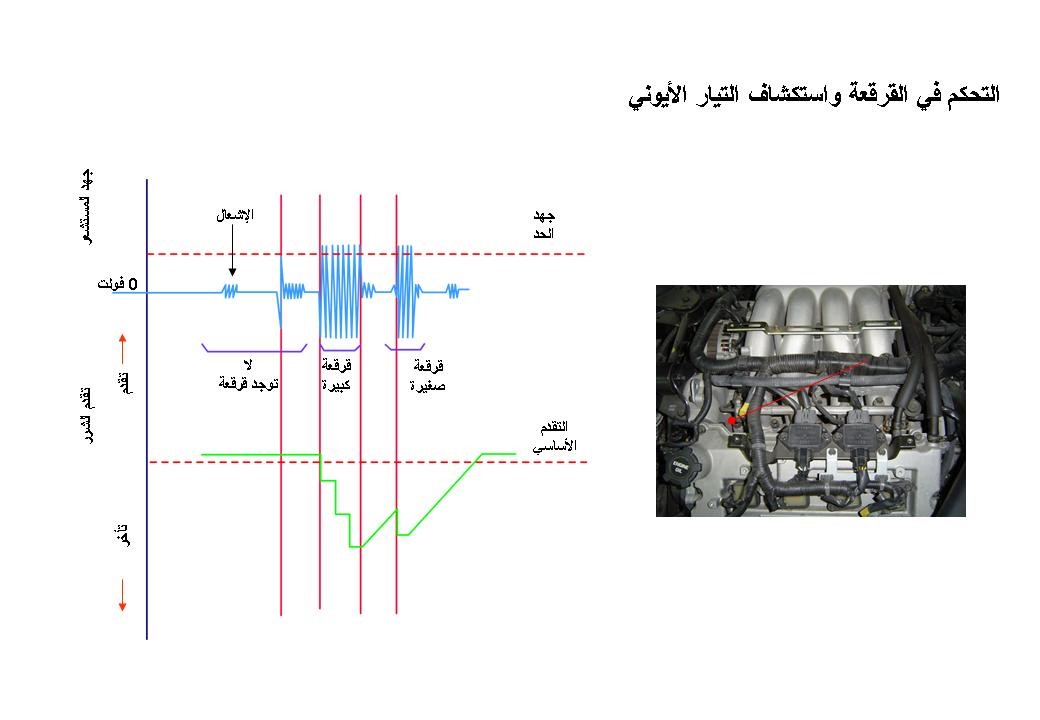
With the knock sensor, the engine and ignition system can be started at maximum efficiency close to the knock limit. If a knock is sensed, the timing is delayed based on the scheme value stored in the ECU, after which it will try step by step to return to the base value. If a knock is detected again during this process the timing is delayed again, otherwise the progression will continue until the base value is reached. If the difference between the knock signal and the noise level is below or above the limit during a specified period of time, the DTC and ignition delay are set to a constant value. The knock sensor needs to be tightened to the torque specified in the workshop manual. A faulty coupling can lead to an unnecessary delay in the ignition timing or in the worst case, engine damage! Another way to detect knock or to achieve better combustion is to measure the ionic current. The ion current detection unit uses the spark plug electrode as an ion sensor. It uses low power with the spark plug and then measures the current flow at the electrodes. This signal is used to control the injection and ignition to achieve the optimum value for each individual cylinder. As the gas mixture in the cylinder burns, the particles in the cylinder are ionized. When a voltage of an ionic current is applied to probe the electrode supplied inside the cylinder (the spark plug in this case) in the ionized state, a current can flow, the ionic current. Since the flow of ionic current is sensitive to change according to the combustion conditions within a cylinder, the quality of combustion can be judged by measuring the ionic current. Knocking can also be detected by the waveform of this ionic current, as it vibrates when a knock occurs. Thus, the combustion conditions in the cylinder can be directly detected. As the gas mixture in the cylinder burns, the particles in the cylinder are ionized. When a voltage of an ionic current is applied to probe the electrode supplied inside the cylinder (the spark plug in this case) in the ionized state, a current can flow, the ionic current. Since the flow of ionic current is sensitive to change according to the combustion conditions within a cylinder, the quality of combustion can be judged by measuring the ionic current. Knocking can also be detected by the waveform of this ionic current, as it vibrates when a knock occurs. Thus, the combustion conditions in the cylinder can be directly detected. As the gas mixture in the cylinder burns, the particles in the cylinder are ionized. When a voltage of an ionic current is applied to probe the electrode supplied inside the cylinder (the spark plug in this case) in the ionized state, a current can flow, the ionic current. Since the flow of ionic current is sensitive to change according to the combustion conditions within a cylinder, the quality of combustion can be judged by measuring the ionic current. Knocking can also be detected by the waveform of this ionic current, as it vibrates when a knock occurs. Thus, the combustion conditions in the cylinder can be directly detected. Since the flow of ionic current is sensitive to change according to the combustion conditions within a cylinder, the quality of combustion can be judged by measuring the ionic current. Knocking can also be detected by the waveform of this ionic current, as it vibrates when a knock occurs. Thus, the combustion conditions in the cylinder can be directly detected. Since the flow of ionic current is sensitive to change according to the combustion conditions within a cylinder, the quality of combustion can be judged by measuring the ionic current. Knocking can also be detected by the waveform of this ionic current, as it vibrates when a knock occurs. Thus, the combustion conditions in the cylinder can be directly detected.
There are no reviews yet. Be the first one to write one.