
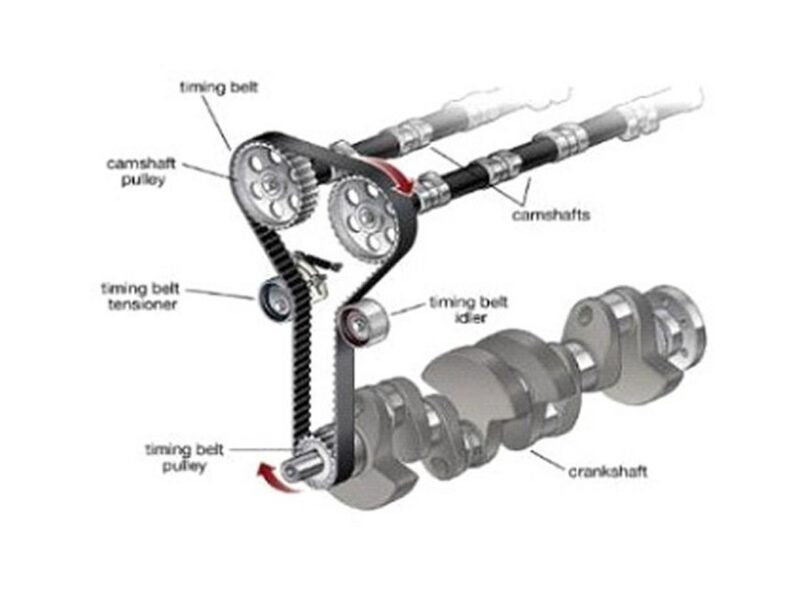
Timing belt (cassette belt) is a belt made of rubber most of the time that connects the crankshaft (crank) and the camshaft, which leads to the transmission of movement between the crankshaft which is connected to the pistons and the camshaft and is responsible for opening and closing the valves, the speed of the camshaft is Half the crankshaft speed, meaning that one camshaft turn is equal to two crankshaft turns.
In many modern engines the timing belt is connected to many components such as the water pump, injection pump and fuel pump. In order for the timing belt to work accurately and correctly, the tension must be adjusted correctly, meaning that the tension must not be too tight or loosen the fastening on it, which makes it not perform its function correctly. In modern cars, the provisions are adjusted automatically without interfering with its adjustment. .
When replacing the timing belt, it is very important to adjust the timing correctly. Before installing a new timing belt, the crankshaft and other components synchronized with the crankshaft must be aligned in a certain way. The repair manual contains appropriate instructions and a diagram with timing marks. Setting the timing incorrectly will result in a variety of problems, including: loss of power, check engine light blinking, vehicle vibration (shake) and more.
Timing belt or chain?
Not all cars have a timing belt. Many new cars use a timing chain instead of a belt. The timing belt wears out over time and needs to be replaced after a certain number of kilometers The chain can last as long as the engine itself does not need to be replaced unless there is a problem with it.
If you don’t know if your car has a timing belt or chain, you can check your owner’s manual. If you do not have the owner ‘s manual, you can browse the owner’s manual for your car from here
When should the timing belt be replaced?
The timing belt must be replaced as recommended by the manufacturer, usually from 60,000 miles to 105,000 miles (96,000 km to 168,000 km). You can find the recommended replacement period in your owner’s manual. If the timing belt is cut or cracked, it must be replaced as this may damage the engine.
If it is not replaced in time, it can cut off the timing belt. If you are close to the mileage limit for changing the timing belt, or if you bought a used car and you don’t know if the timing belt has been replaced, it is a good idea to have the mechanic check the car.
What happens if the timing belt is cut?
If the timing belt breaks, the engine will not start anymore If the timing belt breaks while driving in the engine, the camshaft stops moving and some of the engine’s valves are left open. The heavier crankshaft will continue to rotate by the inertia that moves the pistons up and down. This will cause the pistons to hit the valves that are left open. This may result in significant engine damage with broken valves and damaged pistons
There are no reviews yet. Be the first one to write one.