
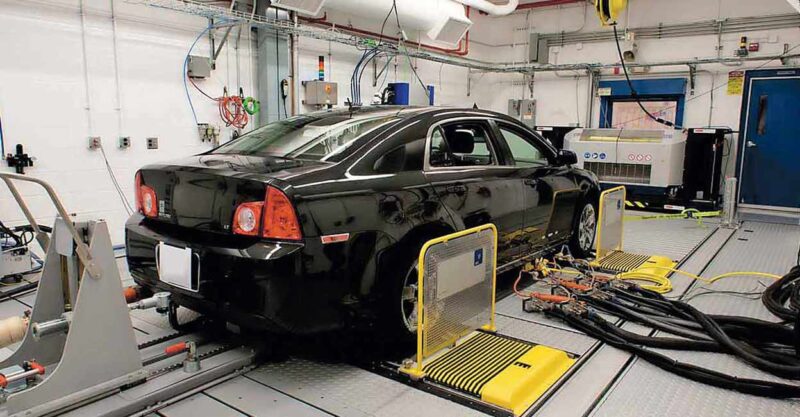

Precautions to be taken when carrying out any engine test
– apply the retaining brake, and secure the calf when starting the engine
– connect the exhaust pipe to me when performing the test in a closed place Connect to the exhaust outlet
– keep clothes, tools, hands and equipment cords away from rotating parts of the engine such as fans and belts
– Disconnect the battery cable if recommended in the maintenance manual to avoid accidental start-up or short circuit
– Avoid touching the hot exhaust manifold when removing spark plugs or letting instrument wires touch the manifold
– Wear eye protection when cleaning spark plug housings or working near a circuit fan
– Keep a fire extinguisher ready near the test site, especially when testing the fuel system
– Refer to the technical instructions in the maintenance manual when performing engine tests so as not to damage the sensors
– When testing a diesel engine and you need to dismantle the fuel injectors, the fuel injection pump must be disabled, as the system pressure is so high that it can penetrate the skin and eyes.
deterioration of the engine condition may be due to damage or wear of the engine body or parts or a malfunction of the engine auxiliary systems; Such as the ignition system, the fuel system, the exhaust system, the cooling system, the air intake system.
The condition of the motor can be judged by observation, but we need to perform motor tests to accurately judge the condition of the motor and determine the source of the failure.
Judging the deterioration of the motor condition by the following observations:
– Engine performance: lack or difficulty starting, irregular operation (cutting or stalling)
– Vehicle performance: unresponsiveness to acceleration (pulling), inability to climb, inability to reach high speed (evidence of poor engine power and torque), High fuel consumption (evidence of inefficient combustion).
Engine condition: engine overheating, engine vibration, high engine oil consumption other than or in addition to leaking.
– Observation: the appearance of smoke in the exhaust, the presence of traces of liquid leakage, the illumination of the warning lamps in the dashboard, and the presence of visible damage to the parts.
Hearing: noise from the engine.
– Detection: lack of fluid quantity, deterioration of fluid condition, non-conformity of clearances to the amount of standard clearances.
Judging the condition of the engine by engine tests:
| The purpose of the test | device used | the test |
| * Determining the condition of the engine * Determining the leakage in the combustion chamber – valves – interlocks – piston rings and cylinder walls | pressure gauge | Pressure Testing Engine Compression Test |
| – Identifying engine problems – Determining the correct timing of the valves – Determining the exhaust problems – Judging the condition of the valves – Judging the condition of the valves and cylinders | vacuum gauge | Test dislocations Engine Vacuum Test |
| – Determine the quality of your knitting cylinders. Determine the source of mechanical failures in cylinders. | Compressed air source, pressure gauge | Test leak engine Cylinder Leakage Test |
| – Determining the defect of spark plugs, connecting wires, and injectors – Parts of the valve opening system – Determining the cylinder that gives less power. | engine check device | Test the ability of poise cylinder engine Cylinder Balance Test |
| – Determining the condition of the bearings – Judging the efficiency of the oil pump | pressure gauge | Engine Oil Pressure Test |
| – Identify fuel system problems – Identify mechanical problems for the engine – Identify ECU problems – Identify ignition problems – Judging the efficiency of the pollution prevention system | exhaust gas analyzer | Exhaust Gas Analysis Test |
| Determining a blockage problem: – catalyst – muffler – sound damper – exhaust pipe | Low pressure gauge or vacuum gauge | Test back pressure exhaust Exhaust Packpressure Test |
There are no reviews yet. Be the first one to write one.