
Motors quad and two – stroke
Four- and two-stroke engines



| Four stroke engine | two-stroke engine | |
| Advantages | – Higher operating life – Higher operating efficiency, lower fuel consumption – Less air pollution – Less noise – Maximum power distributed over a wide range of crankshafts – Lower maintenance rate | – Higher power than the four-wheel drive, which has the same capacity and at the same rotational speed (assuming twice the power due to ignition occurring once per crankshaft revolution instead of two) – It has a high ratio of weight to power as it is lighter in weight and more capable – Less production cost, And cheaper – It can be operated in any position, as there is no oil container like in the four-wheel drive, which limits its position – Less parts and therefore easier maintenance and lighter weight – Light weight made it used in hand-held equipment (tree trimmer, saw) – Operation Soft as it burns every lap, and needs a smaller flywheel for a four-wheel drive of the same capacity |
| Defects | – More parts – Less power than a twin engine of the same capacity and at the same revving speed, power stroke every two crankshafts – Higher price – Heavier weight | – Faster wear, shorter operating life, due to lack of suitable lubrication system – Needs to add oil to gasoline, increases operating expenses (add oil to fuel in a ratio of 1:16 to 1:24) – More pollution, due to simplicity of design (no valves) Leaks Part of the charge, also burning oil with the charge – Low efficiency, as a result of simple design, leads to higher fuel consumption – High sound and high noise – Low power at slow speeds – Poor filling efficiency, charge escapes and part of the exhaust remains in the cylinder – Hotter, temperature High due to combustion per revolution, and not enough cooling time – maximum power is concentrated in a narrow range of speeds (rpm) and at higher speeds – higher maintenance rate |
* Stroke is the distance the piston travels from its maximum point inside the cylinder (upper dead point) to its lowest point inside the cylinder (lower dead point).
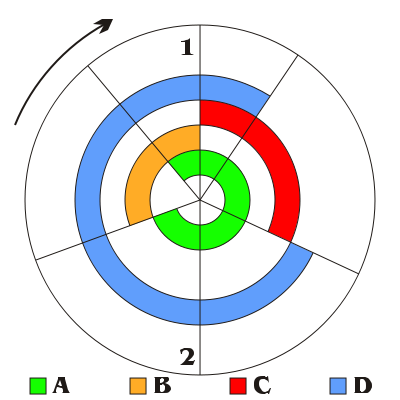
* The internal combustion engine works through a cycle , this cycle consists of four procedures to complete the combustion process (intake, pressure, power, exhaust), and it is repeated after that. A four-stroke engine that completes these procedures in four strokes, and the crankshaft rotates for two turns, is called a four-stroke engine. A two-stroke engine is called when it completes these procedures in two strokes, and the crankshaft rotates one revolution.
Four-stroke engine:
| Round number | the half | piston movement | fuse placement | crankshaft movement | ||
| procedures | intake valve | exhaust valve | ||||
| 1 | Clouds intake | down | Open | Closed | 0 to 180 degrees (1/2 turn) | |
| 2 | Pressure pressure | up | Closed | Closed | 180 to 360 degrees (1/2 turn) | |
| 3 | Ability power | down | Closed | Closed | 360 to 540 degrees (1/2 turn) | |
| 4 | Exhaust exhaust | up | Closed | Open | 540 to 720 degrees (1/2 turn) | |
| number of runs | 4 runs | Number of crankshaft turns | (2 roll) | |||
– the intake valve opens at the end of the exhaust stroke and closes at the beginning of the compression stroke
– the exhaust valve opens at the end of the power stroke and closes at the beginning of the intake stroke
– the spark occurs at the end of the compression stroke (while the piston is rising and before the upper dead point)
Two-stroke engine:
| Round number | the half | piston movement | crankshaft movement | ||
| procedures | |||||
| 1 | Pull and pressure intake & compression | up | 0 to 180 degrees (1/2 turn) | ||
| 2 | The ability of exhaust power ‘s & Exhaust | down | 180 to 360 degrees (1/2 turn) | ||
| number of runs | 2 stroke | Number of crankshaft turns | (1 roll) | ||
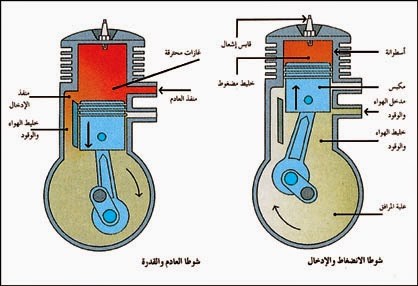
– To complete the required four actions in only two strokes, the bottom of the piston (crankcase) is used to do this
– As the piston rises to compress the charge above the surface of the piston, drag occurs (the charge enters the bottom of the piston)
– As the piston goes down in the power stroke, the charge pressure occurs at the bottom piston; At the end of the power stroke, the charge from the bottom of the piston enters the piston to sweep the exhaust.
There are no reviews yet. Be the first one to write one.