
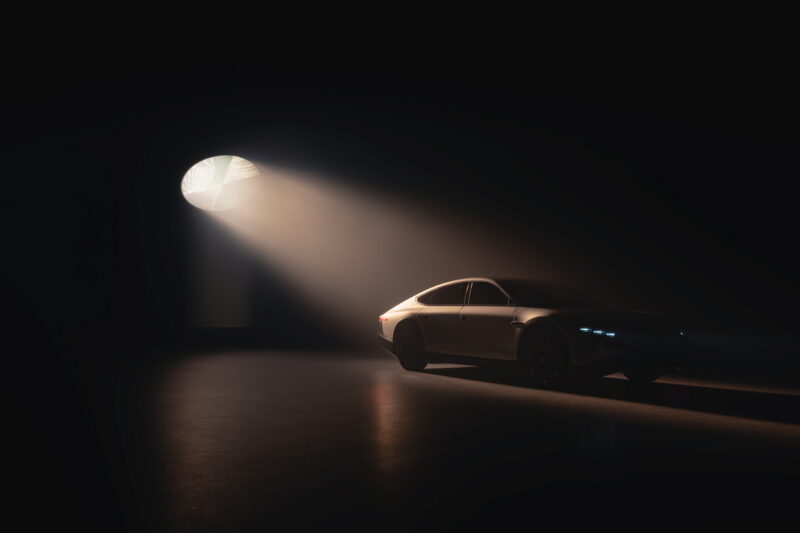
Last year, the Light year One car appeared, which means “light year”, and it is a solar electric car that has the ability to self-charge itself while relying on solar energy only, but it turns out that this car was just a model. Experimentally, the final model was the Light Year Zero, which was recently revealed by Lightyear , and is expected to be produced next fall before being delivered to buyers at the end of 2022.
LightYear Zero Solar Electric Vehicle Launch Video
The solar electric car also retains its elegant and graceful aerodynamic look and design, but with a few minor design differences in the front and rear lights, as well as the fog lights.

The LightYear Zero has very high aerodynamics, with a drag coefficient of 0.19, and the possibility of adding lower rear bumper edges (optional) to enhance the aerodynamic movement.
In the same regard, the Dutch company LightYear says that this optional specification increases the range that the car travels with the electric charge, so that it reaches more than 11 kilometers per electric charge, and the car also obtained cameras that came in the area behind the front wheel arches with the aim of photographing the area Car rear view mirrors instead of side mirrors.
The “LightYear Zero” solar electric car can be charged once every 7 months

The company LightYear explained that it has focused in its solar electric car on improving the level of aerodynamics, and on the other hand reducing air resistance, due to the fact that it uses a relatively small battery compared to its power of up to 60 kilowatts per hour, and accordingly the company says that The car owner can stay for many months (7 months) without the need to recharge the battery.
But it is noted that this only happens if the car owner’s daily commute does not exceed 35 km during the day, and provided that he parks his car in the sun, and in that LightYear says that the solar cell system is able to generate enough electric power to cover a distance of 70 km meters per day.
To make it easier for you, dear reader, as you started your day with a fully charged battery, and walked less than 70 kilometers every day, according to Lightyear, you can spend a long period of time up to more than 7 months without the need to use a car charger electrical.
On the other hand, according to the official
WLTP system approved to measure the range of electric cars within Europe, a test was conducted for the distance traveled by the new LightYear Zero solar electric car with a full battery, and it was noted that the car could travel up to 624 kilometers.

But please note that this previous range is only recorded without considering the ability of the solar cell system to recharge the battery, but when calculating the range resulting from the generation of solar cells, it can reach in this case more than 100 km, and this distance is very large compared to a battery have the same size.
For example, we find the Nissan Leaf’s battery, which has a power of 62 kilowatts per hour, and provides a range that does not exceed 365 kilometers when the battery is fully charged.

From this standpoint, we confirm that the LightYear Zero has already succeeded in achieving these exciting and record numbers by reducing air resistance, as well as the use of carbon fiber during the manufacturing process for the exterior car structure, which resulted in a significant reduction in weight, which is evidenced by this. The weight of the car now reached 1300 kg.
What are the disadvantages of the LightYear Zero solar electric car?

After we got acquainted with the great advantages and capabilities of the new solar electric car LightYear Zero, the most prominent of which is its long range that makes it able to walk great distances and for a period of up to more than 7 months without recharging, which makes the Dutch company LightYear in front of strong competition And fierce with Tesla.
Despite the advantages that the solar electric car has, it is not without flaws. In contrast, the makers of the LightYear Zero had to give up high performance capabilities, and we find that it takes approximately ten seconds to accelerate from zero to 100, which It’s hard to imagine given its elegant, sporty design.
It is noted that the total power of the car reaches 136 hp with a torque of up to 1200 Newton / meter only, do not rush to judge this large number, as the torque decreases over time through the transmission system in the car by 8 to 1, which means Because you will only feel about 150 Nm of torque.

Compared to the Nissan Leaf, which produces 320Nm of torque, you can beat the LightYear Zero in any race.
In addition to the above, there is another drawback of this solar
electric car , which is that its price is very high compared to other electric cars, as LightYear is offering it for sale for 250 thousand euros, excluding the value of taxes and the cost of shipping.
What is a solar vehicle and how do solar panels on cars work?

The term “solar panel vehicle” is generally used when describing any car that has solar cells built into its design, so that such cars can run quite smoothly at night and in the absence of sunlight thanks to the panels storing solar energy in their batteries.
As for how these solar panels work on cars, it can be said that these panels contain photovoltaic cells (PV), where these photovoltaic cells produce the amount of light or photons, and then convert them into solar electric energy.
As soon as sunlight strikes these solar panels, these photovoltaic cells produce an electric current in a direct way.
The electricity generated by this process is converted to standard voltage by a control unit, and then stored in the battery.
There are no reviews yet. Be the first one to write one.