
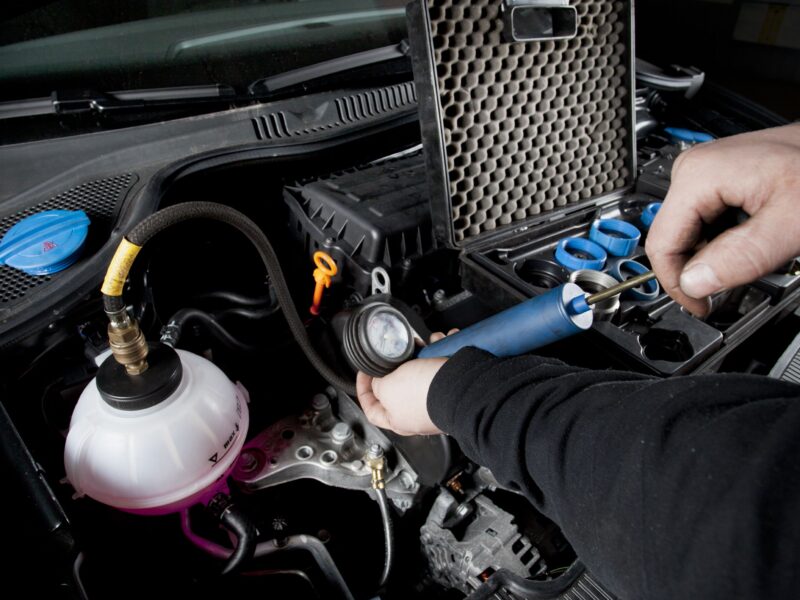

Without the radiator working properly in the car, your car will become like toast, so if you suspect that there is a leak in your car radiator, do the following steps to detect and fix the leak before the engine overheats.
How does the radiator work?
The radiator is designed with ducts or tubes thin and hollow from the inside, and is placed in the front of the car in front of the engine.
Coolant is pumped from the radiator through the tubes to the engine, where the heat is drawn.
When the coolant is returned to the radiator, the cooling process is carried out through the air that passes from the front openings of the car in addition to the presence of a fan.
This cycle takes place throughout the engine life until the engine is running under the ideal temperature because in the absence of coolant or coolant, the engine will overheat.
The first step is to
mark the location of the leak.
One of the most important signs of a leaking radiator is the presence of green or yellow water under the car, it may be small drops of water or at other times it may be a puddle of water.
Another sign is to monitor the car’s temperature if there is an increase in temperature or not. At times, you may find water vapor rising from the radiator, which indicates a hole in one of the radiator tubes. The radiator and hoses can be flushed and leak monitored after the engine is running.
Be careful when checking your engine: engine parts will be extremely hot and could cause burns, always be very careful when checking for leaks in your car’s cooling system.
Step Two
Check the parts
The radiator must be checked and made sure that there are no cracks or breaks in the radiator tubes and check that there are no leaks.
All hoses, including the hot coolant hose that comes from the engine, and make sure that there is no swelling because in this case the hoses are prone to cracking or leaking.
The water pump and the return coolant tank, and also check for corrosion or leakage in the cylinder head gasket. If you do not find any external leakage, the leak may be internal and a specialized mechanic should be visited as soon as possible.
Step Three
Try These Temporary Fixes
If the leak is small enough, you can try using a sealant which is a liquid or powder added to the coolant while the coolant is cold in the starter kit. This substance works its way into the nooks, crannies and leaks providing a near seal permanent.
You can also use cold epoxy. Soldering
requires you to empty the coolant and apply the epoxy when everything is dry.
If the leak is in one of the hoses, you can also resort to some tools such as using adhesive.
A step IV
go to the repair shop if you’re not sure
what the above is only temporary repairs unless you feel confident enough to do it yourself, there may be a lasting solution more is to take your car to the auto repair shop where you will know if you need repairs Complete or replace if the damage is too great.
There are no reviews yet. Be the first one to write one.