
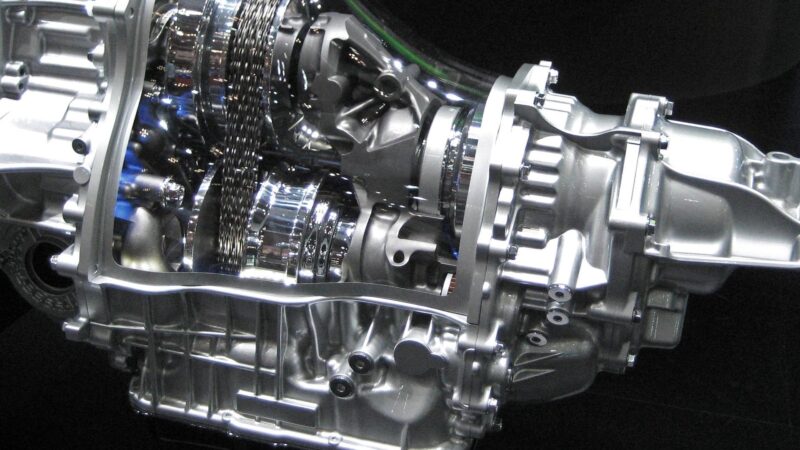

Why do automakers use a variable transmission system? Cars with automatic transmission lose part of the torque while changing gears, and the CVT has a lower penalty, which makes it simple and easy to maintain, as the process of changing the ratio between gears is easily done without interruption, which saves gasoline consumption.
What are its drawbacks? Is it suitable for walking or racing? What to consider when buying a used car with CVT ?
Before talking about that, we will simply talk about the idea of the CVT . The CVT
system relies on two pulleys or two wheels connected to each other through a belt, the size of the wheel moving from or to which the speed is changed according to the driver’s desire. Manufacturers are working on solutions to increase torque In the CVT system , but it is limited at the moment which makes the torque in most cars much higher than that of that system and for this reason it cannot be used in small trucks.Another drawback is that it is expensive to repair as the repair process is done by Replacing the valve body or the whole system needs to be changed and this is very expensive.Can the transmission be used
CVT in high performance cars? Nissan uses CVT models in most of its lineups. CVT
works well in small to medium cars and SUVs. Manufacturers of CVTs keep the engine at a higher degree of acceleration to reduce the load on the CVT variator . Because of their design, CVT engines are better suited for city driving with better fuel consumption and moderate load. If you need a car for long daily commutes on the highway or sporty driving, a conventional automatic or manual transmission will do better in our opinion. What to watch out for when buying a used car with CVT ?
The first question should be about warranty, because as mentioned, CVT transmission repair is expensive.
What are the first signs of CVT problems :
1. Shift delay When shifting from parking to driving or vice versa, it takes more than a second or two for the shift to take place.
2. Abnormal noises in some cars are more noticeable when accelerating and in others when decelerating or going downhill.
3. Loss of acceleration or skidding.
4. Feeling of tremor when changing from one position to another.
5. The lubricating fluid is not clean.
There are no reviews yet. Be the first one to write one.