
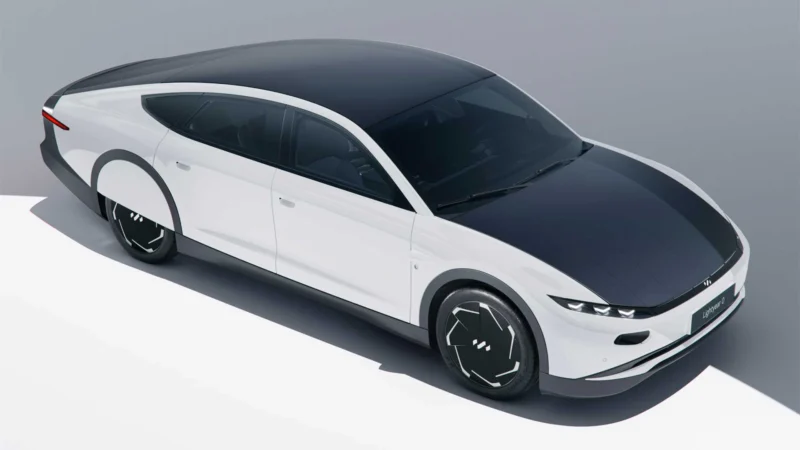
Last June, startup Lightyear officially unveiled its first all-new, incredibly energy-efficient Solar-powered Lightyear 0.
It is the world’s first solar electric car, the world’s most aerodynamic production vehicle and the world’s most aerodynamically productive car.
The Dutch company described it as a car with “more range, less battery” featuring in-wheel drives and aerodynamic design, with a record-breaking drag coefficient.
Covered with solar panels to help it move towards a new carbon-neutral era and towards a zero-emissions environment, the vehicle is designed to be as efficient as possible to take advantage of its array of solar panels.
Depending on the climate the sun can provide around 3,700 to 6,800 miles of range per year. Only 946 units of the Lightyear 0 will be produced, and it ain’t cheap. Lightyear says the 0 starts at 250,000 Euros (about $266,000), nearly double the initially announced price of the One in 2019.

New Solar Lightyear Zero
- The Lightyear is the most sustainable, most aerodynamic production vehicle in automotive history. With the best drag coefficient of a production car in the world, the drag coefficient is a major contributor to the overall efficiency that positions the new solar car as the market leader.
- A good (low) drag coefficient means a car that is more economical and uses lighter electricity, and as a result, can drive farther on a single charge, so electric car companies are interested in the drag coefficient numbers and compete in the aerodynamic ratings of their models.
- Tested at the FKFS wind tunnel facility in Germany, according to WLTP, testing confirmed that the car had an astonishing record drag coefficient of 0.175, making it the smallest drag coefficient or drag coefficient ever recorded in any production car in automotive history.
- After relegating the luxury Mercedes EQS to a distant second place, with a Cd of 0.20, it also beats the 0.23 Cd of the market-leading Tesla Model 3, and even the limited-edition Volkswagen XL1 Diesel-Electric Hybrid, which scored a Cd of 0.186.
- Although the company previously stated the car’s drag coefficient was closer to 0.19, but after recent design updates, it has been reduced to just 0.175, which is a 12.5% improvement over the EQS.
- Obviously, aerodynamics has to be balanced with cabin space and luggage so that not every car reaches a drag coefficient of less than 0.20, but most automakers have plenty of room for improvement.
Specifications of the new Solar Lighter Zero
- It makes sense that a solar-powered car makes the best use of energy, and therefore, its elegant design is not only about appearance but about being as light in terms of energy consumption as possible, as the car’s aerodynamics and agility in the exterior design ensure low air resistance while driving, and support a longer range And it consumes less energy.
- The car is covered in patented dual solar arrays panels integrated into its fully streamlined roof and hood, covering an area of approximately 54 square feet (5 square metres).
- Allowing the vehicle to be charged any time it is in the sun while commuting or standing outdoors, these panels provide an additional 70 kilometers (43 miles) per day from the sun, or up to 11,000 kilometers (6,835 miles) per year depending on weather conditions. Southern Europe, from solar energy only, which relieves drivers of dependence on charging stations.
- Weighing in at just 3,472 pounds (1,575 kg), the car is slightly heavier than the Toyota Supra, despite having an overall length of more than 16.4 feet (5 metres), just under the BMW 7 Series.
INTERIOR SPECIFICATIONS
- Inside, the company promised that the car will have a 10.1-inch touchscreen that can be refreshed through the air, with upholstery in all-vegetal and natural-source textiles like microfiber suede seats and rattan palm details.
- Key to this record-breaking achievement is the highly efficient heating system, low drag coefficient and of course that elegant aerodynamics, which Lightyear considers the biggest factor in efficiency and therefore range.
- It is estimated that the new Solar Lighter 0 will have an all-electric range of up to 1,000 km on a single charge from a relatively small 60 kWh battery, but the range will of course change depending on the nature of the climate and temperature.
- This is thanks to the impressive aerodynamics, aerodynamics and highly efficient wheel-mounted engines.
- By ignoring solar charging, the new car is able to run entirely on electric power up to 388 miles (625 km) per charge of a realistic electric range according to the European WLTP test cycle.
- 625 km is not a record, the Tesla S Long Range achieved 652 km in the WLTP test, but the Lightyear 0 only has a 60 kWh battery which in mainstream electric cars saves an average of just 450 km.
- In fact, at highway speeds of 68 mph (110 km/h), aerodynamics accounts for about 60% of total energy consumption, with estimates suggesting that the car could travel 348 miles (560 km) before running out of power.
- The manufacturer claims that its electric propulsion system is currently the most efficient, using only 10.5 kWh of energy for every 62 miles (100 km) at highway speeds.
The price of the new Lightair 0 solar car
- The company is in the final stages of factory preparations, which heralds Lightyear 0 production to begin this fall, and the manufacturer will produce just 946 units of it annually.
- The first deliveries are expected to start as early as November 2022, with a starting price of 250 thousand euros (equivalent to 263,243 thousand US dollars).
- The startup also plans to develop its second product, the Lightyear 2, which will go into production in late 2024/early 2025, with a starting price of 30,000 euros ($31,589,000).

There are no reviews yet. Be the first one to write one.