

Transmission / manual gearbox
Manual transmission / Gearbox
Manual Transmission Manual Transmission / gearbox (transfer of torque and movement “directly or enlarge or reduce torque at the expense of speed” from the clutch to the axis of the calf). Types, working theory, parts.
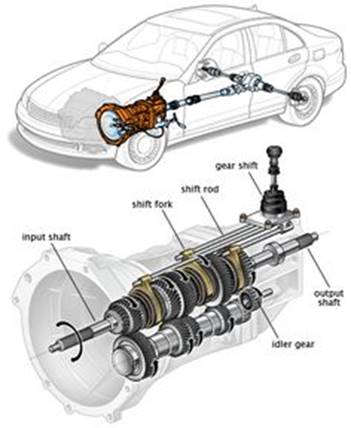
The transmission/gearbox provides a choice of gears suitable for different driving situations: starting from a stop, going uphill, or going on a flat road. The lower the gear shift, the lower the wheel’s rotational speed compared to the engine speed (first gear: less speed and greater torque, second gear: more speed than the first, less torque than the first, and so on..). The gearbox is the second stage in the power transmission system, its arrangement after the clutch. It is usually installed at the rear of the engine, with the clutch between them. Modern cars with a manual transmission have four or five forward gear (1,2, 3,…) and one reverse gear (R), plus a neutral (N) position. The gearshift lever, operated by the driver, is connected to a number of selectors at the top or side of the gearbox. The selection shafts shall be parallel to the shafts bearing the gears. The most popular design is the constant-mesh gearbox, which has three shafts: the input shaft, the lay shaft, and the main shaft, all of which rotate on bearings attached to the gearbox housing. There is also an idler pinion for the reverse gear. The engine drives the input shaft (via the clutch), which drives the neutral shaft. The neutral shaft drives the gears in the main shaft, which rotate freely on the shaft, until they are engaged with the shaft as selected, by means of a synchromesh device, which is mounted on the shaft’s splined shafts. The synchronous gear is what the driver actually operates, via the shift lever, by moving it on a selector shaft with a fork that then turns the synchronizer into gear. Some gearboxes have an additional gear, called an overdrive. It provides a higher speed than the high gear speed and thus gives an economical driving at the cruising speed. (1, 2, 3 gears have a transmission ratio less than 1, decreases speed, increases torque. direct drive (speed and torque are transferred as for an engine), over drive increases output speed and decreases torque).
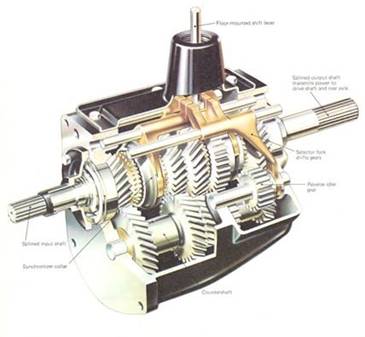
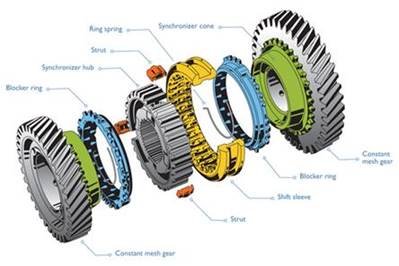
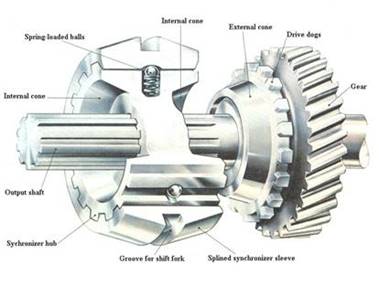
manual transmission, also known as manual gearbox, stick shift, n-speed manual, it is called standard transmission, or MT for Manual Transmission, or colloquially In US English, “stick”, relative to the way gears work, is a transmission used in vehicles. It uses a clutch operated by a pedal used by the driver’s foot pedal for cars, and a manual lever for motorcycles, to regulate the torque transmitted from the engine to the transmission system. It has a gear selector by hand (by cars) and by foot (by motorcycle).

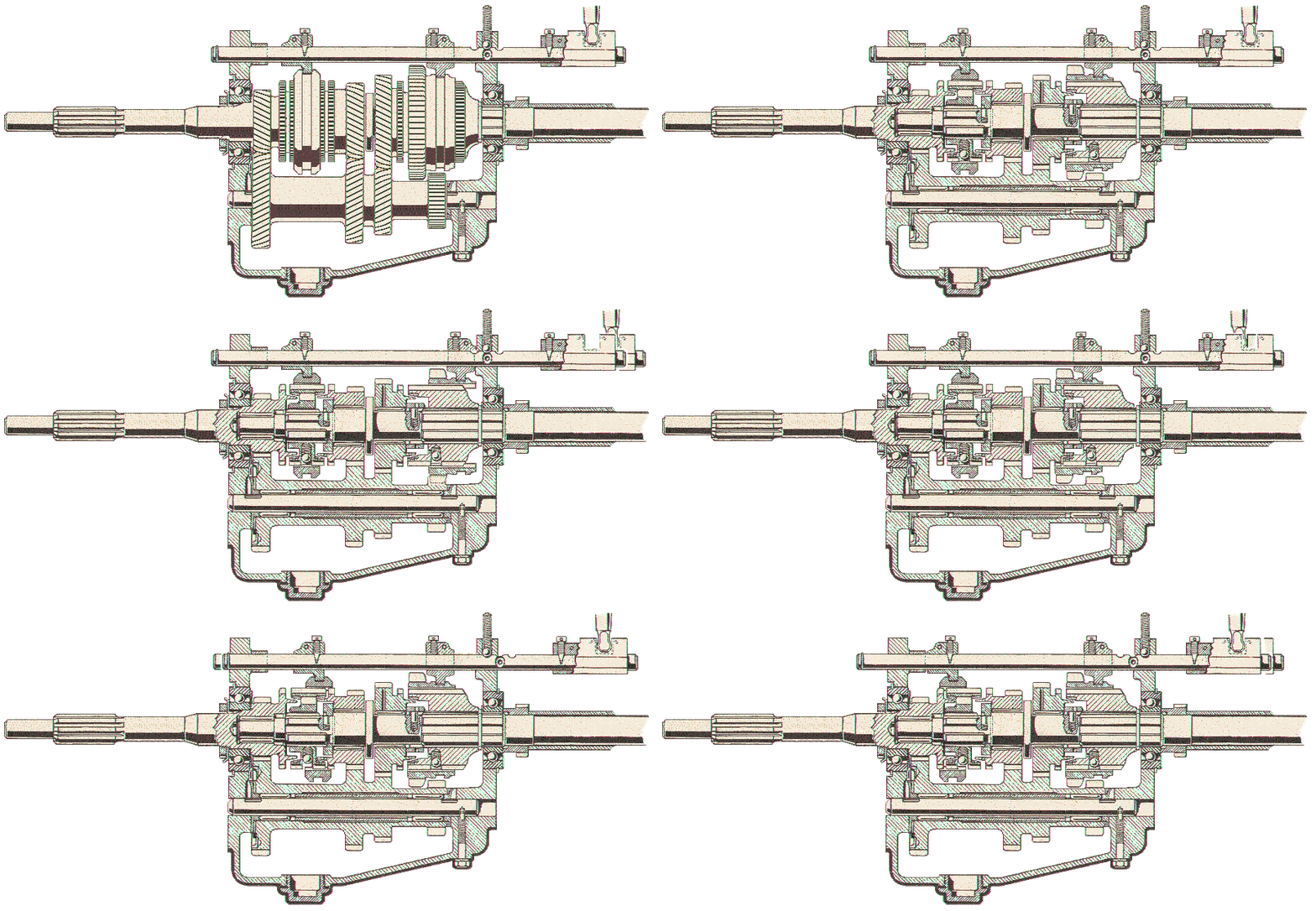
A modern transmission where all gears are connected at all times is called a constant-mesh transmission , which uses synchro-mesh to engage the gears with the freely rotating shafts. Another type of manual transmission is called a sliding mesh transmission , in which the gears on the shafts are not meshed with each other, and are slid onto the shaft by means of a fork connected to the selector lever.
 |  |
| sliding mesh . gearbox | constant mesh . gearbox |
The manual transmission system features a driver-operated clutch and gear stick. Most auto transmissions allow the driver to select the forward gear ratio at any time. But some of them, such as those usually found on motorcycles and some cars, allow the driver to only choose the next higher move or the previous lower move. This type of transmission is called a sequential manual transmission. In addition to the ease of use for the driver, this type is distinguished by the fact that the use of the clutch by foot or hand can be reduced or completely eliminated, and the use of the clutch is limited only at the beginning from a complete stop.
In a manual transmission, the flywheel contacts the crankshaft of the engine and rotates with it. The clutch disc is located between the pressure plate of the clutch and the flywheel, and it communicates with the surface of the flywheel by the pressure exerted on it by the pressure disc under the influence of springs. When the engine is spinning with the clutch engaged (there is no foot pressure on the clutch pedal), the flywheel rotates the clutch disc and thus the transmission. With the clutch pedal pressed, the clutch is pushed out bearing , preventing the pressure disc from affecting the clutch disc and thus preventing the clutch disc from getting power from the engine, so the driver can make the gearshift without the force between the gear teeth . When the foot is removed from the clutch pedal (releasing the clutch pedal), the clutch disengagement bearing is deactivated, and the clutch disc is pushed back onto the flywheel surface, allowing it to start receiving power from the engine.
Modern car transmission usually uses four to six forward gears and one rear gear, and the range of gear shifts in some cars may be from two to seven. Transmission for heavy trucks may have a number of gears from 8 to 25, which provides a wide range of gear with close gear ratios to keep the engine working during the power band of the engine.
On most manual transmissions, the gears are selected using a lever called the gear stick, shift stick, gearshift, gear lever, gear selector, or shifter . This arm connects to the transmission via couplings and cables, and is attached to the vehicle’s floor, dashboard, or steering column.


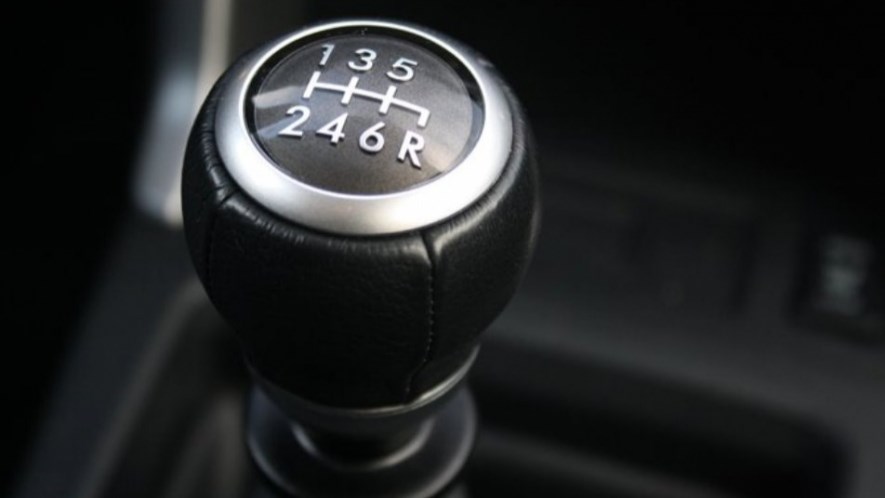
Shift pattern Using the shift stick, it is done as in the drawing of the shift diagram on the handle of the gear selection column to indicate the position of the stick to choose the shifts. Car running.


There are no reviews yet. Be the first one to write one.