
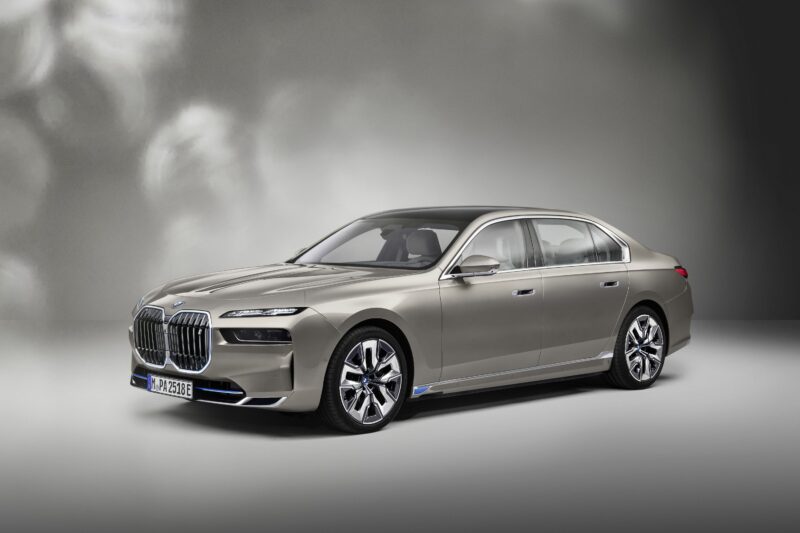

The current generation of the car has been with us for 7 years, and we will soon see a completely new version. BMW offered a preview of the 7 Series prototypes, the first with petrol, and the second with the new 7 Series electric car, the new and fierce competitor to the Mercedes EQS. BMW’s flagship sedans will carry some advanced technologies, the most important of which are semi-autonomous driving and the ability to park the car itself, which means that the new 7 Series will drive itself.
And believe it or not, it’s not a car. Rather, it is more like a luxurious barge that embraces comfort and ease. And if you can’t afford a human driver, this new car offers you a digital chauffeur. But the BMWs we tested were still cars in the process of major development. So let’s dive into the depths of the new BMW 7 Series, in both its regular and electric versions.
Engine options for the regular BMW 7 Series
BMW did not mention concrete facts and technical specifications or the powertrain, but confirmed that the BMW 7 Series will come with a wide range of engines, including a six-cylinder engine and another V8 for America only, both of which are equipped with 48-volt electrical systems, and 12-volt hybrid systems, of course. There will be a diesel engine (for the German market, at least). A hybrid version will also be produced.
The electric drives of the BMW 7 Series
As for the electric BMW 7 Series, the company says it expects it to have a range in excess of 300 EPA-certified miles, can accelerate from zero to 60 mph in less than five seconds, and will be offered with an enhanced twin-motor powertrain with xDrive50 technology. . It will feature 516 horsepower and 564 pound-feet of torque, produced by a 200 kW front motor, 250 kW rear motor, and a 106.3 kWh battery.
The BMW 7 Series electric and regular car with the same name
Instead of separating the name of the pioneering petrol sedan from its electric car, as Mercedes-Benz did, it changed the name of the electric version of the S-Class and called it EQS, but it seems that the large BMW electric sedan will be called the BMW i7 Series within the seventh category, which is similar to it to an extent. Big, and BMW allowed us to tour both versions of the car with a V8 engine, and touring the BMW i7 Series electric version.
The exterior design of the new BMW 7 Series


In terms of design, the BMW 7 Series concept models were still camouflaged, and it appears that the seventh generation of the 7 Series will continue to take on the traditional sedan form, and in my opinion it has taken on an even worse form than the car it replaces. The front end appears to be ditching the circular quad halo lights in favor of twin horizontal strip lights.
The new headlights on the BMW 7 Series remind me of the Genesis design of the front and rear lights. It seems that the kidney grille will be large, and it seems that the rear end will be very conservative with simple and horizontal lights, while taking the normal sedan shape.
The interior design of the new BMW 7 Series
Most of the interior was heavily covered and no photos were allowed, but I can tell you it will have many of the same crystal controls, as well as the same ultra-wide curved, infotainment screens seen in the BMW iX crossover. Sitting in the back seat, I also spotted smaller, smartphone-like screens embedded in the door cards near where the hands rest.


The screen controls audio, climate and displays other information. None of the development prototypes on site had this, but production models will be available with a 31-inch, 8K, ultra-wide, rear-passenger integrated touchscreen infotainment screen that folds down from the roof and looks like the IMAX car edition screens for existing fold-up DVD players. in the back of her pickup truck.
The flexible platform of the BMW 7 Series
The new 7 Series sits on a wider body, increased by 1.9 inches at the front and 0.16 inches at the rear, and sits on larger wheels and wider tires to improve body rigidity and handling. It also rides on a revised double wishbone front suspension and a five-link rear suspension, with a new “acoustic-improving” soft steering gear installed and new rear axle hydraulic mounts to improve ride comfort.
Suspension of the new BMW 7 Series
All 7 Series models get standard two-axle adaptive air suspension with self-leveling and electronically controlled dampers, with locally balancing the air supply at each wheel helping to maintain an “optimal ride height” even at higher speeds. The ride height will drop by 0.4 inches in Sport mode, and the car will drop a lot at speeds over 87 mph.

Optionally, the suspension can be raised by 0.8 inches. While all-round steering is BMW Integral Active Steering, this suspension will be optional on the 740i but standard on the 760i xDrive, reducing the vehicle’s turning radius by 2.5 feet.
Additional and Optional Packages for the BMW 7 Series
The BMW “M Sport Package” normally available on other models is standard for the two combustion cars, but will be optional at no extra cost on the electric BMW 7 Series i7. That means adding 20- or 21-inch wheels on high-performance or all-season tires and a flat-bottom steering wheel.

And for those who hate this genre. The optional M Sport Professional package adds M Sport brakes with black or blue calipers, adds a small rear spoiler, and removes the grille feature.
Driving and riding impressions of the BMW 7 Series prototype
Taking off in the prototype BMW 7 Series powered by a V8 petrol engine, one of the first things I noticed is that it drives more compactly. The rear-wheel steering up to four degrees is really nice.


And when it comes to cornering, the BMW 7 Series handles curves more than decently, like any good BMW. The double wishbone front axle maximizes the contact patch while the noticeably light steering was fairly precise, and I found the car stable in curves. The M Sport’s brakes on the 19-inch wheels were suitably firm, while the pedal touch felt natural and never jerky.

In Sport mode, the car became more enthusiastic and more lively to drive, and the driver’s seat bolsters were inward-facing, holding me well. I also found that the German car at 110 mph was stable and steady on the highway and even felt quite stable, also getting up to speeds was simple and easy.

The accompanying BMW engineers offered to take the wheel, and she sat in the back, showing her prowess. On a short ride of a few minutes, it was enough for me to say that the new 7-Series rides very comfortably, and I felt that the car absorbs all the bumps and ripples softly.
Driving impressions of the electric BMW i7 Series
After driving the petrol V8, I climbed into the electric BMW 7 Series i7. It came as a surprise, and I maneuvered it in and out of highway inclines, and the acceleration of the electric 7 Series is like any other luxury electric car – very smooth and nimble – while remaining stable and stable, especially in corners.

And I can say, I didn’t feel much different driving compared to the Mercedes EQS, believe it or not, I spent most of my time behind the wheel of the electric 7 Series, and in fact, I wasn’t really driving, because the e-driver took off for the first time, and Bemers is The latest technology product from the company does futuristic semi-autonomous driving on highways, and during the motorway trip in the BMW i7 Series, the system has already proven itself to be very capable.
Level 2 automated driving system test for the electric BMW i7 Series
The second level of autonomous driving provided very stable and reassuring performance with lane keeping, and the electronic driver drove the car at speeds of up to 112 mph, even in heavy rain at a speed of 112 mph according to the American specifications, while German-spec cars will be able to drive electronically at speeds of up to 130 miles per hour. The automated system was good and reliable, detecting vehicles in front of the car, while the automatic braking was reassuringly firm but not harsh enough to feel surprising.

As a practical system, taking your hands off the steering wheel for an extended period means the car will prompt you to reset at least one hand. Unlike other similar systems, BMW’s approach uses sensors in the steering wheel rim to detect hand contact with the steering wheel, rather than forcing a steering wheel shake, which might not be ideal when the car is moving at over 100mph.

And when driving at speeds below 85 mph, Level 2 Assisted Driving Plus can engage, providing hands-off on semi-autonomous highways, similar to technologies from Ford’s Super Cruise and Blue Cruze driving systems, and Tesla’s AutoPilot. But they’re systems that still need you to keep your eyes on the road, and the car will beep audibly and visually if it detects you’re looking away or closing your eyes for too long.

But in terms of the actual steering, acceleration and braking, the car was able to do all the work very efficiently, naturally and with complete independence. It was making turn-signal-triggered lane changes that Ford’s system could not yet make, with little hesitation. The movement of the BMW i7 Series from one lane to another was very steady and quick, something BMW says was optimized for the American market, but it was clear that on German streets the car could change lanes more gently.

Once it was time to exit the motorway as planned with the car’s built-in navigation, the BMW i7 Series prompted me to start moving on the far right via the slightly changed lane icon on the dashboard. It indicated right once and the BMW i7 Series started moving automatically one lane at a time before returning to practical Level 2 driving as it entered the actual ramp. This job was really impressive.
If the car deems that maneuvering at the last moment is too much or the traffic is too heavy, it will do the sensible thing and slow down.
Restoration of manual driving for the electric BMW i7 Series
I felt it would be presumptuous to reclaim manual control from the BMW i7 Series on the highway, and I decided to enter the fast lane. I pressed the accelerator pedal, and the electric BMW was surprised at what I was doing and seemed shocked when I reached the electronically limited top speed of around 134 mph. And I got there in no time, and I couldn’t reach the usual German top speed of 155 miles.

BMW tried to maintain the speed set for the yet-to-be-announced M Performance model: when decelerating to 112 or 85 mph it reverts to the semi-autonomous driving mode it was doing automatically, and manages the sudden impulses of manual driving that you’d I perform on highways more smoothly.
BMW declares its legal liability for the BMW 7 Series autonomous driving accidents
BMW says Level 3 autonomous driving at speeds of up to 37 mph does not require the driver to pay attention or follow the wheel, but must remain in the driver’s seat. . The company says it will use what appears to be the most powerful radar in the auto industry. It’s a full-range radar with vertical separation, and is paired with an 8-megapixel windshield camera.

The Bavarian company finally said it would also take legal responsibility in the event of a collision, which Mercedes did earlier this year. The company hasn’t provided more details on the matter, but it’s definitely something to keep an eye on. Yes, I have no doubt that BMW is capable of developing a system that can do this from a technical point of view.
Self-parking of the electric BMW i7
BMW also wants to complement the autonomous driving operations with the automated driver doing the parking process. Automatic parking systems are nothing new, but in my experience, the process was actually quite whimsical. After a demonstration of the new BMW i7 Series, I was worried, but the car was more accurate at professional parking, reversing and distance maneuvering, and it looks like BMW is really on to something new.

All you have to do is take the car to a place where you parked, whether perpendicular or parallel, and just turn on the function, and the car will be able to detect the parking place. And it will ask you to confirm the selection of this position on the central touch screen, and when you confirm your desire to do so, you will park, and when you try to adjust the movement by using the brakes, the car will continue to steer itself.
New to this system is the addition of augmented reality in the real-time camera view which shows you exactly where the car is going, which certainly increased my confidence as the i7 maneuvered around several parked cars.

Did you know that the new BMW i7 can also recognize when you arrive home, and will navigate to your driveway, or where you are, and take over and park itself inside your garage. Just set the location of the starting point, program the route to your place, by driving manually just once, and the car will save this entire routine and ask you if you would like to do it semi-autonomously each time you reach that starting point.

The car can be controlled via BMW’s smartphone app while parked outside, just like Hyundai’s SmartPark system, but instead of simply moving forward and backward, the car can memorize up to 200 meters of pre-programmed routes. And when you try to adjust its movement, the car does not automatically cancel the self-driving function.

There are no reviews yet. Be the first one to write one.