
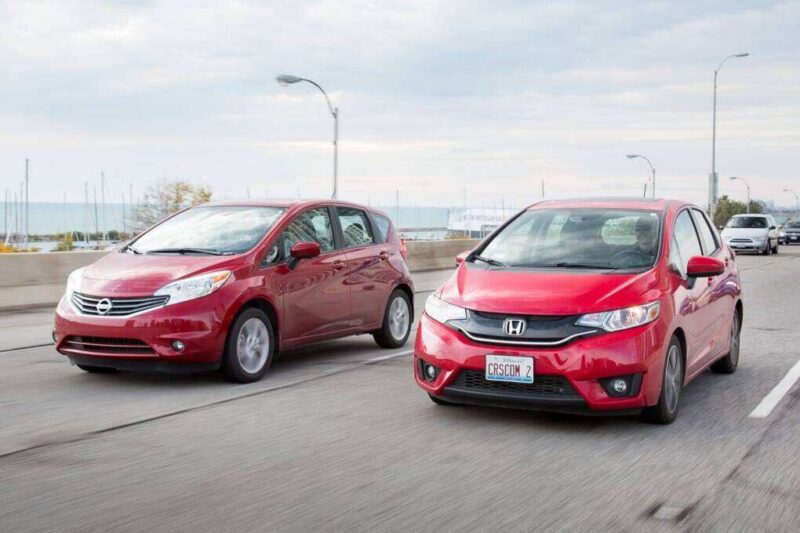

Honda Fit, designed to be more professional and more practical for a large group of users, this time Honda did not rely only on providing the distinctive shape, but for the first time Honda cares about what is under the skin, and offers a distinctive model of the small sports hatchback.
The first thing to notice about the 2015 Honda Fit is its new look, which resembles an attractively designed pickup truck, the glass-to-metal ratio is more acceptable than past models, and the car’s styling looks perfect for suburban cars and city traffic.
The dimensions of the car were intentionally reduced, the overall length lost 1.6 inches compared to the previous generation, the width lost 0.3 inches, the height remained unchanged at 60 inches. Legroom has been expanded with the wheelbase now 99.6 inches, 1.2 inches longer than the second generation.
One of the most important features that has not been changed in the new generation is what Honda calls the magic seat, where the rear seat can be controlled in four positions to accommodate more passengers, or goods.
With Honda’s promise to provide eco-friendly models, it used its proven technologies to reduce fuel consumption. The new engine’s displacement is 1.5 liters, while its power increases by 13 hp to 130 hp at 6500 rpm and 114 lb-ft at 4600 rpm of torque.
The transmission this time comes with six manual gearboxes, or a CVT automatic transmission instead of the original seven-speed automatic transmission. With the new engine and new transmission, fuel economy will be 33 mpg city and 41 mpg highway.
Nissan Sport Sedan
Nissan Nissan Sport Sedan The Nissan Sport Sedan Concept is one of the most admired cars from the public, amid speculation that it will be the nucleus of the next generation of “Maxima” and the dimensions of the car reveal that the sport sedan comes very close to the current “Maxima” in all dimensions.
The car has a 3.5-liter V6 engine with 300 horsepower sent to the front wheels through a continuously variable transmission (CVT) like the one in the current Maxima, powered by a XTRONIC CVT driven by 21-inch front wheels.
In my assessment, I side with Nissan, because it is often more practical and powerful, waiting for your opinions and comments
Honda Fit, designed to be more professional and more practical for a large group of users, this time Honda did not rely only on providing the distinctive shape, but for the first time Honda cares about what is under the skin, and offers a distinctive model of the small sports hatchback.
The first thing to notice about the 2015 Honda Fit is its new look, which resembles an attractively designed pickup truck, the glass-to-metal ratio is more acceptable than past models, and the car’s styling looks perfect for suburban cars and city traffic.
The dimensions of the car were intentionally reduced, the overall length lost 1.6 inches compared to the previous generation, the width lost 0.3 inches, the height remained unchanged at 60 inches. Legroom has been expanded with the wheelbase now 99.6 inches, 1.2 inches longer than the second generation.
One of the most important features that has not been changed in the new generation is what Honda calls the magic seat, where the rear seat can be controlled in four positions to accommodate more passengers, or goods.
With Honda’s promise to provide eco-friendly models, it used its proven technologies to reduce fuel consumption. The new engine’s displacement is 1.5 liters, while its power increases by 13 hp to 130 hp at 6500 rpm and 114 lb-ft at 4600 rpm of torque.
The transmission this time comes with six manual gearboxes, or a CVT automatic transmission instead of the original seven-speed automatic transmission. With the new engine and new transmission, fuel economy will be 33 mpg city and 41 mpg highway.
Nissan Sport Sedan
Nissan Nissan Sport Sedan The Nissan Sport Sedan Concept is one of the most admired cars from the public, amid speculation that it will be the nucleus of the next generation of “Maxima” and the dimensions of the car reveal that the sport sedan comes very close to the current “Maxima” in all dimensions.
The car has a 3.5-liter V6 engine with 300 horsepower sent to the front wheels through a continuously variable transmission (CVT) like the one in the current Maxima, powered by a XTRONIC CVT driven by 21-inch front wheels.
In my assessment, I side with Nissan, because it is often more practical and powerful, waiting for your opinions and comments
There are no reviews yet. Be the first one to write one.