

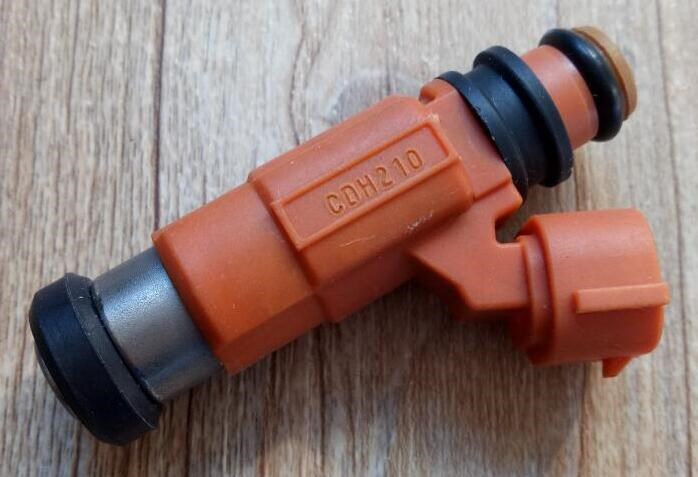
Increasing strict laws to reduce car exhaust pollution and competition in designing engines with less fuel consumption while maintaining high engine capacity in the seventies and eighties of the last century led to work continuously to develop the carburetor, until the development became useless with The more stringent the laws and the more complex the feeder. With the entry of electronics into the automotive field, the fuel intake system switched to the electronic injection system, replacing the simpler, less expensive, and less parts feeding system with the fuel injection system.
Fuel injection involves injecting or injecting fuel directly into the engine’s intake manifold. It has many advantages over the car burettor system. These features include improved driving in all conditions, improved fuel control and economy, reduced exhaust pollutants, increased engine efficiency and increased power, and ease of maintenance and repair.
The electronic refueling system has proven to be the most accurate, reliable, and economical method of supplying fuel to today’s automobile internal combustion engine. ELECTRONIC FUEL INJECTION SYSTEM The correct air-to-fuel ratio must be provided at all engine loads, at all speeds, and at all associated temperatures. To achieve this, the system uses a fuel supply system, an air intake system, input sensors, an electronic control unit, atomizers (injectors), and some no-load speed control systems.
Although fuel injection technology began to emerge in the 1920s, in the 1980s auto manufacturers began replacing the feeder system with systems electronic fuel injection (EFI).
The first appearance of the fuel injection system for American cars was in the late fifties, followed by the emergence of fuel injection in European cars in the late sixties, and the transition to fuel injection began to take a high acceleration during the seventies and eights, and in the early nineties most cars in the world started using the electronic fuel injection system.
The different fuel injection systems can be classified in several ways as follows:
1- According to the method used for fuel injection
a. Mechanical injection
b. Electro-Mechanical Electro-mechanical injection
c. fuel injection (EFI)
2- According to the shape of the fuel injected
a. Continuous fuel injection (CFI)
b. Intermittent
3- The place of fuel injection a.
Central
Throttle body injection (TBI)
– Port fuel injection (PFI)
b. Multi-point injection (MPFI)
– Sequential
– Batched
– Simultaneous
c. Direct injection (DI)
4- Time Evolution
a. – Jetronic (D, K, L, Mono-Jetronic), fuel injection control.
B. Motronic (M, KI, Mono-Mettronic), integrating fuel injection and ignition control.
Various fuel
injection systems Throttle body injection:
(This system is also known as single point injection, or central fuel injection).
Many of the systems that first appeared were throttle body injection (TBI) systems in which the throttle was injected above the throttle valve, in the same location as the fuel entry via the feeder. General Motors called it the TBI system, and Ford called it CFI (continuous fuel injection). Engines equipped with a throttle system gradually switched to port fuel injection (PFI) systems, in which the injectors are mounted on the intake port of the cylinders.
Central port injection (CPI) system:
Developed by General Motors, this system may be called a central port fuel injection (CPFI). This system uses tubes extending from the central injection to deliver fuel at each intake manifold rather than through the throttle. In this system, fuel is continuously injected to all the nozzles at the same time, which is not an optimal method.
Multi-point fuel injection (MPFI):
(This system is also known as a multi-port fuel injection, or sequential fuel injection).
In this system, fuel is injected into the intake manifolds before the intake valve rather than at the center point in the intake manifold. This system can be sequential, in which the injection coincides with each intake stroke of each cylinder. Or it is batched, in which the injection is for all cylinders and without compatibility with any of the intake strokes of any cylinder. Or it is simultaneous, in which the injection is at the same time for all cylinders.
Direct injection (DI):
(also called gasoline direct injection (GDI))
Some modern cars use direct injection. It is a multipoint injection and the injector is installed inside the combustion chamber. This system is more controlled for the exhaust by eliminating the wet part of the intake manifold.
Injection systems for Bosch:
Bosch, for its part, has developed the fuel injection system for gasoline, through several injection systems, and has also developed a system that combines the injection system and the ignition system in a system called the Motronic engine management system. And improving the control factors in the two systems, taking into account the requirements of combustion procedures.
The following table shows the development history of Bosch’s fuel injection and ignition systems:
| Gasoline-injection systems: | ||
| D-Jetronic | D-Jetronic | 1967- 1979 |
| Ka-Jitronic | k-Jetronic | 1973- 1995 |
| L-JETRONIC | L-Jetronic | 1973- 1986 |
| LH – Jetronic | LH-Jetronic | 1981-1998 |
| Kai – Jetronic | KE-Jetronic | 1982- 1996 |
| Mono-Jitronic | Mono-Jetronic | 1987- 1997 |
| Ignition systems: | ||
| ignition coil | Coil Ignition (CI) | 1934- 1986 |
| transistor ignition | Transistorized Ignition (TI) | 1965- 1993 |
| semiconductor ignition | Semiconductor Ignition | 1983- 1998 |
| Integrated systems of ignition and fuel injection gasoline (Combined ignition and gasoline injection systems) : | ||
| M-Motronic | M-Motronic | since 1979 |
| Ki-Motronic | KE-Motronic | 1987- 1996 |
| Mono-Motronic | Mono-Motronic | Since 1989 |
Jetronic Jetronic
is the brand name for the type of fuel injection technology marketed by Bosch from the 1960s onwards. Bosch has licensed the idea to several car manufacturers. Over time there have been many variations in technology, which represent a technical improvement of the system.
– D-Jetronic system (1967-1976): It
is a system that works by means of a sensor that measures the pressure (vacuum) in the intake manifold that is used to estimate the engine load (the amount of air used by the engine). This system was initially called jetronic only, but the name de-jetronic was given to it to distinguish it from the new types. The name “D” comes from the German word Druck, which means pressure. This pressure is sent to the ECU to calculate the amount of fuel needed.
K-Jetronic (1974-1988): It
is a hydraulically operated continuous gasoline fuel injection system that introduces fuel to the engine as a function of the intake air. The fuel is injected continuously from all the injectors. The name “K” comes from the German word Knotiuerlich, which means continuous, and was called “CAC” by Volkswagen, Audi and Mercedes, which means continuous injection system (CIS).
– K-lambda Jetronic
system, and the system can be extended through the Lambda closed-loop control system to obtain a low value for the exhaust gases.
– KE-Jetronic system (1985-1993):
To obtain less exhaust gases in terms of pollution, it led to the addition of an electronic control unit (ECU) to the system, a primary pressure regulator, and a pressure activator to control the air/fuel mixture vehicles, to turn System to KE-Jetronic system. It may or may not be equipped with a lambda control circuit, which is an electronically controlled mechanical system, and it is designed to operate mechanically in the event of a failure of the electronic system.
L-Jetronic (1974 -1985):
It is a system that uses an air flow meter to measure the amount of air entering an engine. It performs intermittent fuel injection as a function of the amount of air drawn into the engine, and engine speed, among many other influencing factors. The name “L” came from the German word Luft, which means air. There is another opinion that the name L came because this system came immediately after the Ki system (the letter L follows the letter K in the Latin letters). It is also called the AFC injection system Air-Flow Control (AFC).
– LE-Jetronic (1981 -1991):
It is a simpler and more advanced system than the L-Getronic system. The ECU is cheaper to produce and has more modern components. There are three types of LE, there is LA1 the basic type, then LA2 (1984), it has cold start activation inside the electronic control unit, and does not need an injector (sprayer) to start the cold management, and a thermal timer as in the systems previous. And the L3 system (1989), which uses a hybrid technical system, and the system has become using digital technology, and thus it was possible to perform a control that was not done with the previous system. It does not have a closed system to control lambda.
– LU-Jetronic (1983-1991): It
is a system similar to the LI 2-Jetronic system, but it has a closed circuit to control the range to meet the requirements of the American market.
LH-Jetronic (1983-1998):
It is an electronic digital fuel injection system. Instead of measuring the amount of air drawn into the engine, the air mass is recorded and measured with a hot wire. This makes the formation of the correct air/fuel ratio independent of atmospheric conditions. LH is the German word Luftmasse-Hitzdraht which means the measurement of air mass by means of a hot wire. There are many different types such as LH 2.2 which uses the Intel 8049 (MCS-48) microcontroller, LH 2.4 which uses the Siemens 80535 microcontroller.
Mono-Jetronic System (1988-1995):
This system has one central injector. This system is called in the American system TBI, which differs from other known types, one injection point, that it depends on the throttle position sensor to judge the engine load. There are no sensors to measure air flow or vacuum in the intake manifold. The system has a closed circuit control principle. It uses an Intel 8051
microcontroller. Motronic engine management system:
It is the first electronic engine management system that combines the Jetronic system with the electronic ignition timing control system in one unit. In early Motronic systems there was an integration of the ignition timing control system with existing Jetronic fuel injection systems such as L, LH, K and some Mono. It was developed and used in BMW 7 Series cars, before being used in Volvo and Porsche engines starting in 1980.
The system control unit receives information related to engine speed, crankshaft position, intake manifold airflow, cooling water temperature, and throttle position , as well as the temperature of the air entering the engine after passing through the turbocharger and intercooling.
There is also a transformer to send information to the control unit in the event that any internal electrical unit is operating, which needs an increase in the speed of the empty load. There is also a cold start injector (cold start) to provide rich fuel during cold start.
– KE-Motronic
system This system is based on the K-Jetronic system for the continuous injection system.
Mono-Motronic
system This system is based on the Mono-Jetronic intermittent injection system.
– M-Motronic
system This system is based on the L-Jetronic system for intermittent injection system in the intake manifold.
ME-Motronic
is an integrated electronic throttle control (ETC) system in the M-Motronic system.
MED-Motronic
is a system that combines in one system direct petrol injection, electronic ignition and electronic throttle control.
– DI-Motronic (Direct Gasoline Injection)
In engines with direct petrol injection, the mixture ratio of air is formed directly into the combustion chamber. During the intake stroke, air is drawn only through the intake valve, and the fuel is compressed at high pressure into the combustion chamber by means of a special injector. Accurate calibration, preparation and distribution of inlet air and fuel for each combustion stroke reduced fuel consumption rates and reduced exhaust emissions.
Bosch’s direct gasoline injection system is a torque-controlled system that breaks new ground for the direct gasoline injection sector. This intelligent system adjusts various parameters for each requirement of various driving situations. At partial loads, the system provides a poor air/fuel mixture, and at full load it provides a homogeneous mixture of air/fuel.
There are no reviews yet. Be the first one to write one.