


The engine depends on several systems to do its work, these systems are classified as engine operating systems. Starting system, air intake system, charging system, fuel system, ignition system, lubrication system, cooling system, pollutant control system, exhaust system.
Purpose of Lubrication System:
- The system lubricates moving parts to reduce wear by trapping the clearances between moving parts such as bearings, shafts, …etc. Thus, the parts move on a layer of oil, and not by direct contact with each other, thus reducing the loss in engine power caused by friction with the connecting rod and cam shaft.
- The oil cools the moving parts of the engine and transfers them to the cool oil in the oil pan. Thus, the oil acts as a cooling medium. Some engines have injectors that spray oil at the bottom of the pistons, thus eliminating heat from the pistons.
- The oil carries load by filling the clearances between the rotating parts and the bearings. When the load on the pistons on the bearings is increased, the oil acts as a damping agent.
- The oil seals by forming an interlock between the cylinder walls and piston rings, thus reducing gas blowby from the cylinders to the crankshaft case.
- The oil does the cleaning by cleaning the surfaces of the abrasive parts of the metal filings and carrying them to the crankshaft case. Large parts remain at the bottom of the crankshaft case and small parts are filtered by means of a filter.
- Reduce wear by preventing metal-to metal contact between moving parts.
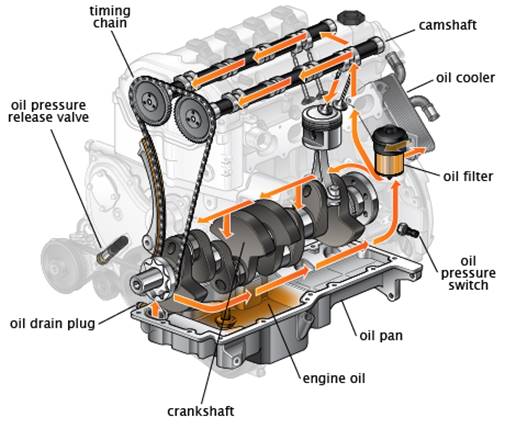
Engine Parts Lubricated by Engine Oil:
- Movement of the piston inside the cylinder wall.
- crankshaft rotation in bearings (main bearing, big end bearing)
- Benz turning the piston pin on the bush connecting rod.
- Camshaft rotation in camshaft bearings.
- reciprocating motion of valve stems.
. Rotational motion of valve gears (in V engines).
- Rotational motion of the turbocharger shaft.
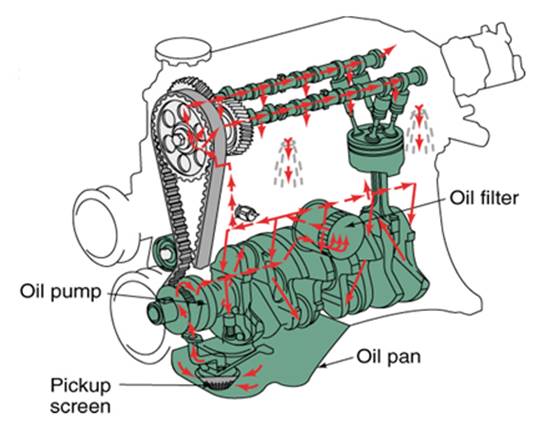
Parts and Operation of Lubrication System:
- Oil pump: Each engine requires a certain amount of oil flow to lubricate bearings, camshafts, valvetrain, and moving parts. This is done by the oil pump. But the oil pump does not generate oil pressure. All the pump does is move the oil and push it through the oil tracks, so it can flow into the bearings and overhead valve assembly. What actually generates oil pressure is the resistance that the oil faces as it flows through the engine. Automobile manufacturers recommend a minimum oil pressure of 10 psi for every 1,000 engine revolutions per minute. Thus, the pressure generated is 50 to 60 psi. The oil is drawn through the floating oil intake and screen, which prevents suspended particles from entering the pump.
There are two types of pumps used in the engine lubrication system:
- The gear pump- Twin gear pumps (also called external pumps)
- The gear-rotor pump- Rotor pumps (also called “gerotor” pumps)
- Oil pan: It is also called the crankshaft box, which is a tank for engine oil and is fixed to the bottom of the engine body by means of screws and is separated by two gaskets for threading the oil. At the lowest point of the basin there is an oil filter. The sump contains an oil pump. Oil dipsticks are used to measure the oil level in the oil sump.
- Oil cooler: The oil cooler prevents overheating of the oil, through a radiator, so that the coolant passes through pipes carrying the hot oil, and the coolant transfers and cools the heat.
- Oil filter: The oil passes from the oil pump through the oil filter to the engine bearings. The filter prevents the passage of impurities and suspended particles and allows the pure oil to pass through.
- Lubrication system indicator: There is an indicator light that lights up when the oil pressure is low.
- Motor oil: There are many types of different viscosities available in the market.
- Oil and Radial shaft seal Gasket: to prevent oil leakage from between the parts connected to its parts, gaskets between the neutral surfaces, and interlocks to prevent leakage from the rotating shafts.
- Oil dipstick: The oil dipstick passes through an external tube and rests inside the crankshaft case. It has two marks, max and min. The oil level should be between the two marks.
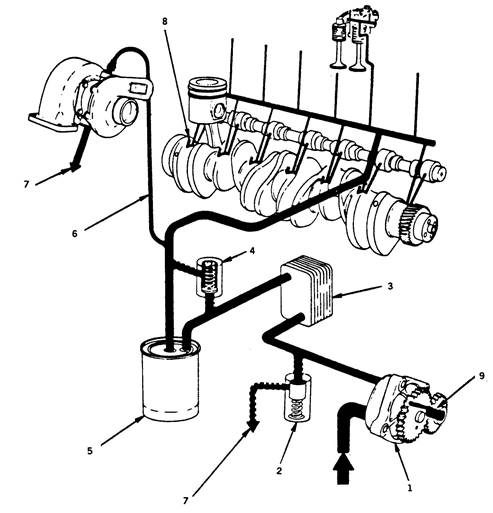 |
| 1. LUBRICATING OIL PUMP 2. PRESSURE REGULATING VALVE 3. OIL COOLER 4. FILTER BYPASS VALVE 5. OIL FILTER 6. TURBOCHARGER OIL SUPPLY 6. TURBOCHARGER OIL SUPPLY 7. OIL RETURN TO PAN 8. PISTZON COOLING I NO . ENGINE LUBRICATION SYSTE |
There are no reviews yet. Be the first one to write one.