

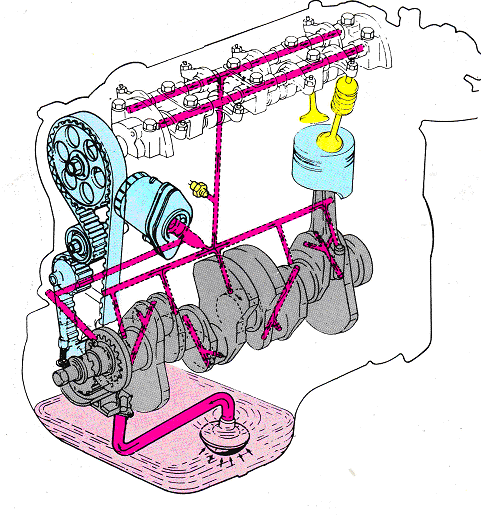
Lubricating System Engine Lubricating System Purpose of Engine Lubrication System
:
- Minimize wear of moving parts.
- Removing some of the heat generated by friction helps to cool the engine.
- The oil acts as a cleaner and removes dust and carbon particles between the moving parts.
4- It absorbs shocks between the chairs and other parts of the engine and thus reduces the sound of the engine.
Engine oil:
One of the functions of the lubrication system is to reduce friction. Where friction occurs between all contacting surfaces. When moving surfaces come into contact, friction slows their movement. This can cause the metal parts to overheat to the point that they may melt and melt together. When this happens, the motor is said to be stuck. Thus, lubrication reduces unwanted friction, and thus reduces wear on moving parts. Clearances are filled with oil so that engine parts move or float on layers of oil rather than rubbing against each other.
Lubrication helps cool the engine. Where it collects heat from the engine, then returns to the sump (oil pan/carrier) where it cools down. It helps absorb shock loads. The power stroke can suddenly impose a force of 2,000 kg on the main bearings. But the layers of oil soften this load.
Oil is also a cleaning tool. It collects the metal and carbon particles and carries them back to the oil pan. And the big pieces fall to the bottom.
In order for an oil to do everything expected of it, it has to have distinct properties. The most important is the degree of viscosity. The degree of viscosity is a measure of how easily a liquid can flow. A liquid with a low viscosity is thin and flows easily. A fluid with a higher viscosity is thick and flows slowly, and the lubricating oil should be thin enough to circulate easily between the moving parts, but not so thin that it rushes out. If it is pushed out, the parts will remain in direct contact and will be damaged. If the oil is too viscous, it will move too slowly to protect the parts, especially in a cold engine.
Modern oils are a mixture of oils that combine these properties. Where oils are mixed with additives. Oils are ranked or rated by the Society of Automotive Engineers (SAE), the American Petroleum Institute (API), or the Society of Automotive Engineers.
SAE:
motor oil with number SAE 50Its viscosity is higher, or thicker, than an oil with the number SAE 20 .
API: API
ratings are different for gasoline and diesel engines. For a gasoline engine, the list begins with the letter “S” (short for Spark means spark plug) whereas a gasoline engine is called a spark ignition engine, followed by another symbol for the standard, eg “SM” and “SH”. For diesel oils, the first letter is “C” (an abbreviation for Compression ) as a diesel engine is called a compression ignition engine followed by another letter to indicate the standard, eg CH.
ACEA:
The letter “G” for Gasoline Engines (short for Gasoline Punch) is placed at the forefront of ACEA standards.(meaning petrol) and the letter “D” or “PD” for diesel engines (short for Diesel ). This is coupled with numerous endorsements by car manufacturers.
Components of the engine lubrication system:
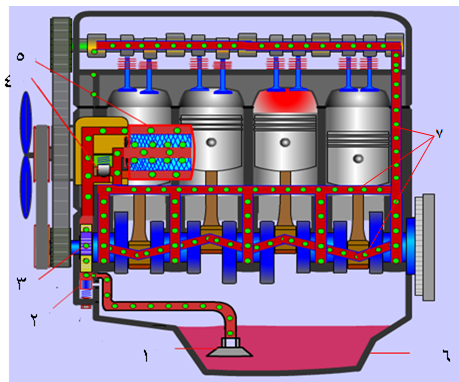
The lubrication system consists of:
- Oil filter. Oil Trainer
- Oil pressure relief valve. Discharge of oil pressure valve
- Oil pump. Oil Pump
- oil pressure indicator Oil Pressure Indicator
- oil filter (oil filter) Oil Filter
6- Oil tank / oil pan
7- Oil Pipes
The lubrication system distributes oil throughout the engine. The oil is drawn from the sump by the oil pump. The oil pipes are small passages in the cylinder block that are responsible for directing the oil To the moving parts The tubes allow oil to be supplied to the camshaft bearings, the valve mechanism and the crankshaft main bearings The holes in the crankshaft of the main bearings allow oil to be supplied to the large end bearings The oil that is pumped to the crankshaft master bearings travels through the oil passages to the Connecting rods Oil can also be sprayed from the connecting rods on the cylinder walls
After the oil is circulated through the engine parts, the oil falls back into the sump to cool.
Diesel engines are lubricated in almost the same way as gasoline engines, but there are some differences. Diesel engines typically operate at maximum operating capacity so their operating temperatures are usually higher than comparable gasoline engines, and thus diesel engine parts are usually subjected to higher stress. As a result, diesel oils require different characteristics and are also classified differently. Oil pressure relief valve
: The
function of the oil pressure relief valve is to stop excessive pressure. It’s like a controlled leak, enough oil is released back into the sump to regulate the pressure of the entire system. In cold conditions, the oil pressure required to force it through the small clearances in the bearings may be so excessive that it damages the pump. Here the valve opens due to excessive pressure and an amount of oil leaks back into the sump.
Oil tank/sump:
The sump is mounted to the engine under the crankcase. It is an engine lubricating oil storage tank or container, and a collector for the return oil from the engine lubrication system. The sump can be designed in the form of a thin pressurized metal plate, and can also be shaped to ensure that the oil returns to its deepest part. The oil capture tube and oil filter are located in this deep part to ensure that they remain submerged in oil, and to prevent air from being drawn into the oil pump. The filter prevents large dirt particles and carbon from entering and damaging the pump. The pickup tube leads to the inlet of the oil pump, on the low pressure side of the pump. The fenders prevent oil from going up and out of the pickup tube during cornering, braking or acceleration. The large outer surface area of the sump helps transfer heat from the oil to the outside air. On some designs, the tub is made of an aluminum alloy with fins and ribs to aid in heat transfer.
Engine crankcase ventilation:
During the normal compression stroke, a small amount of gases escape into the combustion chamber beyond the piston. Approximately 70% of these ‘leaking’ gases are unburned fuel (hydrocarbon) which can dilute and contaminate engine oil, resulting in wear of critical parts and buildup of deposits. At high engine speeds, leaking gases increase the pressure inside the crankcase, which can lead to oil leaks from sealed engine surfaces. The purpose of the PCV positive crankcase ventilation system.
( Positive Crankcase Ventilation) is to remove these harmful gases from the crankcase before damage occurs and to combine them with the normal air/fuel charge coming from the engine. There are two types of this system, fixed orifice type and variable flow type. However, PCV (Positive Crankcase Ventilation) systems that use a variable flow PCV valve, more accurately match the ventilation flow to the characteristics of the leakage product. Variable flow type positive crankcase ventilation systems are also simple in design and contain the following components:
- PCV . valve
- PCV Cleaning Hose
- ventilation hose
The PCV valve is used to regulate the flow of the leak back into the intake manifold.
During idle and idle, the leakage yield is very low, while the intake manifold vacuum is very high. This causes the primary shaft inside the PCV to fully retract against the spring tension. The position of the primary axle provides a small vacuum passage and allows a low leakage flow into the combustion chamber.
During low-load travel, the position of the primary axle inside the PCV valve is somewhat midway through its travel distance. This position allows a moderate amount of leakage to flow into the combustion chamber.
During acceleration and high load operations the leakage yield is very high. The primary axis extends outward further from the baffle allowing maximum leakage flow into the combustion chamber.
During excessive engine loads, if the amount of leakage exceeds the ability of the PCV (positive crankcase ventilation) valve to draw fumes in, the excess leak flows through the vent hose to the air cleaner housing where it can enter the combustion chamber.
When the engine is stopped or the fuel is ignited prematurely, the tension in the spring will close the valve completely to prevent leakage into the intake manifold. The valve closes when the fuel is ignited prematurely to prevent the flame from traveling to the crankcase where it could ignite trapped fuel vapors.
There are no reviews yet. Be the first one to write one.