

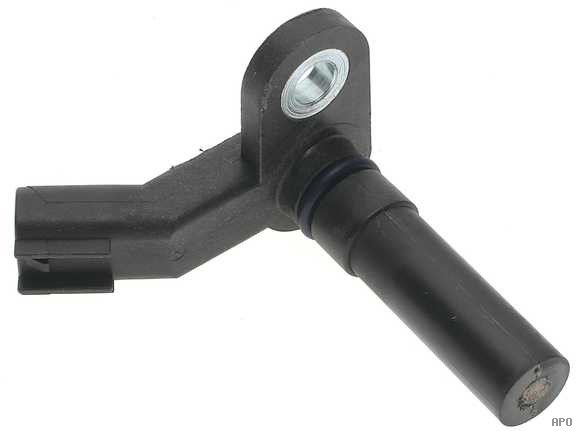
crank sensor types
- Crank sensor with three ends.
- Double crank sensor.
What is the crank sensor and what is its function in the car The
crank sensor is like the rest of the car sensors, and its importance lies in that it indicates the number of engine laps, by knowing the degree of rotation of the crankshaft, for example, if the crankshaft rotated at an angle of 360 degrees, meaning that it made a full turn, i.e. He did 4 runs.
Where is the crank sensor located?
The crank sensor is located in different places according to the design of the car. In most cars, it is installed towards the gearbox in the engine from the back, where it is installed on the flywheel by a gear called the fulam gear.
Why is it necessary to know the number of engine revolutions?
The control needs to know the number of turns so that it can determine the timing of fuel injection and what period the injector or fuel injector should be opened or closed.
How does the crank sensor work and how can it calculate the number of engine revolutions?
In order to know how the crank sensor works, it is necessary to know the types of the crank sensor, as there are two types of the crank sensor, which are:
1- A crank sensor that operates with a magnetic field ( INDUCTIVE CRANK SHFAT POSITION SENSOR) .

This type of sensor consists of a permanent magnetic coil, the magnetic field generated by the permanent magnet is cut through the gear installed in front of it. The computer is on the crankshaft.
This type of sensor measures the signal in analogues, in which the output is in the form of a current of variable value and direction, such as household current, so the current is measured with an oscilloscope.
The sensor plug has two terminals, a positive terminal and a negative terminal. There are some sensors that have a third party that works to discharge the electrical charges in the sensor to prevent interference with the values.
2- The second type is the Hall effect sensor . 
This sensor consists of an internal electronic circuit connected to 12 volts that generates a magnetic field that is cut by the gear teeth and through that the position of the crankshaft is determined.
Symptoms of crank sensor damage
- Uneven speed when starting the engine.
- Wrong acceleration
- Irregularity in the fire
- Check engine light illuminated
These above signs are caused by:
- The presence of impurities on the tip of the sensor, which leads to a lack of sensitivity
- There are pieces in the sensor plug that connects the voltage to the electrical circuit in the sensor.
- A change in the internal resistance of the sensor.
- Accumulation of dust or feathers on the tip of the front sensor, which results in weak ability and sensitivity
There are no reviews yet. Be the first one to write one.