
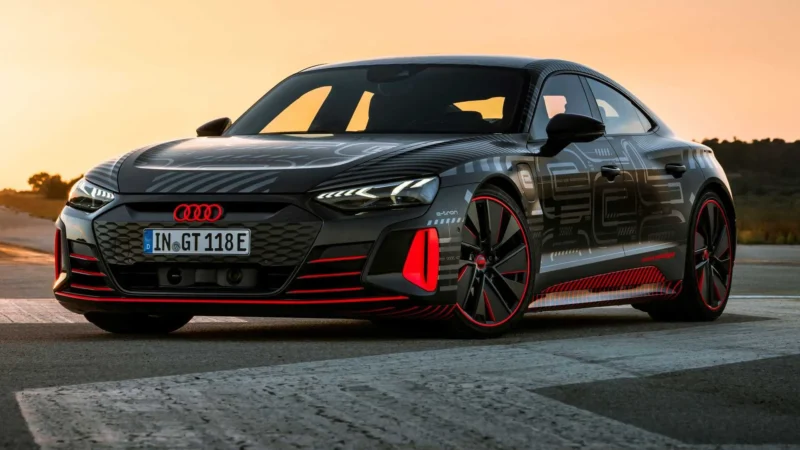
Historically, the Q8, Audi’s last ICE combustion car, will be launched in 2026. Six years before its electric counterpart

Audi’s CEO has revealed the timeline for the brand’s shift to producing electric-only cars, and internal combustion engine models will reportedly be phased out by the early next decade, as lawmakers in Europe and other major markets impose stricter emissions limits to combat climate change and air pollution.
According to the report, 2026 will be the year when the Ingolstadt-based automaker will unveil its final production vehicle equipped with an ICE engine.
German business newspaper Handelsblatt highlighted a four-stage plan to phase out gasoline and diesel engines.
Audi’s current full electric vehicles
are the e-tron, e-tron Sportback and e-tron GT .
The e-tron and e-tron Sportback models are based on the Audi MLB Evo platform,
while the electric GT shares the Porsche Taycan with the J1 platform .
The luxury brand has already hinted
that its A1 supermini will not get a direct replacement because VW Group has more popular cars like the Polo, Ibiza and Fabia competing in the small hatchback segment.
Audi will have 20 electric cars on sale by the middle of this decade, some of which will ride on the PPE Premium Platform Electric (PPE) platform jointly developed with Porsche.
While rivals BMW and Mercedes have not set strict cut-off dates for their internal combustion engine, Audi’s switch to electric-only cars goes further than rival German luxury brands, while BMW and Mercedes-Benz are both slated to switch more cautiously to all-electric.

There’s no word on the A7 or the A8, but it’s expected to follow a similar timeline that’s likely planned for an SUV as well.
Speaking of which, it is believed that the Q8 will go down in history as the last Audi car with a conventional powertrain.
When it arrives in 2026,
According to German media reports, the A3 and A4 will not have a combustion engine successor, but will be replaced by the battery-powered A3 e-tron and the A4 e-tron.
German newspaper Handelsblatt said the electric development of the Audi A5 and A6 models would follow a similar timeline.

In April, Audi announced plans to sell the all-electric A6 e-tron alongside the standard A6 internal combustion engine models when it goes on sale in early 2023.
The A6 e-tron concept was revealed at the Shanghai Auto Show last April .
In production form it is equipped with a 100 kWh battery that allows a range of more than 700 km (435 mi).
This will be the second Audi car built on the PPE (Platform Premium Electric) platform developed with Porsche.
After 2026, the automaker will only develop battery-powered models. There is no word on the A7 or the A8, but it is expected to follow a similar timeline with a scheme that includes SUVs turning electrified as well.
The Q8 is believed to go down in history as the last Audi with a conventional powertrain. When it arrives in 2026, the company’s largest SUV will be complemented by the all-electric Q8 E-Tron before production of the petrol model is discontinued around 2032. Its career as the company’s largest SUV will continue with an electric version carrying The Q8 E-Tron was called before the petrol model was discontinued in 2032.
Firing on combustion cars in 2032

Although Audi plans to discontinue production of new petrol, diesel and hybrid cars, its new models to be launched by 2026 will continue to be manufactured and sold until early 2030 after which time Audi will become a purely electric car maker.
The conventional engine would be dropped entirely by switching entirely to electric motors EVs without keeping the mild hybrids and plug-in hybrids in the lineup. Meanwhile, more upcoming electric models will be on the way, with the Q6 E-Tron SUV launching in 2022, while a concept preview of the A6 E-Tron with a sleek electric throwback is coming in 2023.
As a final note, it’s worth noting that Audi has already acknowledged that development of combustion engines is over, but the company will upgrade existing petrol and diesel units to meet increasingly stringent emissions regulations. The Volkswagen flagship made a similar disclosure shortly after the Audi announcement.
There are no reviews yet. Be the first one to write one.