


Factors affecting the ability of the engine
The Factors Affecting Engine Power (Pb)
engine capacity is beyond the ability of the output shaft of the engine (attached column). The value of the engine’s power is determined by measuring it by braking at full throttle opening (full load) and it is called the brake power of the engine, and there are many units used to measure engine power such as kilowatt or horsepower.
Power is defined as the product of torque multiplied by rotational velocity

where
T = motor torque N m, torque is a measure of the motor’s ability to do work
Pb = motor power (engine braking power) W, power is a measure of the rate of work performance
N = motor rotational speed rpm
BMEP = average pressure Braking action N/m2
VH = Engine capacity (volume) m3
Definitions:
- Indicated Power (Pi)
is the theoretical maximum power output of the motor. An engine’s graph power is the power that can be obtained from the expansion of gases in the cylinders, ignoring the friction losses, or the heat losses. Its value can be calculated from the pV diagram.
- Indicated Mean Effective Pressure (IMEP)
By measuring the pressure in the cylinder during the cycle, the average effective pressure of the engine can be calculated, where the area under the pressure curve and the volume represent the work produced from the cycle, and by dividing the amount of work by the volume gives the graphic mean effective pressure. Part of the power caused by the pressure is lost in friction and the negative workload of the piston. Dividing the measured braking power by the stroke size gives what is called the mean brake mean effective pressure (BMEP). The brake effective average pressure is used to compare the performance of motors of different capacities.
- Mechanical Efficiency ηm
It expresses the amount of power that can be utilized from the expansion of gases in the engine cylinders.
Mechanical Efficiency = Actual Power / Graphic Power
-

- η = mechanical efficiency
- = Braking power kJ/s (kW)
- = graphic power kJ/s (kW)

- Thermal Efficiency ηi,th
Theoretical thermal efficiency = work done / energy input
= work done / (mass of fuel x fuel calorific value)
- = Actual thermal efficiency
- = Theoretical thermal efficiency
- = work kJ
- = time s
- = amount of fuel consumed kg fuel consumption rate kg/s
- = calorific value of fuel kJ/kg
 fuel consumption rate kg/s
  …………… (B)
- Volumetric Efficiency ηV
It is the ratio of the actual volume of the charge drawn inside the cylinder in the intake stroke to the engine swept volume. Fill
= actual air mass / theoretical air mass
= (engine volume x actual air density) / (engine volume x theoretical air density)
= air density Actual/Theoretical Air Density
- η = volumetric efficiency
- = Actual volume of air inside the cylinder m3
- = cylinder volume m3
- = Theoretical density of air kg/m3
- = Actual mass of air kg
- = Theoretical mass of air kg
- = Actual air density kg/m3
Power Equations:
From Equation (A) …………………………………… (1)
* From equation (1) the engine power depends on:
– Indicated power (Pi) ………….(A )
– Mechanical efficiency (ηm) …………………………..(B)
From equation (B) ……………………… (2)
* From equation (2) the power of the engine depends on:
– Thermal efficiency (ηb,th)……………………….(c)
– Average oil consumption  …………………….(D)
– Fuel calorific value (CV) ………………………… (E)
Multiplying equation (2) by  (Rated fuel/Air consumption)
 …………… (3)
* From equation (3) the power of the engine also depends on:
– the air intake rate  ………………………………… (f)
Fuel-air ratio (F) ………………………………… (g)
Rewrite equation (3) …………… (4)
* From equation (4) the power of the engine also depends on:
– Density of consumed air (ρa) …………………..(h)
– Inlet air rate (filling rate) the engine)  ………..(i)
by multiplying equation (4) by  (Theoretical density of air / Theoretical density of air)

* From equation (5) the power of the engine also depends on:
– Volumetric efficiency (ηV) ………………………(K)
And since the rate of incoming air is  , then becomes equation (5)

Where:
i = 1 for the two-stroke engine, = 2 for the four-stroke engine
* From equation (6) the engine power also depends on:
– Engine displacement (VH) ………………………………… (L)
– Engine speed (N) ……………………………………(m)
– Engine number of strokes (i)…………………………….(n)
Where The volume of the engine is equal to the volume of the cylinder times the number of cylinders, VH = Vcy z,
and the compression ratio r is equal to the volume of the cylinder over the volume of clearance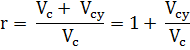
So, the volume of the cylinder is equal to
Vcy = (r-1) Vc,
and the volume of the engine VH is equal to
VH = Vcy z = [(r-1) Vc] z
and becomes equation (6) …..… (7-A)
 … (7-B)
* From equation (7) the power of the engine also depends on:
– Compression ratio (r) ………………………..(y)
– Engine dimensions (d, L, z) …………………..(x)
Thus, the factors affecting the engine’s power are:
| code | Influencing factor | Notes | |
| a | Pi | Ability charts Indicated Power | Depends on the type of thermal cycle (petrol, diesel,..), compression ratio, mechanical efficiency |
| B | mη | Mechanical efficiency Mechanical efficiency | Depends on friction, losses to run the accessories The mechanical efficiency decreases at partial loads of the motor (equal to zero at empty load). Between 10-50% for combustion engines. |
| c | thη | Thermal efficiency Thermal Efficiency | Depends on the type of thermal cycle gasoline engines 30% and diesel engines 45% |
| Dr |  | The rate of fuel consumption Fuel Mass Rate | Depends on thermal efficiency, fuel type, and operating conditions |
| h | CV | Thermal value of fuel Fuel Calorific value | It is stable for gasoline and diesel and ranges between 4200-4400kJ/kg |
| And |  | Air consumption rate Air Mass Rate | Depends on incoming air volume and air density |
| g | F | Fuel ratio of air Fuel-Air Ratio | Depends on the ratio (w/e) 0.07 for the best combustion and exhaust gases |
| h | aρ | Air density Air Density | Depends on the temperature of the forced charge shipment |
| i |  | The rate of air entering the Air Flow Rate | Depends on the air intake path cross-sectional area, air passage speed, cylinder cross-sectional area, piston speed, valve timing |
| K | Vη | Volumetric efficiency Volumetric Efficiency | It depends on the engine design and the following operating parameters: Mixture temperature – ratio between intake and exhaust pressure – compression ratio – engine speed – design of the intake and exhaust manifold A value between 70-80% for engines and more than 100% for charged engines. Forced charging and valve timing |
| to | VH | Engine Capacity Engine Swept Volume | Depends on the design and dimensions of the motor |
| M | N | Engine rotation speed Engine Speed | Specific to the maximum value of the inertial forces, throttle engine for gasoline engines. |
| n | i | Number of rounds Number of Storks | A two-stroke engine of the same dimensions is theoretically twice as powerful as a four-stroke engine. |
| y | r | Compression ratio Compression Ratio | Depends on the engine design defined by the slapping limit of gasoline engines – the stress limit for diesel |
| s | d, L, z | Dimensions Engine Engine Dimensions | Depends on engine design, engine capacity, power, torque required |
There are no reviews yet. Be the first one to write one.