


The principles of increasing the engine capacity of
Fundamentals of Increasing Engine Power
Definitions:
– Mechanical efficiency Mechanical efficiency (hm):

 , , | |
| (1) |  |
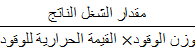
Thermal efficiency (hth, i ) Indicated:
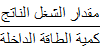 =
= 
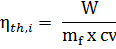 |
Divide both the denominator and the numerator by time t
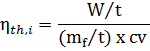 | |
| (2) | 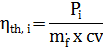 |
Brake thermal efficiency (hth, b):
| (3) |  |
Volumetric efficiency (hV):

| (4) | 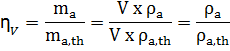 |
From equation (3) we find that:
| (5) |  |
From equation (5), we find that the engine power depends on:
1- Thermal braking efficiency hb, th
2- The rate of fuel consumption mf
3- The calorific value of the fuel cv
* by multiplying equation (1) by 
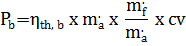 | |
| (6) |  |
From equation (6) we find that the engine power depends on:
4- The ratio of fuel to air (f / e) F
5- The rate of air entry (air mass) ma
* from equation No. (6)
| (7) |  |
From equation (7) we find that the engine power depends on:
6- The density of the incoming air ra
7- The rate of air entry (air volume) Va
* by multiplying equation (7) by 
 | |
| (8) |  |
From equation (8), we find that the engine power depends on:
8- the volumetric efficiency (degree of fullness) hV
* and since the volume of air entering the engine is equal to:
 |
If equation (8) becomes
 | |
| (9) |  |
From equation (9) we find that the engine power depends on:
9- Engine capacity (cylinder capacity x number of cylinders) Veng
10- Engine rotational speed N
11- Number of engine strokes (quadruple i = 2, binary i = 1) i
* Since the engine size equals volume of cylinder x number of cylinders
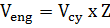 |
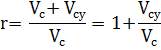
Whereas, the compression ratio (r) is:
 | |
 |
Substituting in equation (9) a value of x Z Veng = Vcy we get:
| (10) |  |
From equation (10), we find that the engine power depends on:
12- compression ratio r
* where the mechanical efficiency is equal to (the actual (braking) power divided by the theoretical power), so it is:
| (11) |  |
From equation (11) we find that the power of the motor depends on:
13- Mechanical efficiency hm
14- Graphical power Pi
Factors affecting the power of the motor:
| 1 | Braking thermal efficiency | Reduce heat loss, loss in cooling |
| 2 | fuel consumption rate | Increase the amount of fuel |
| 3 | calorific value of fuel | Using a fuel with a high calorific value |
| 4 | fuel to air ratio | Ratio increase during acceleration |
| 5 | air intake rate | Depends on the air intake path section area, air passage speed, cylinder section area, piston speed, timing and number of valves, forced charging. |
| 6 | Intake air density | Forced charging, inlet air temperature, cooling |
| 7 | Inlet air volume | forced freight |
| 8 | Volumetric efficiency (degree of fullness) | Forced charging, valve timing |
| 9 | Engine Capacity | Depends on engine design, number of cylinders, cylinder diameter, stroke length |
| 10 | Engine rotation speed | Limited to the maximum value of the inertial force |
| 11 | Number of engine strokes | A two-stroke engine has twice the power of a four-stroke engine |
| 12 | compression ratio | Depends on the engine design, limited by the slapping limit of the gasoline engine, and the increased stresses for the diesel engine |
| 13 | mechanical efficiency | Depend on friction, it has running parts and accessories of the engine |
| 14 | graphic ability | Thermal cycle, ignition |
Table of symbols used:
| code | the meaning | Meaning |
| hm | mechanical efficiency | Mechanical efficiency |
| hth, i | Thermal Efficiency – Graphic | Indicated thermal efficiency |
| hth, b | Thermal Efficiency – Braking | Break thermal efficiency |
| hV | Volumetric efficiency | Volumetric efficiency |
| Pb | Engine brake power (kW) | Engine brake power (kW) |
| Pi | Graphic motor power (kw) | Engine indicated power (kW) |
| W | Engine work output (joules) | Output work (J) |
| t | time (sec) | Time(s) |
| mf | fuel mass (kg) | Fuel mass (kg) |
| mf | Fuel inlet rate (mass) (kg/sec) | Fuel rate (kg/s) |
| cv | Fuel heat capacity (joules/kg) | Fuel Calorific value (kJ/kg) |
| ma | intake air mass (kg) | Actual input air mass (kg) |
| ma th | Theoretical air mass (kg) | Theoretical air mass (kg) |
| ma | Air intake rate (mass) (kg/sec) | Rate of input air mass (kg/s) |
| F | Fuel-Air Ratio (Reciprocal of H/F Ratio) | Fuel air ratio |
| ra | Actual air density (kg/m3) | Actual air density (kg/m3) |
| ra, th | Theoretical air density (kg/m3) | Theoretical air density (kg/m3) |
| Va | Air intake rate (volume) (m3/s) | Rate of input air volume (kg/s) |
| d | Engine cylinder diameter (cm) | Cylinder bore diameter (m) |
| L | Stroke Length (cm) | Stroke length (m) |
| Z | Engine cylinder number | Number of engine cylinder |
| N | Engine rotational speed (rpm) | Engine rotation speed (rpm) |
| i | A number indicating the number of engine revolutions per revolution = 2: four-stroke engine = 1: two-stroke engine | Number of engine rev/cycle =2: four stroke =1: two stroke |
| Veng | Engine Capacity – Engine displacement (m3) | Engine swept volume (m3) |
| Vcy | cylinder volume – cylinder volume (m3) | Cylinder swept volume (m3) |
| Vc | Clearance Size (m3) | Clearance volume (m3) |
| r | compression ratio | Compression ratio |
There are no reviews yet. Be the first one to write one.