

Verdict on the case of car fluids
Checking the Car Fluids Condition
There are many fluids in the car, and their overall function is: cleaning, lubricating, cooling, knitting the internal parts of the system in which you are working, and they may contain additives to improve the performance of these fluids, increase their operational life, and maintain the system.
Several factors affect the condition of the fluids in the car, such as the type and quality of fluids, their compliance with the required specifications, the style and method of driving the car, the condition of the car, car care and maintenance.
Fluids are subjected to a change in their properties as a result of containing deposits from corroded parts of the system, ineffective cleaning filters in the system, absorption of moisture from the air (leading to a change in density and viscosity, and causing rusting of parts), and contamination with fumes and other liquids (contamination of engine oil with fuel fumes, exhaust). , and water). Or mixing different types of liquids, or mixing different compositions of the same type of liquid.
These fluids are also exposed to leakage (as a result of damage to the interlining and sealant gaskets resulting from loss of flexibility, cracking, lack of tight connection, and corrosion of parts and connections, due to the interaction of those parts with the chemical component of the liquid, and the heating of the liquid as a result of its exposure to heat. Part of the liquid is also lost as a result of Operation (engine oil combustion in the combustion chambers as a result of damage to the piston rings)
Fluid handling in the car:
Preventive maintenance (changing fluids periodically):
in which the car’s fluids are changed, periodically, and it follows the preventive maintenance schedule (according to the time or distance of the car). it does not depend on the detection of fluid status, but are changed (depending on the table the topic in advance of the manufacturer) and often are changed fluid which is still in good condition somewhat by the deterioration of the condition.
or are changed according to the liquid state after detecting it. the
means used to detect the state of Liquids:
The state of fluids is detected in several ways:
Relying on the senses:
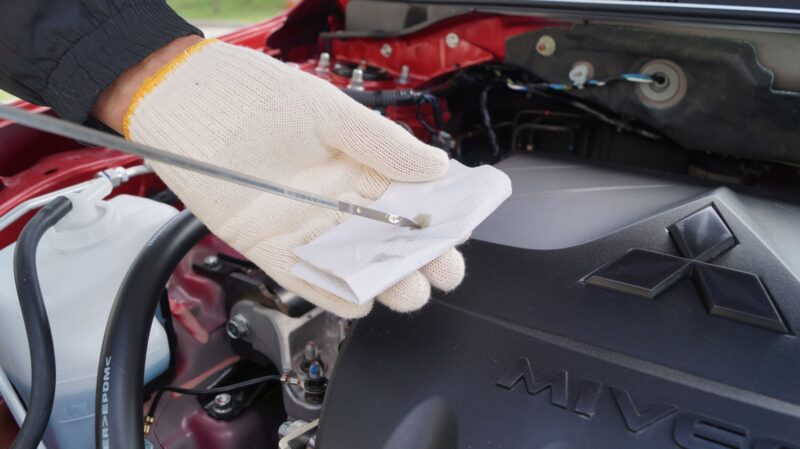
After checking the fluid level, the technician wipes the scale with his finger and rubs the fluid between the index finger and thumb. By sensing the liquid, he can identify the presence and amount of sediment in the liquid, then look at the liquid between his fingers to notice the color of the liquid, and the extent of the change in it. He also brings the finger close to the nose to smell the liquid to determine its quality or deterioration in its condition. Based on his experience dealing with vehicle fluids, he can judge the condition of the fluid and know the need to change and replace the fluid.
The use of devices to indicate and measure the properties of fluids:
Check the brake fluid color: the
color of car fluids changes with the length of use, and often turns into a dark color.
 |  |  | |
| brake fluid | Auto transmission fluid | engine oil | |
 |  | ||
| Differential fluid color (front and rear) – manual transmission and auxiliary gearbox | Automotive Transmission Fluid Color Test | ||
Use a brake fluid test strip:
by dipping the fluid test strip /chemical test strip in the fluid. Copper has been identified in brake fluid. As brake fluid ages, the antirust inhibitors present in the fluid degrade. The higher the level of copper components in the liquid, the greater the evidence of the decomposition of the inhibitors, and the weaker the rust resistance. Using these chips it is possible to quickly identify whether the brake fluid is still serviceable or if it needs to be changed.


Use an optical refractometer to test the moisture content of vehicle fluids:
An optical refractometer determines how much water is in many vehicle systems. The chemical composition of hygroscopic brake fluid makes it voracious to absorb the water in the atmosphere, with the passage of time the fluid mixes with water and its effectiveness decreases. Which can lead to rusting of system parts and sticking of the wheel cylinders, as well as rusting of brake tubes, and damage to the interlocks. The device can be used with many different solutions and liquids such as battery fluid, wiper fluid, and out of the field for sugars and various drinks.
Evaluate the brake fluid’s boiling point with an electronic tester:
The boiling point of brake fluid varies depending on the type of fluid used in the brakes. For example, DOT 3 brake fluid has a dry boiling point of 401°F (205°C) and a wet boiling point of 284°F (140°C). DOT 4 brake fluid has a dry boiling point of 446°F. 230°C) and a wet boiling point of 311°F (155°C).
* Liquid absorption of water vapor will reduce anti-rust property. Since the boiling point of water is lower than the boiling point of brake fluid, the moisture and water vapor absorbed from the atmosphere by the brake fluid will reduce the actual boiling point of the fluid and affect the brake capacity. The spongy brake pedal is an indication of the presence of water in the brake system that has evaporated as a result of the heat generated from the brakes and has become steam / gas in the system and causes the phenomenon of the spongiform pedal. Water is absorbed from water vapor over a two-year period of 5% by volume of brake fluid being water, which lowers its boiling point by more than 50%.
Use filter paper and compare the colors with the color analysis panel. Compare the findings to the fluid analysis charts:
In this test, a drop of liquid is placed on test paper and the color of the liquid point is compared with the color of the liquid on its color palette. Engine oil, gearbox oil, power steering fluid, transmission fluid, brake fluid, and coolant can be detected by this indication. This method gives quick information about the condition of the fluid, and identifies the need to make a change and replace it to maintain the performance of the system, preserve its parts, increase its operational life, and reduce maintenance expenses in general.
There are no reviews yet. Be the first one to write one.