

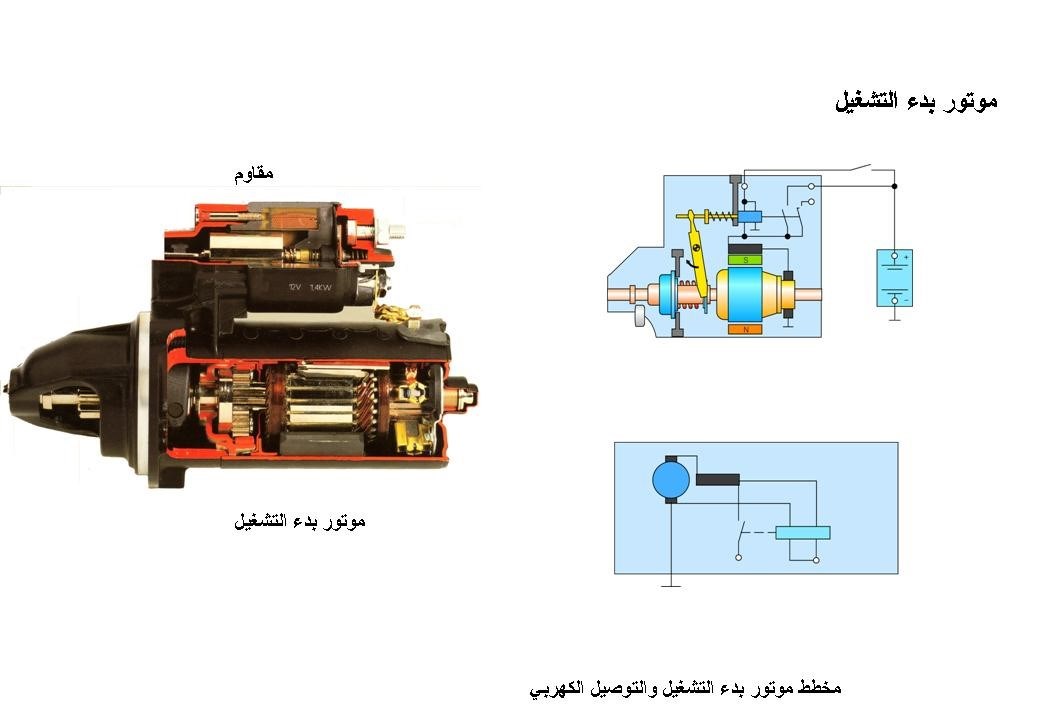
Engine Starter Motor
The system startup converts electrical energy from battery into mechanical power to engine management and make process startup possible. This conversion process is carried out by the starter motor. The rotational speed required to start the engine is approximately 60 to 100 rpm for diesel engines and 80 to 200 rpm for gasoline engines. The starting motor provides a very high speed greater than that speed to ensure a good starting capacity.
The operating system contains six main components:
- The ignition key (contact).
- The battery.
- The starter solenoid.
- Starting motor (Electric motor)
- Electric activation system (relay)
- Mechanical activation system (engagement mechanism)
When the contact switch is turned to the on position, electric current flows from the battery to the starter solenoid and from it to the starter motor.
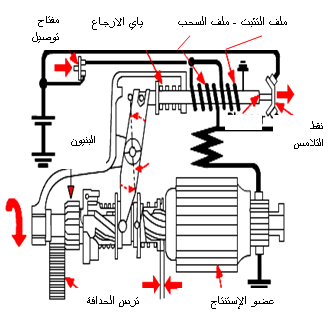
The solenoid is an electromagnetic switch mounted on the starter motor. When the solenoid coils are energized, the piston is pulled back. A lever is attached to one end of this piston, and this lever is also connected to the neon drive gear and the clutch assembly of the starter motor. When the lever is retracted, the drive gear (pinion gear) is engaged with the flywheels. Also, when the starter motor is energized, it generates a torque that turns the flywheel and then turns the engine.
The starter motor is characterized by its small size, but it is a powerful electric motor that provides high power for a short period of time. When the driver releases the contact switch from the start position to the travel position, the starter solenoid is deactivated and the internal rebound springs will pull the pinion out of gear with the flywheel, and the starting motor will stop itself.
A safety switch :
This ensures that the key is not connected control circuit if the gear is not in neutral mode, especially in automatic cars.
Engine starter motor working theory :
The starter motor works on the following rule: “Different magnetic poles attract and like poles repel.” The strength of the field depends on the amount of current passing through this conductor. As for the direction of the field around the conductor, it depends on the direction of entry of the current. The direction of the field formed can be known by the right-hand rule .
If we made the conductor in the shape of a letter ( u ) according to the figure (a), the direction of the field effect on the tip of the conductor would lead to the rotation of the conductor clockwise as in the figure (b).

At that, the direction of rotation can be known by using the left hand rule as in Figure (C) and if we connect on the end of the conductor half a copper ring (the conductor is called the output member and the conductive half ring) and we connect two carbon brushes with the poles of the battery and touching the copper rings as in Figure (D) to form all of them The basic main parts of a starter motor. The current passes from the battery through the carbon brush to pass through the middle of the contact ring, then the left conductor, and return from the right conductor, then half of the right copper ring, then the carbon brush in contact with it, and return to the battery when the conductor rotates clockwise as in Figure (d) and this can be known using the left hand rule .
In order to obtain sufficient thrust and a fast rotation of the starting motor, several coils called output member coils are used, and to strengthen the field, coils called field coils are used in series with each other, where current passes through them from the battery when starting.

March starter motor parts :

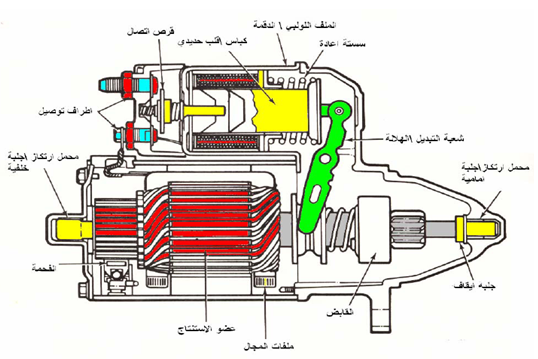
The starter motor consists of the following parts:
1- The body (barrel).
It is a hollow iron cylinder in which the steel electrodes are fixed by means of screws and the field coils are held in place inside the casing.
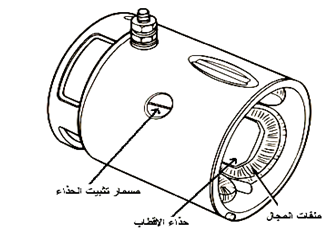
2- electric coil fields.
They are wires made of copper with a large diameter, in order to withstand the high electric current of up to 300 amperes for some types, and their number is often four inside the body (the barrel).

3- Armature.
It is a group of discs made of iron flakes isolated from each other and fixed on the shaft . It has long ducts in which coil wires are placed, which are made of copper, through which the electric current passes, forming a magnetic field.
The armature consists of several coils, each coil of which is only one conductor and is placed in its own places, and the ducts in the armaturer are connected in series by the coppers of the unification member. Therefore, the current passing through the field coils passes through all the coils of the armature and thus leads to the formation of a field Magnetic coils around each coil causing repulsion between the poles and the terminal coils as this leads to the rotation of the terminal member.

4-Commutator:
It consists of pieces of copper installed between two pressure rings in a way that they combine with them in an interlocking manner and the chips are isolated from each other by a special insulator (mica) and it carries out the transfer of the feeding current of the armature from the carbon brushes to the armature coils.
5- Carbon brushes (charcoal)
It is made of a mixture of carbon and copper and is fixed in the holder of the carbon brushes by means of springs that are pressed hard in order to be in constant contact with the coppers of the unification member. The number is often four carbon brushes, two (positive) where they conduct the electric current from the field coils to the coils of the conclusion member and two (negative) are connected directly to the cover without insulation and form the path to the ground.
6- The theory of free rotating action:
- When the leading member 2 rotates to the right, the wear balls are pushed to the left in the narrow section (impacted) between members 1 and 2 and act as a clutch so that member 1 rotates with member 2 at the same speed.
When member 2 stops moving, the wear balls are pushed to the right and disengaged with member 1 and member 1 rotates at a speed higher than that of member 2 ( over run ).

1- gear 2- internal organ (leader) 3- cam 5- pellets 6- spring
7- Electromagnetic switch (Automatic March) :
The work of the electromagnetic switch depends on the electrical theory that proves that if an iron rod is placed inside a coil of wire through which an electric current passes, the rod moves inside the coil, and the magnetic switch is used in many engineering applications that need to Reciprocating movement (pull / push) The magnetic switch is used to move the interlocking fork of the starter motor gear with the flywheel gear at the link shown in the following figure.
When the starter switch is open, the magnet switch arm is in the forward position, and thus the link (fork) works to attract the shaft of the starter motor with the pinion gear backwards away from the flywheel.
When the start switch is turned on, the key contact points are closed and the electric current passes through the coil and a magnetic field is formed that works to attract the key arm back and the interlock process takes place as shown in the figure.
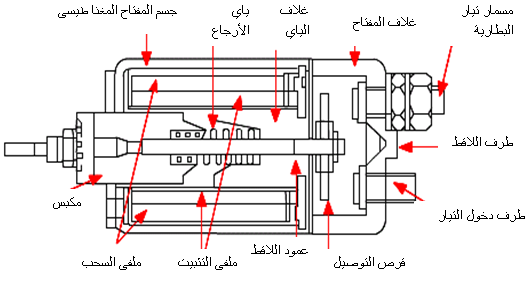
The method of operating the magnetic switch :
The magnetic switch performs two functions:
A – moving the lever (fork) of the pinion gear until it is engaged with the flywheel gear.
b- It works as a relay for the passage of high current from the battery (high battery current) to the motor starter coils without passing through the starter motor switch or the ignition switch.
When the ignition switch is closed, the electric current reaches the relay coils, locking the contact points, and then the electric current passes to the magnetic switch coils and a magnetic field is generated that attracts the iron core of the key, which pushes the fork to the left and with it the brown gear, which attracts the starter motor to engage with the flywheel gear.
There are no reviews yet. Be the first one to write one.