


The oxygen sensor (O2 sensor) measures the amount of oxygen in the exhaust gases, and sends the signal to the engine computer (control unit) A front oxygen sensor is installed in the exhaust manifold or in the front exhaust pipe before the catalytic converter (environment box), catalytic converter (environment box) It is an essential part of the car’s exhaust system, which converts exhaust gases into ordinary gases that can be inhaled, for example, it converts carbon monoxide (CO) into carbon dioxide (CO2).
Another oxygen sensor is placed after the catalytic converter so that it can evaluate the operation of the catalytic converter and see if it is working or not.
Cars with 4 cylinders contain 2 oxygen sensors, while cars with 6 or 8 cylinders contain at least 4 oxygen sensors.
The computer uses the signals that come from the first oxygen sensor, on the basis of which it adjusts the ratio of air to gasoline, by adding or decreasing the percentage of injected gasoline. In modern cars, the first oxygen sensor is replaced with another sensor to measure the ratio of air to gasoline, as it works in the same way as the oxygen sensor, but More accurately.
How does the oxygen sensor work?
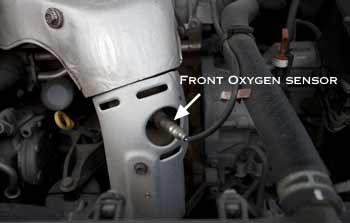
There are types of oxygen sensors, but for simplicity in this article, we will only look at conventional voltage-generated oxygen sensors. As the name suggests, a voltage-generated oxygen sensor generates small volts that are proportional to the difference in the amount of oxygen in and out of the exhaust.
In the event that the mixture is poor (the proportion of air is more than the fuel), that is, the thread is poor, then the oxygen sensor generates a small percentage of volts up to (0.1 – 0.2) volts, but if the mixture is rich, that is, the proportion of gasoline is higher than the proportion of air, the oxygen sensor generates A voltage difference of up to 0.9 volts.
In order for the oxygen sensor to function properly, it must be heated to a certain temperature, so most modern oxygen sensors have an internal heating element in order for the sensor to do its job accurately.
Adjusting the ratio of air to gasoline in the engine
The function of the first oxygen sensor is to maintain the ideal ratio of the air-fuel mixture, which is 14.7:1, meaning that each part of the fuel has an amount of air up to 14.7, when the oxygen sensor records that the mixture is poor, meaning that the air is higher than the fuel, the signal reaches the engine computer and it By injecting an increased percentage of gasoline, when the mixture is recorded as being rich, meaning that the gasoline is too high, the computer reduces the percentage of fuel injected to obtain the ideal ratio of the mixture.
This process is continuous. The engine computer constantly alternates between changing conditions to maintain the air/fuel ratio at an optimum level. This process is called the closed loop process. If you look at the front oxygen sensor voltage signal (see band signal above), it will be somewhere between poor 0.2 Volts and rich 0.9 Volts.

When the vehicle is started cold the front oxygen sensor is not fully heated and the PCM does not use the front O2 sensor signal to adjust the fuel trim This mode is called open loop Only when the oxygen sensor is fully heated the fuel injection system switches to closed loop mode.
Modern cars have a broadband air/fuel ratio sensor installed in place of a regular oxygen sensor. The air/fuel ratio sensor works differently but serves the same purpose for detecting whether the air/fuel mixture entering the engine is rich or poor. The air/fuel ratio sensor is more accurate and can It measures a wider range of air/fuel ratio
There are no reviews yet. Be the first one to write one.