
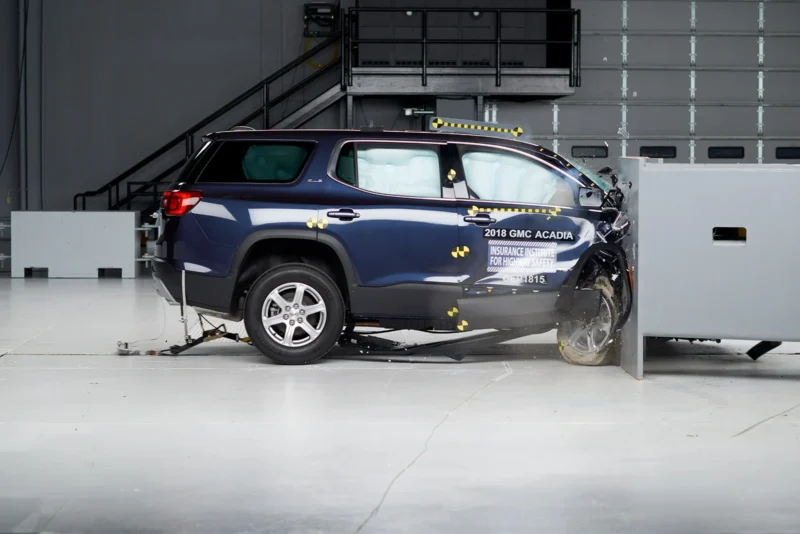
The Insurance Institute for Highway Safety has a history of making crash tests more difficult, and automakers have a similar history of rising to the challenge. The agency always hopes its latest test will further inspire the industry to make safer cars in the event of an accident, although it’s clear that many automakers have a lot more work to do in the future.
After two years of viewing it in public and learning about side-impact testing, the safety agency for the first time released an updated and more rigorous assessment. The result was many SUVs failing in crash tests, and only one of 20 small SUVs tested received a good rating , the agency’s highest rating (the agency rates ratings as good, fair, marginal, or poor): The only one that has passed the new tests is the 2021 Mazda CX-5.

Regarding the new crash tests, IIHS says the new test aims to address and reduce the impact of high-speed crashes that cause fatalities. 20 vehicles were tested for 2020 and 2021 using the new test, which simulates a heavier barrier hitting the side of the vehicle. Previous crash testing used a 3,300-pound barrier traveling at 31 mph; The new crash test uses a 4,180-pound barrier that hits the test vehicle at 37 mph. IIHS says the new weight is closer to that of today’s midsize SUV, a category popular with consumers.

“We developed this new test because we suspected there was room for further progress and these results confirm that,” David Harkey, president of the Insurance Institute for International Road Safety (IIHS), said in a statement received by Malaki . “The CX-5’s good rating shows that robust protection can be achieved in the most severe side impacts.”
Ranking of cars in crash tests
How well a car does in a side impact collision depends on several factors: the structural integrity of the passenger compartment after a collision, and injury measures collected from dummies used in crash tests, which are dummies sitting in the driver’s seat and behind the driver, and displaying measurements of how well the car’s airbags are. , How to protect the heads of dolls. The Insurance Institute for Highway Safety and Security (IIHS) found that SUVs with marginal or poor ratings in the new test showed the cars had structural problems, and that test dummies in both grades had significant chest and pelvic injuries.
Of the 20 SUVs tested, nine received an acceptable rating:
2021-22 Audi Q3
2021-22 Buick Encore
2021-22 Chevrolet Trax
2021-22 Honda CR-V
2021-22 Nissan Rogue
2021-22 Subaru Forester
2021-22 Toyota RAV4
2021-22 Toyota Venza
2021-22 Volvo XC40
Eight SUVs received a marginal rating:
2021-22 Chevrolet Equinox
2021-22 Ford Escape
2021-22 GMC Terrain
2021 Hyundai Tucson
2021 Jeep Compass
2021-22 Jeep Renegade
2021-22 Kia Sportage
2021-22 Lincoln Corsair
Two cars received the lowest rating in crash tests, with a poor rating:
2021-22 Honda HR-V
2020, 2022 Mitsubishi Eclipse Cross (Mitsubishi Skip model year 2020)
Crash tests..a history of improvements
The new requirement for side-impact tests may be really high, but IIHS points out that all 20 of the SUVs tested scored well in the first generation of side-impact testing – but that wasn’t always the case across the industry. When the agency presented the original test in 2003, only one in five models had a good rating; Now, nearly all current vehicles have a good side-impact rating, and IIHS says the progress has saved lives.
Reasons for tougher crash tests
In a 2011 study analyzing 10 years of collision data, IIHS found that a driver of a car with a good sideways rating was 70% less likely to die in a left side collision than a driver of a poorly rated car. Fast forward to 2019 and side collisions were still a huge problem: the agency’s study showed that side collisions accounted for 23% of passenger car occupant deaths that year.
“There is no single reason why many side accidents continue to cause fatalities, but these findings provide a roadmap for specific improvements that can save lives,” Becky Muller, IIHS senior research engineer, said in a statement.
There are no reviews yet. Be the first one to write one.