
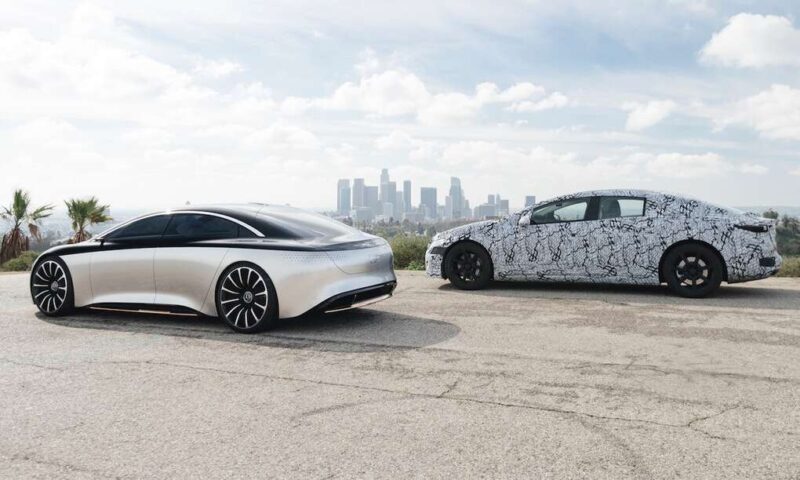

The Tesla Model S still has to face a real challenge from another automaker…for now. Competitors like Lucid Air and the Mercedes EQS are set to hit the aisles and hearts of customers in the coming months, both looking to steal a piece of the flagship electric sedan pie that Tesla Model S practically owns.
Arguably, it’s the Mercedes that interests us a bit more. This isn’t bending or targeting the Lucid, which looks great and firmly promises a real and powerful competitor. However, we haven’t yet seen Lucid produce a truly salable car. On the other hand, Mercedes has been doing it for more than a century. Read on to see how the 2022 Mercedes EQS competes against the Tesla Model S.
Mercedes-Benz EQS Vs. Tesla Model S: range and performance
The EQS uses the new Mercedes EVA2 architecture. Available in two trims, the EQS450+ is rear-wheel drive while the EQS580 4Matic is powered by all-wheel drive, all EQS models will initially rely on a 108kWh battery pack, with a smaller 90kWh unit possibly coming up later.

The EQS450+ generates 329 hp and 406 lb-ft of torque, while the 580+ generates 516 hp and 611 lb-ft of torque from its two electric motors (one on each axle). Mercedes says the 580+ can go from 0 to 60 in 4.3 seconds. According to the standard WLTP test cycle, the Mercedes-Benz EQS offers up to 478 miles of range, which can be adjusted to less than 400 miles by the US Environmental Protection Agency.

By comparison, the entry-level Tesla Model S is only available with all-wheel drive (thanks to an electric motor on each axle) and a 100 kWh battery. The long-range model produces 670 horsepower and has an estimated driving range of 412 miles on a single charge. Tesla claims it can hit 60 mph in 3.1 seconds.
More recently, Tesla introduced the Model S Plaid and Plaid+. This class is distinguished by variants, including the three-engined Model S, with 1,100 horsepower and a top speed of 200 mph. Both are said to hit 60 mph in just under 2.0 seconds. The Plaid has a range of 390 miles on a charge, while the Plaid+ has a range of 520 miles on a charge, according to Tesla estimates.
Mercedes-Benz EQS Vs. Tesla Model S: Charging
The EQS can accept a 200 kW charge via a DC fast charger, which can add approximately 186 miles of range in just 15 minutes. And in the case of the Model S, it can add up to 200 miles of range in about 15 minutes when connected to just one Tesla supercharger.

Mercedes-Benz EQS Vs. Tesla Model S: Superior Interiors
The interiors of the Mercedes EQS and Tesla Model S are far apart. On the inside, you can think of the EQS as the quiet student who knows more than the professor, while the Type S can be described as the extrovert who always wants attention.
Mercedes offers the EQS with a massive Panoramic Hyperscreen (actually three screens with a large 17.7-inch unit in the middle and a pair of 12.3-inch screens on the left and right sides of the dashboard). A 12.8-inch tablet-style console display comes standard on the EQS 450+.

A panoramic hyperscreen is standard on the EQS 580 and optionally available on the EQS 450+. Meanwhile, Tesla has upgraded the interiors of the Model S for 2021. Changes include a steering wheel with an aircraft-style steering wheel yoke and a new 17.0-inch center display with landscape orientation.
Mercedes-Benz EQS Vs. Tesla Model S: the cost of luxury
As far as price goes on both Mercedes-Benz and Tesla, the Tesla Model S Long Range starts at $81,190. And it keeps going up with more options, and when we go up to the Model S Plaid that number goes up to $121,190. And if you want to go all out and have all the options for your car, Plaid+ will cost you $151,190.

In contrast, the 2022 Mercedes EQS will arrive in the US this fall, and will likely wear a price tag close to $100,000
There are no reviews yet. Be the first one to write one.