

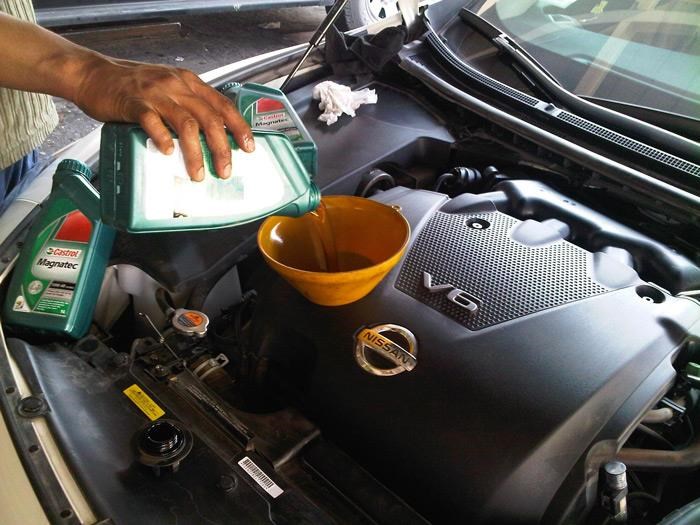
Whether you are a car owner or a passenger, you should know the requirements for car care, and know the identification of faults and ways to fix them. Safe driving tips:+ Before starting the car and when opening the switch (or turning the key) all the warning lamps must light up automatically, and if they do not light up, this is a warning of a problem.+ Check the low and high beams, reverse lights and dimples to make sure they are working.+ Do not turn curves at high speed and do not turn left or right suddenly.+ Avoid going through potholes and bumps with the steering wheel facing one way, and avoid pressing the brakes fully over the bumps.+ Avoid leaving the steering wheel heading in one direction for a long time, and do not drive quickly while heading to the right or left.+ Turn the car off with the steering wheel facing straight ahead and not in either direction and turn it on while he is.+ When the car is stopped, the transmission (gear) must be in the off position.+ While the engine is warming up, do not press too hard on the gasoline.+ In normal cars, the speed is not transferred from R to first gear or vice versa, except when the car is completely stopped, but in automatic cars, the speed is not transferred from R to P or vice versa if the car is moving. Car care tips:+ Check the water level in the battery, and apply distilled water in case of shortage.+ In cases of waiting at the signals, do not use the pedal (the clutch or the clutch) as this leads to the wear of the cylinder.+ In the event of friction or a scratch on the car body, try to paint it quickly to avoid rust.+ In the case of using the car air conditioner while it is standing, put a little pressure on the gasoline, so that the engine temperature does not rise if the car is old.+ Wash the battery compartment from the salts resulting from the battery with hot water so that the battery compartment does not erode.+ Clean the air filter with every oil change, so that dirt does not enter the engine.+ Always clean the tire cracks from the gravel stuck in them to extend the life of the tires.
Avoid doing the following:
- Do not increase the radiator (coolant) with cold water while it is hot, unless the car is running, and the water must be added slowly.
- Try not to leave the car for more than three days without running, so as not to lose the battery charge .
- Do not turn on the air conditioner before driving the car to conserve the battery.
- Do not leave the mud stuck to the car from the bottom, but wash it to avoid rust.
- Do not turn on the AC directly when operating, but gradually raise it.
- Try not to park one of the tires in a pit or on a bump, but rather stop it on a flat ground.
- Do not exceed the motor oil , the transmission and power fluid above maximum limit, and always check it so that it does not fall below the minimum limit.
Knowing car malfunctions and signs on them:
- The appearance of strange sounds or strange smells in the car is a warning of a malfunction or problem in the car, and you must solve it early to save your effort and money.
- Battery light appears in the dashboard and the car is running: The problem here is that the alternator is not charging the battery or there is a problem with the battery.
- Vibration of the steering wheel or the whole car at high speeds: you have to make a wheel alighnment & adjustment or the so-called (steering balance) by the car a specialist.
- If you feel a tingling or sound when the car is running or the car’s acceleration is weak: you should check the electrical circuit . The spark plugs and coil and coil cables should be checked, as it is possible that one of them has malfunctioned.
- Strong oil smell: Either the oil tank is overfilled, or the oil has burned too much and needs to be changed.
- Burning plastic smell: Either the tires have heated up due to contact with something, or you are driving with the brakes tight.
- Whistle sound when pressing (brake): It is often due to the entry of gravel between the lining and the drums, and you must clean the bottom of the car well or the type of brake pads is not good.
- High friction sound when pressing the brakes: you need to change the brake pads.
- Abnormal sound of the engine: the sound of the engine changes when its temperature increases while driving, and here you have to make sure of the temperature of the thermostat clock in the dashboard and stop until the engine cools down if necessary.
Gasoline saving tips:
- Shifting between the brakes and gasoline recklessly and driving at an irregular speed increases fuel consumption by 33%
- Starting driving while the car engine is cold increases the fuel consumption rate to double in the case of heating, but do not warm up the engine more than one minute, as it is sufficient for most new cars.
- You have to fill the tires with air, as tires that are not well filled increase the percentage of gasoline consumption by up to 3.3%.
- Changing the gasoline filter reduces fuel consumption by 10% and protects the engine as well.
- Overloading the car increases fuel consumption.
- Avoid traffic jams and crises, as ten minutes of traffic consumes fuel that can travel 8 to 10 kilometers.
There are no reviews yet. Be the first one to write one.